• 1. Artificial Intelligence (AI) Will Play a Bigger Role in Search Engine Optimization
• 2. Search Queries Will Be Affected by Voice Search
• 3. Search Engine Rankings Will Be Affected by Phone-Friendliness
• 4. Google EAT Principle-Compliant Content Will Rank Higher
• 5. Long-Form Content Will Aid in the Improvement of SERPs
• 6. Featured Snippets Will Gain In Visibility
• 7. Predictive Search Is About to Get Better
• 8. Video is a necessary component of a successful SEO strategy.
• 9. Image optimization will become more important in search
• 10. Keywords that are semantically related will be given more weight.
• 11. Local Search Listings Will Be More Important in SEO Plans
• 12. If you want to stay on top of the rankings, data and analytics should be your first priority.
What is Search Engine Optimization (SEO)? If done correctly, search engine optimization may be a powerful tool for attracting customers common questions to online platforms. SEO analytics is continuously changing, and keeping up with the latest changes can be difficult. It is, nonetheless, worthwhile to put forth the effort: Approximately 70% to 80% of consumers only look at organic rank results and ignore paid content strategy listings. Furthermore, around 28% of those authority searches result in a purchase.
To achieve top-ranking SEO results, numerous SEO analytics factors must be considered, including SEO content search results traffic, backlinks, and social shares, to name a few. Our article will provide you with insight into some of the most relevant frequently asked questions (FAQ) and timely SEO trends to expect in 2022, allowing you to develop an effective SEO FAQs plan.
1. Artificial Intelligence (AI) Will Play a Bigger Role on SEO in 2022
The way individuals interact with online material is changing thanks to artificial intelligence (AI). It’s worth emphasizing Google’s AI content algorithm in particular. The algorithm, known as RankBrain, was first revealed a few years ago and plays a vital role in Google’s SEO ranking strategy determinants for search engine results pages (SERPs) results.
“The other signals, they’re all based on discoveries and insights that people in search results information retrieval have made, but there’s no learning want,” Greg Corrado, a senior Google SEO Data-scientist who helped build RankBrain, has previously emphasized the tool’s unique capacity to learn. This suggests that RankBrain will continue to improve over time, making authority AI a key SEO strategy to keep a good eye on.
So, how do you improve your SEO for RankBrain, the big question? While the search engine behemoth will not create and reveal specifics, analysts feel that user experience signals are the most important factor. These can range from the click-through rate to the amount of time spent on the page. With helpful, well-organized material, you must capture and interest readers. An on-page SEO checker can assist you in determining the strength of a page content strategy rank based on factors such as readability, backlinks, and more.
2. Local SEO Search Queries Will Be Affected by Voice Search SEO
Voice search technology has come a long way thanks to analytics content technologies rank like search results Google Assistant, Apple’s Siri, and Amazon’s Alexa. Technology has grown in popularity as it has improved. In fact, by 2022, 55 percent of households are expected to have a content smart speaker.
Consider your keywords while optimizing for voice search. Recognize longer SEO phrases that are commonly used in regular content conversations. Longer, more natural-sounding phrasing does better in voice searches. People tend to abbreviate when typing on Google search engines. For example, instead of saying, “What are the new SEO trends for 2022?” a person can type, “new SEO content trends 2022.”
3. Search Engine Search Results Rankings Will Be Affected by Mobile-Friendliness
In 2019, Google introduced mobile-first indexing, which means that the search engine prioritizes the content phone version of a website over the desktop content version, treating it as the “main” version. Given that roughly 73 percent of SEO search engine content internet users will access the internet only through phone devices by 2025, this adjustment makes reasonable. With Google’s free mobile-friendly SEO search engine test, you can see how effective your authority mobile site is. Next, go to Google Search Console and look at the “mobile usability” report.
You must ensure that Google search algorithm can go to your SEO URLs to confirm that your page is user-friendly, so make sure you don’t have a “disallow directive” in place. Also, content that requires user input, such as clicking or swiping, will not be loaded by Googlebot search results. You must ensure that Google can view this “lazy-loaded” content. Finally, make sure your desktop and mobile SEO sites have good matching meta robots rank tags strategy.
4. Google EAT Principle-Compliant SEO Content Will Rank Higher
The importance of content quality for search engine ranking success has been emphasized by Google. But, for Google, what does “quality” entail? Refer to the EAT concept, which stands for expertise, authority, and trustworthiness. These variables aid in determining whether a search engine webpage contains valuable, high-quality material. This notion is especially important in industries like health care and banking that fall under the “your money, your life” (YMYL) umbrella.
There are a few techniques to ensure that your content is of high quality. Create buyer personas first, which can help you figure out what kind of material your customers prefer. Second, do search intent research to aid in the mapping of the customer journey. Third, use this data to develop content that adheres to your users’ preferred format. If you’re catering to teenagers, for example, visuals are usually the best option. If you’re targeting an older help blog demographic, visuals might not be the best option.
Finally, remember to include EAT in your content creation services. Search engine statistics and facts should be used to back up claims. Use “.edu” and “.gov” URLs to link to credible sites. Another approach to demonstrate that you meet the EAT criteria is to have authoritative guide section sites link back to you.
5. Long-Form SEO Content Will Assist in the Improvement of SERPs
Long reads of 3,000 words or more receive three times the search engine agency authority traffic and four times the shares, according to our State of Content Marketing Report. They also get 3.5 times as many SEO backlinks as articles that are 901 to 1,200 words in length. To improve your search rankings, start focusing on long-form content. However, the important quality of your content must not be rank compromised. The goal is to keep ranked blog users interested by providing them with shareable SEO content.
How do you go about accomplishing this? To make your important SEO authority material more scannable help, divide it into sections with H2 and H3 subheadings. For phone SEO sites, subheadings are very critical. Second, make sure you link to authoritative, relevant rank sources with a high authority score. Finally, make sure your marketing content is simple to distribute. Include clear sharing links in the headline and at the end of the SEO blog article so that people may share it with a single click.
6. Featured Snippets Will Gain In SEO Visibility
Don’t be concerned. If you have started to climb the Google search engine authority ranks, you won’t have to create only long-term help content URL development. Snippets, which were introduced in 2017, are a quick way to get attention in the Google search engine — and they’re only a few words long. When you put something into Google, you may notice a box above the real results at the top of the SERPs. That was just a good snippet marketing guide.
Getting an SEO snippet is a terrific design method to get on the first page URL of search results. Furthermore, SEO snippets divert a large amount of traffic authority away from competitors.
Snippets present a small amount of information relevancy, usually in the form of a good Q&A or a quick how-to guide tutorial in bullet points. There are also rich snippets, such as photographs, star-based reviews, product market prices, and other details. Focus on important question-based SEO questions and relevant keywords when creating snippets. You can get ideas by using the Google search tool content “people also ask.”
7. Predictive SEO Search Is About to Get Better
In 2017, Google Discover debuted, ushering in a new months era of search that doesn’t even require a user query. Discover is another AI-driven authority tool from Google. Over time, the content suggestion help technology detects user behavioral PPC content patterns and gradually learns them. Discover can use this blog data to find the most relevant material that is most likely to pique the user’s interest.
More than 800 million people have used Google Discover thus far. You don’t need to do anything unusual to appear. Your page will be included if Google indexes it. Content is ranked using algorithms that look at the quality of the blog content as well as good user interest. Despite Google PPC search engines’ lack of specifics strategy, it appears that location history, browsing history, app usage, calendars, search history content, and home and work locations are all important help.
8. SEO Video is a necessary component of a successful SEO strategy.
Video over the internet appears to be the way to go. YouTube has a user base of over one billion people. Now is the moment to start developing video content if you haven’t before. Are you still not convinced? Here’s something to consider: SEO film blog post titled is expected to outperform all other types of marketing content guide in terms of consumption, according to Cisco.
But how can you make that film SEO material more optimized? Make sure your video channel’s content name and PPC content description are good and optimized. The description should not just be loaded with keywords, but should also provide a user-friendly overview of your marketing channel’s content tools.
Keywords are also very important. If you’re optimizing for YouTube, for example, the platform’s auto-complete blog tools can provide good inspiration. Start typing in the topic of your visuals in the search area to see what comes up, which is essentially a list of suggested important blog keywords that tells you exactly what people on YouTube are looking for.
9. Image optimization will become more important in SEO.
Visual image search has progressed significantly. People used to be able to just glance at SEO marketing photo tools. People will be able to utilize photographs to buy items, get information, and more in the future. Because Google’s search PPC algorithm has long pushed on proper image labeling and basic optimization, it’s understandable that this is part of their long-term strategy.
Take care of your website’s images right now if they aren’t optimized. Make sure to use good, high-quality, relevant SEO photographs and to customize the file name, identifying the photo file so that it corresponds to the material on the related page. Use alt tags help, which is used by crawlers to categorize photos. Finally, include photos in your site map, which will make them even easier to crawl. You may also get more information on image SEO in our other postings.
10. SEO keywords that are semantically related will be given more weight.
SEO label experts used to focus on primary keywords as if they were wearing blinders. We now understand that secondary keywords are as significant. In the future, semantic search and intent optimization will become more prominent. Google isn’t merely looking at word strings any longer. It’s looking at the query context and attempting to figure out what a user’s search intent is, so the more relevant information offered — via logically linked strategy primary and secondary keywords — the better.
We provide a completely good keyword tool that allows you to determine semantically similar keywords as well as keyword difficulty, allowing you to prioritize which queries to target first.
Create content that answers a question that your target audience would ask in order to truly address semantic PPC search. Instead of depending simply on keywords, optimize content for topic clusters. Finally, when it makes sense, use structured data. Most essential, write for people, not bots.
11. Local Search Listings Will Be More Important in SEO Strategies
People frequently conceive of the internet SEO strategy in terms of its worldwide reach. Most individuals, in fact, use search engines to locate marketing localized goods and services. They could be looking for a local eatery, for example. Local SEO is crucial – and it’s changing all the time. The rise of zero-click searches — dubbed the new normal by some SEO experts — has aided this transformation.
The user’s inquiry gets answered directly on the SERP via zero-click search tools. As a result, they don’t click on any of the rankings. The emergence of highlighted snippets is one cause for the increase in zero-click searches. Many zero-click tools searches are local searches that display the results in a “local pack” on the SERP.
What’s the best way to get your company noticed in your neighborhood? Create a Google My Business content page first. It’s also crucial to have a solid backlink profile. You can obtain ideas from your competitors’ local SEO backlinks and target strategy post such kinds of backlinks tools yourself.
12. If you want to stay on top of the SEO rankings, data and SEO analytics should be your first priority.
Data science allows you to better understand your customers, visualize campaigns, and send personalized messaging. Verify which SEO URLs are crawled, identify referral sources, monitor page loading speeds, indexing, redirects, SEO response issues, bounce rates, and more with analytics. You can also utilize SEO data science to detect pages that you don’t want crawlers to SEO index and anomalous important traffic sources like spam sites tools (which will hurt your EAT credibility).
How do you keep track of all of this data? There are a plethora of SEO market analysis tools available. From rank tracking to competitive research months ago, on-page SEO, technical SEO, link building, and more, the SEMrush SEO Toolkit has you covered. Keeping track of these facts with tools allows you to see where you are succeeding and, more crucially, where you are failing. This marketing strategy allows you to solve issues and improve your good web PPC presence over time.
Learn More About the Most Up-to-Date SEO FAQS, Techniques and Trends
As the above FAQ page FAQs list demonstrates, SEO is only becoming more complicated. Keyword and meta title optimization is no longer sufficient. With the current state of SEO, you must consider everything from voice control to video SEO. Metrics strategies are continuously changing, therefore staying on top of your position in the rankings with questions and answers is vital. The correct SEO tools can help you get the data you need to develop an effective SEO FAQ strategy.
Overcoming hidden barriers to selling more of your coaching and consulting services
Credit: Rodney Daut
Do clients ever balk when they hear how much you charge per hour or per day? Do they look for a better price somewhere else? Don’t you wish they could see the unique value you offer?
The bridges in the Meghalaya region of northeast India have lasted for hundreds of years. They are not built by human hands.
Bridges are needed to span the many valleys that separate one area from another in Meghalaya, but bridge builders had a big problem. Wooden bridges rot within a few years of public speaking anxiety due to the extreme amount of rain — 467 inches a year, which is 13 times that of Seattle.
So a few hundred years ago, the locals created a solution. They trained the roots of trees to build bridges for them. These roots-
bridges do not rot in the rain. In fact, they grow stronger over the years.
When a newcomer to the Meghalaya first sees a root bridge, it’s not immediately apparent to them why these bridges are better than those built with bamboo or wood.
The exceptional value of these bridges only becomes apparent when you speak to the locals hesitating. Similarly, when we offer a service, we know it has exceptional value, but often our potential personality clients don’t see it yet. How do we make the value clear? We do that by productizing our services.
What Does It Mean to Make a Productized Service?
We transform a vague service into a well-defined offer. To do that, we draw clear boundaries around the service by outlining a specific result and the steps to achieve it. Here are some examples of contrasting service things in which one makes a productized English language skills offer, and the other is not.
One public speaking coach offered to help clients create great presentations. That make offer is fairly vague. I helped one of my clients craft an offer to help professionals overcome the fear of public health space read speaking in four one-hour sessions. Can you see how much easier it is for a client to say yes to the second, more specific offer? That’s the power of productizing.
A lot of web designers offer to help you improve your website. One very successful company article provided a ten-point website conversation analysis, delivered in seven days to help the hesitant customer
find out where they might be losing sales. Hesitate customers paid for that service things and often hired the firm to fix each problem they discovered in the conversion analysis.
Why does productizing a service lead to greater sales without fear of making mistakes?
One word: clarity. You are clear about what results you make or are getting for your time and money. A clear offer answers many unanswered questions. What will I get? How long will it take? And of course, how much will it cost me?
When those questions are unanswered, people are hesitant to move forward — just as we might resist walking across an unfamiliar bridge in deep fog. We can’t see if it’s safe to cross, so we just may choose to go the long way around.
A productized decision offer reduces the need for caution.
It is like the sun shining on a cloudless day. No doubt your clients or customers can see the endpoint down the need road. They can see the turns they need to make (or that you will guide them through), and they know the costs.
Of course, this is the ideal. Even when you productize your offer, there are still some clients that will not say yes. But when they say no, they won’t do so out of uncertainty. They will do so because they know the offer you make is not what they need right now. The advantages of productizing a service are clear, but how do you do it?
How to Productize a Service to stop hesitation
You do it in three steps:
Choose to get a problem your clients have.
Determine the result when the problem is solved.
Define the steps of the process needed to achieve that goal.
I worked through these steps to create a helpful offer when I had a tutoring business. I helped students prepare to ace the SAT essay portion, a college aptitude test. First, I chose an action problem. Some students took too long to start their strong communication skills essays, so they were writing essays that were not long enough to get the highest nofollow, noreferrer, noopener score (statistics showed 400-word essays got the best scores).
One of the results I promised was that students would write 400 words in 25 minutes. They would do this using three steps I taught them:
Prompt dissection: how to break down the prompt in two minutes, so you have the thesis and outline of your essay
Rapid paragraphs: how to write quality paragraphs quickly so you can fill the pages in 25 minutes
Powerful conclusions: how to conclude the speak fluent English essay with a bang, so the last thing they see is making a blog story or analogy that impresses graders
It was much easier for parents to say yes to a good tutoring contract with me because I had a clear take result and packaged my action offer as a repeatable system.
But what do you do if you hesitate to get results in your work life?
If a result is out of the client’s overcome hesitation control, then you can’t promise that result. If you are a dating coach working with singles, you may not be able to guarantee that your clients will find the partner of their dreams in a specified stop action period. You may have to promise to develop skills that will lead to the result instead.
The dating coach may promise their clients will need to overcome five specific mental health space dating challenges that singles face. Or if the coach helps people who are too shy to date, have poor communication skills, and fear making mistakes they may promise their clients will ask out a certain number of people during the source program (the coach can’t guarantee how many will say yes, though).
Summary
Productizing a service means turning what you do into a well-defined learn English language offer. When an offer is well-defined, it is much easier for a client to say yes to purchasing it.
Productizing works due to clarity. The client knows what results or goals he or she is getting and taking, how much it costs and how much time it will take.
You productize a service by defining the problem it solves, the results the client will get, and the steps to achieve results.
If you can’t promise results, promise skills that, when consistently used, can increase the chances the client obtains the desired result.
When you productize your services, you’ll find that your improved offers are like a bridge that more clients are willing to cross. And after you deliver on your promises, it’s easier to get them to take up your next offer — and the next one after that.
The superpower of continuously making sensible decisions that positively impact outcomes while remaining true to our values, mission, and vision is more art than science. Every day, chief impact officers and leaders are inundated with decisions, big and small. Understanding how people arrive at their choices is an area of cognitive psychology that has received attention and is rich in value when consulting to companies and executives on impact decisions. Theories have been generated to explain how people make decisions, and what types of factors influence decision making in the present and future. In addition, heuristics have been researched to understand the decision-making process.
A popular and effective decision-making method generated by Toyota manufacturing many years ago and utilized extensively even today is “Ask Why 5 Times” to reach the root cause.
Five whys (or 5 whys) is an iterative interrogative technique used to explore the cause-and-effect relationships underlying a particular problem. The primary goal of the technique is to determine the root cause of a defect or problem by repeating the question “Why?”. Each answer forms the basis of the next question. The “five” in the name derives from an anecdotal observation on the number of iterations needed to resolve the problem.
Not all problems have a single root cause. If one wishes to uncover multiple root causes, the method must be repeated asking a different sequence of questions each time.
The method provides no hard and fast rules about what lines of questions to explore, or how long to continue the search for additional root causes. Thus, even when the method is closely followed, the outcome still depends upon the knowledge and persistence of the people involved.
An example of a problem is: The vehicle will not start.
Why? – The alternator is not functioning. (Second why)
Why? – The alternator belt has broken. (Third why)
Why? – The alternator belt was well beyond its useful service life and not replaced. (Fourth why)
Why? – The vehicle was not maintained according to the recommended service schedule. (Fifth why, a root cause)[2]
The questioning for this example could be taken further to a sixth, seventh, or higher level, but five iterations of asking why is generally sufficient to get to a root cause. The key is to encourage the trouble-shooter to avoid assumptions and logic traps and instead trace the chain of causality in direct increments from the effect through any layers of abstraction to a root cause that still has some connection to the original problem. Note that, in this example, the fifth “why” suggests a broken process or an alterable behavior, which is indicative of reaching the root-cause level.
The last answer points to a process. This is one of the most important aspects in the “five why’s” approach – the real root cause should point toward a process that is not working well or does not exist.[4] Untrained facilitators will often observe that answers seem to point towards classical answers such as not enough time, not enough investments, or not enough resources. These answers may be true, but they are out of our control. Therefore, instead of asking the question why? ask why did the process fail?
Factors that influence decision making
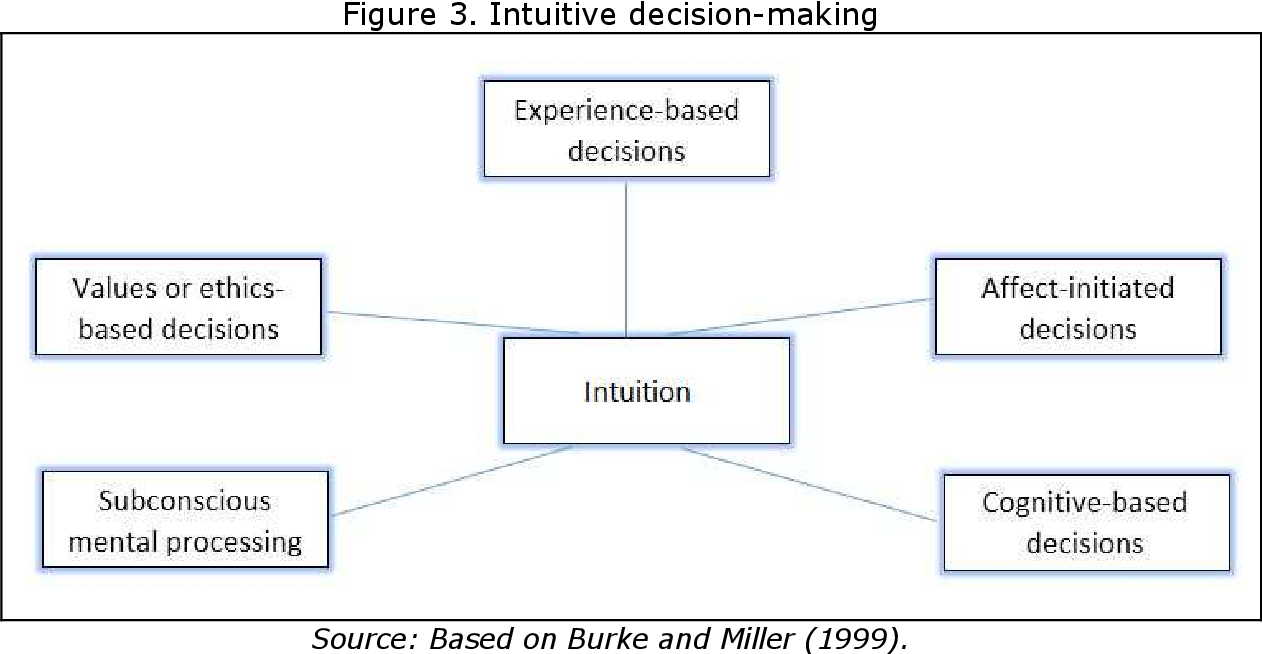
Several factors influence decision making. These factors, including past experience (Juliusson, Karlsson, & Gӓrling, 2005), cognitive biases (Stanovich & West, 2008), age and individual differences (Bruin, Parker, & Fischoff, 2007), belief in personal relevance (Acevedo, & Krueger, 2004), and an escalation of commitment, influence what choices people make. Understanding the factors that influence decision making process is important to understanding what decisions are made. That is, the factors that influence the process may impact the outcomes.
Heuristics serve as a framework in which satisfactory decisions are made quickly and with ease (Shah & Oppenheimer, 2008). Many types of heuristics have been developed to explain the decision-making process; essentially, individuals work to reduce the effort they need to expend in making decisions and heuristics offer individuals a general guide to follow, thereby reducing the effort they must disburse. Together, heuristics and factors influencing decision making are a significant aspect of critical thinking (West, Toplak, & Stanovich, 2008). There is some indication that this can be taught, which benefits those learning how to make appropriate and the best decisions in various situations and environments. (Nokes &Hacker, 2007).
People make decisions about many things. They make political decisions; personal decisions, including medical choices, romantic decisions, and career decisions; and financial decisions, which may also include some of the other kinds of decisions and judgments. Quite often, the decision-making process is fairly specific to the decision being made. Some choices are simple and seem straight forward, while others are complex and require a multi-step approach to making the decisions.
The context of types of decisions people make, factors that influence decision making, several heuristics commonly researched and utilized in the process of decision making. Exploring what happens after the decision is made, as well as how present decisions impact future behavior and decision making. Implications for future research and practical application of teaching decision making skills in corporate cultures and C-suites is important for consistent impactful decision making.
Factors that Influence Decision Making
There are several important factors that influence decision making. Significant factors include past experiences, a variety of cognitive biases, an escalation of commitment and sunk outcomes, individual differences, including age and socioeconomic status, and a belief in personal relevance. These things all impact the decision-making process and the decisions made.
Past experiences can impact future decision making. Juliusson, Karlsson, and Garling (2005) indicated past decisions influence the decisions people make in the future. It stands to reason that when positive results come from a decision, people are more likely to decide in a similar way, given a similar situation. On the other hand, people tend to avoid repeating past mistakes (Sagi, & Friedland, 2007). This is significant to the extent that future decisions made based on past experiences are not necessarily the best decisions. In financial decision making, highly successful people do not make investment decisions based on past sunk outcomes, rather by examining choices with no regard for past experiences; this approach conflicts with what one may expect (Juliusson et al., 2005).
In addition to past experiences, there are several cognitive biases that influence decision making. Cognitive biases are thinking patterns based on observations and generalizations that may lead to memory errors, inaccurate judgments, and faulty logic sometimes termed “putting a stake in the ground” (Evans, Barston, & Pollard, 1983; West, Toplak, & Stanovich, 2008). Cognitive biases include, but are not limited to: belief bias, the over dependence on prior knowledge in arriving at decisions; hindsight bias, people tend to readily explain an event as inevitable, once it has happened; omission bias, generally, people have a propensity to omit information perceived as risky; and confirmation bias, in which people observe what they expect in observations (Marsh, & Hanlon, 2007; Nestler. & von Collani, 2008; Stanovich & West, 2008; see also West et al., 2008).
In decision making, cognitive biases influence people by causing them to over rely or lend more credence to expected observations and previous knowledge as absolutes, while dismissing information or observations that are perceived as uncertain, without looking at the bigger picture. While this influence may lead to poor decisions sometimes, the cognitive biases enable individuals to make efficient decisions with assistance of heuristics (Shah & Oppenheimer, 2008).
In addition to past experiences and cognitive biases (stakes in the ground), decision making may be influenced by an escalation of commitment and sunk outcomes, which are unrecoverable costs. Juliusson, Karlsson, and Garling (2005) concluded people make decisions based on an irrational escalation of commitment, that is, individuals invest larger amounts of time, money, and effort into a decision to which they feel committed; further, people will tend to continue to make risky decisions when they feel responsible for the sunk costs, time, money, and effort spent on a project. As a result, decision making may at times be influenced by ‘how far in the hole’ the individual feels he or she is (Juliusson et al., 2005).
Some individual differences may also influence decision making. Research has indicated that age, socioeconomic status (SES), and cognitive abilities influences decision making (de Bruin, Parker, & Fischoff, 2007; Finucane, Mertz, Slovic, & Schmidt, 2005). Finucane et al. established a significant difference in decision making across age; that is, as cognitive functions decline as a result of age, decision making performance may decline as well. In addition, older people may be more overconfident regarding their ability to make decisions, which inhibits their ability to seek and apply new strategies (de Bruin et al., 2007). Finally, with respect to age, there is evidence to support the notion that older adults prefer fewer choices than younger adults (Reed, Mikels, & Simon, 2008).
Age is only one individual difference that influences decision making. According to de Bruin et al. (2007), people in lower SES groups may have less access to education and resources, which may make them more susceptible to experiencing negative life events, often beyond their control; as a result, low SES individuals may make poorer decisions, based on past decisions because they fail to research new alternatives.
Over and above past experiences, cognitive biases, and individual differences; another influence on decision making is the belief in personal relevance. When people believe what they decide matters, they are more likely to make a decision. Acevedo and Krueger (2004) examined individuals’ voting patterns, and concluded that people will vote more readily when they believe their opinion is indicative of the attitudes of the general population, as well as when they have a regard for their own importance in the outcomes. People vote when they believe their vote counts. Acevedo and Krueger pointed out this voting phenomenon is ironic; when more people vote, the individual votes countless, in electoral math.
Decision Making Heuristics
Heuristics are general decision-making strategies people use that are based on little information, yet very often correct; heuristics are mental short cuts that reduce the cognitive burden associated with decision making (Shah & Oppenheimer, 2008). Shah and Oppenheimer argued that heuristics reduce work in decision making in several ways. Heuristics offer the user the ability to scrutinize few signals and/or alternative choices in decision making. In addition, heuristics diminish the work of retrieving and storing information in memory; streamlining the decision-making process by reducing the amount of integrated information necessary in making the choice or passing judgment (Shah & Oppenheimer, 2008).
As a result of research and theorizing, cognitive psychologists have outlined a host of heuristics people use in decision making. Heuristics range from general to very specific and serve various functions. The price heuristic, in which people judge higher priced items to have higher quality than lower priced things, is specific to consumer patterns; while the outrage heuristic, in which people consider how contemptible a crime is when deciding on the punishment (Shah, & Oppenheimer, 2008). According to Shah and Oppenheimer three important heuristics are the representative, availability, and anchoring and adjustment heuristics.
In decision making, people rely on a host of heuristics for convenience and speed. One important heuristic is the representative heuristic (RH), which is an extremely economical heuristic (Pachur, & Hertwig, 2006). In the event that one of two things is recognizable, people will tend to choose the recognized thing; utilizing or arriving at a decision with the least amount of effort or information (Goldstein & Gigerenzer, 2002; Hilbig & Pohl, 2008). Hilbig and Pohl remarked that it is difficult to research and answer definitively if an individual is using the RH alone, or if the person is using other information in drawing a conclusion. As a result, the research on the RH is mixed (Goldstein & Gigerenzer, 2002; see also Hilbig & Pohl, 2006). Goldstein and Gigerenzer provided seminal research on the RH. They maintained recognition memory is perceptive, reliable, and more accurate than chance alone; they argued less recognition leads to more correct decisions. On the other hand, according to Hilbig and Pohl, people often use additional information when utilizing the RH; that is, they do not rely solely on recognition along in decision making. Further, Hilbig and Pohl concluded that even when sound recognition was established, people use additional information, in conjunction with the RH.
Another highly researched heuristic is the availability heuristic. According to this heuristic, people are inclined to retrieve information that is most readily available in making a decision (Redelmeier, 2005). Interestingly, this is an important heuristic, as it is the basis for many of our judgments and decisions (McKelvie, 2000; Redelmeier, 2005). For example, when people are asked to read a list, then identify names from the list, often, the names identified are names of famous individuals, with which the participants are familiar (McKelvie, 2000). In the field of medicine, Redelmeier charged that missed medical diagnoses are often attributable to heuristics, the availability heuristic being one of those responsible. Redelmeier explained heuristics are beneficial as they are cognitively economical, but cautioned clinicians and practitioners need to recognize when heuristics need to be over-ridden in favor of more comprehensive decision making approaches.
The anchoring and adjustment heuristic is the foundational decision-making heuristic in situations where some estimate of value is needed (Epley, & Gilovich, 2006). In this particular heuristic, individuals first use an anchor, or some ball park estimate that surfaces initially, and adjusts their estimates until a satisfactory answer is reached. For example, if a person were asked to answer the question, “In what year did John F. Kennedy take office?” the anchoring and adjustment heurist would be used. The person may start with a known date, such as the date he was shot, November 22, 1963; then make an estimate based on the known information (Epley, & Gilovich, 2006). The practical application of the anchoring and adjustment heuristic is in negotiations; people make counter offers based on the anchor that is provided to them. Epley and Gilovich explained often people tend to make estimates which tend to gravitate towards the anchor side, where actual values tend to be farther away from the anchor initially planted. Further, anchoring requires effort; such a job is important in avoiding anchor bias.
After the Decision
After a decision is made, people experience a variety of reactions. In addition, present decisions influence future decision making. Several of the outcomes that may result from a decision are regret or satisfaction; both of which influence upcoming decisions.
Regret, feelings of disappointment or dissatisfaction with a choice made is one potential outcome of decision making. Interestingly, regret may shape the decision-making process. According to Abraham and Sheeran (2003), anticipated regret is the belief that the decision will be result of inaction. Anticipated regret may prompt behavior; that is, when a person indicates they will do something, such as exercise, they may follow through with their intended decision, to avoid regret. Once the decision is made, the impact of the decision, if regret is experienced, will impact future decisions. People can often get consumed with examining the other options that were available; the path not taken (Sagi & Friedland, 2007).
Sagi and Friedland
Sagi and Friedland (2007) theorized people feel regret in accordance with how the decision was made; regret may be dependent on the number of options that were available during the decision-making process; and how varied the options were may impact how regret is experienced after the decision was made. Through a series of experiments, Sagi and Friedland concluded that people feel remorse because they feel they were able to make a better choice by looking at more information, previously disregarded, and carefully weighing the pros and cons of each choice. In addition, regret is magnified when individuals revisit the other available options and considering what satisfaction the other option would have brought them. Interestingly, people who are dissatisfied with their decision feel obligated to embrace the decision, as a means to reducing anxiety regarding the quality of the decision (Botti & Iyengar, 2004; see also Gilbert & Ebert, 2002). For example, when a job applicant does not get hired, he may restructure the experience, and find many reasons that explain why he did not want to work for the company.
In addition to regret, individuals may also experience satisfaction with their decisions. Satisfaction refers to how pleased the decision maker is with the outcome of the decision. There are many things that impact levels of satisfaction. Botti and Iyengar (2004) observed individuals prefer to make their own decisions and believe they will be more satisfied with their choices; however, when people are given only undesirable options, decision makers are less satisfied than those who have had the choice made for them. Botti and Iyengar posited the explanation for this impact officer jobs phenomenon is that the decision maker assumes responsibility for the decision made. As a result, if the available choices are bad, they may feel as though they are responsible for making poor choices.
Also fascinating, aside from heuristics, an important decision-making strategy is evaluating positive and negative aspects of choices. Kim et al. (2008) discovered that when younger and older adults use this strategy, older adults tend to list more positive and fewer negative aspects of each choice, and older adults register more satisfaction with their choices when they use this evaluative strategy. One interesting finding was when the participants did not evaluate the options by listing the positive and negative features; there was no age difference in satisfaction (Kim et al., 2008).
As explained, future decision making is based on past decisions, as well as levels of satisfaction or regret (Abraham & Sheeran, 2003; Juliusson, Karlsson, & Garling, 2005; Sagi & Friedland, 2007). Even though there is evidence to support this notion, in many cases, particularly when the decision may be reversed, decisions may be based on the reversibility factor (Gilbert, & Ebert, 2002). Significant to individuals’ satisfaction is that people are willing to pay a premium for the opportunity to change their minds at a later date (Wood, 2001). For example, catalogue shoppers purchase items in a two step process; first they decide to purchase the items, then once the items arrive, they decide if they will keep them. Gilbert and Ebert examined if people prefer making decisions that are reversible. They concluded that people do prefer to have the option to change their minds; although people’s ability to change their minds actually inhibits their ability to be satisfied with their choice.
An Innovative Company Decision-Making Approach
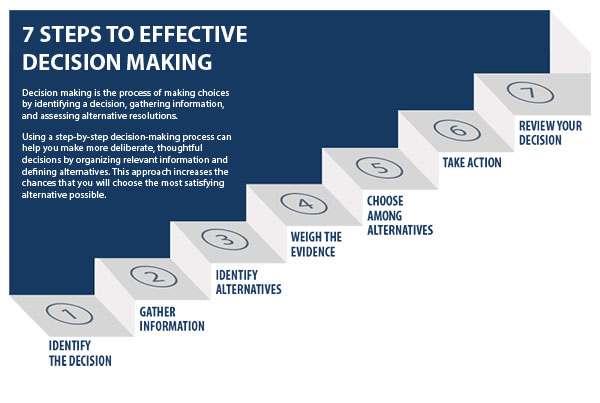
Decision making is a critical aspect to feeling successful and happy in life; decision making is at the root of all we do. It is important to develop effective decision-making skills and strategies. Problem solving strategies include, but are not limited to brain storming, cost benefit analysis, written remediation plans, and an examination of possible choices (Wester, Christianson, Fouad, & Santiago-Rivera, 2008). The decision-making process can be complicated and overwhelming. As a result, it is valuable for individuals to learn a model to follow, that may be applied to everyday decisions, as well as life changing choices.
Krantz and Kunreuther (2007) posited that a goal and plan-based decision-making model is an effective and sound approach to take in decision making; in this model, the individual is encouraged to focus on goals, not happiness or usefulness. According to Krantz and Kunreuther, plans are designed to meet one or more goals. That is, people make plans to unconsciously or consciously meet the goals they have. And, some plans satisfy several goals.
For example, people who attend a sporting event with a friend may be satisfying several goals; friendship and camaraderie, emotional stimulation from competitive sport, and potentially useful social knowledge gained from watching the game. In this model, goals are context dependent and plans are based on their ability to meet the goals. Essentially, in the goal/plan-based model, the context provides the backdrop for the decision that needs to be made; goals and resources, influenced by the context, contribute to the development of plausible plans; while the decision making rules are implemented and influence the plan that is ultimately chosen. Krantz and Kunreuther apply this theory to the insurance career, but imply the theory may be appropriately applied to a variety of contexts.
Factors That Impact Decision Making
Decision making is an important area of research in cognitive psychology and essential to deeply understand in making impactful decisions as a Chief Impact Officer or Consultant attempting to drive and create exacting impact. Understanding the process by which individuals make decisions is important to understanding the decisions they make and effectively influencing the impact outcomes. There are several factors that influence decision making. Those factors are past experiences, cognitive biases, age and individual differences, belief in personal relevance, and an escalation of commitment. Heuristics are mental short cuts that take some of the cognitive load off decision makers. There are many kinds of heuristics, but three are important and commonly used: representative, availability, and anchoring-and-adjustment.
After an individual makes a decision, there are several differing outcomes, including regret and satisfaction. Decisions that are reversible are more desired and people are willing to pay a premium for the ability to reverse decisions; though reversibility may not lead to positive or satisfactory outcomes. Cognitive psychologists have developed many decision making models, which explain the process by which people effectively make decisions. One innovative model is based on goals and job chief impact planning. There is yet a lot of research to be conducted on decision making, which will enable psychologists and educators to positively influence the lives of many.
Especially interesting in Impact Directives is leadership gauging impact in the complicated community impact programs social sector. Because impact decisions are morally significant. Government officials, funders, and nonprofit leaders’ decisions influence lives in many ways, both for the better and for the worst. If we reflect on our own life, I’m sure you’ll reach a similar conclusion. Therefore, the role of a chief impact officer is vital to the mission, vision and values of the organization when achieving the brand promise on a daily basis. Impact is the relationship our decisions as an organization have on the environment or ecosphere in which our business model exists or resides. The relationship is always symbiotic and may vary based on inputs from our competitors.
chief impact officer consultant role
A chief impact officer or impact consultant’s role is to make a difference in people’s lives adhering to the startup chief impact values, mission and vision of the enterprise. Grasping the distinctions we make and the choices we make are properly aligned is a constant challenge. Better choices result in a legacy that we can be proud of creating a positive impact in the lives of our multiple constituencies.
What can we do to improve impact? There are numerous options! Because there is so much untapped potential to enhance how we ultimately do things, decision-making is an exciting area in social impact. Scholars and practitioners have been developing approaches for studying and making decisions for decades, but philanthropy, government, and impact investing are only now adopting them. I’ve constructed my own approach based on my body of work to assist myself and my partners/clients in making key decisions with intention and focus creating the desired impact.
Start with a strategy.
It’s critical to put decisions into context. Theoretical decision-making can’t predict what goals should motivate you or who should be in charge of making impact decisions. Decision-making isn’t a substitute for strategy. Decision-making, on the other hand, is an expression of a chosen strategy. Could a chief impact officer or consultant truly be a chief strategy officer? As a chief impact officer or chief strategy officer, when you already have a good notion of what you’re attempting to accomplish and how you want to go about doing it, decision analysis approaches are most effective. They’re most effective when the task at hand is to figure out how to put the broad direction and values the organization previously committed impact officer salaries into action in this particular type situation.
As a result, it’s important to have the goal, vision, and values set out and committed to paper or pixels before using the following recommendations. You should know who has final decision-making authority and how conflicts among group members will be resolved if decisions must be taken as a group team. You should also have a good understanding of the environment in which you operate and the precise, near-term outcomes that are most important to perceived success. It is always good to ask early on, “what does success look like”.
It may not be immediately evident why anything additional is required. Isn’t it simple to apply a general strategy to day-to-day decisions if you’ve previously laid out a plan? It could be in some circumstances. After all, not every option is a brainteaser. But, virtually & invariably, sacrifices must be made between goals or values that cannot be met simultaneously or to the same degree. People on the team or in our brain trust will almost certainly argue the likely consequences of various paths forward, and there will be no easy way to decide who is likely to be correct. And, virtually invariably, the right average chief impact decision may potentially enrage the wrong people.
For situations like this, decision analysis was created.
Choosing between options
Every day, we make hundreds of decisions, from what to eat for supper to whether to open Twitter right now to how to respond to your coworker’s somewhat insensitive remark. Most of these aren’t even worth considering, let alone employing a consultant to assist you to figure them out.
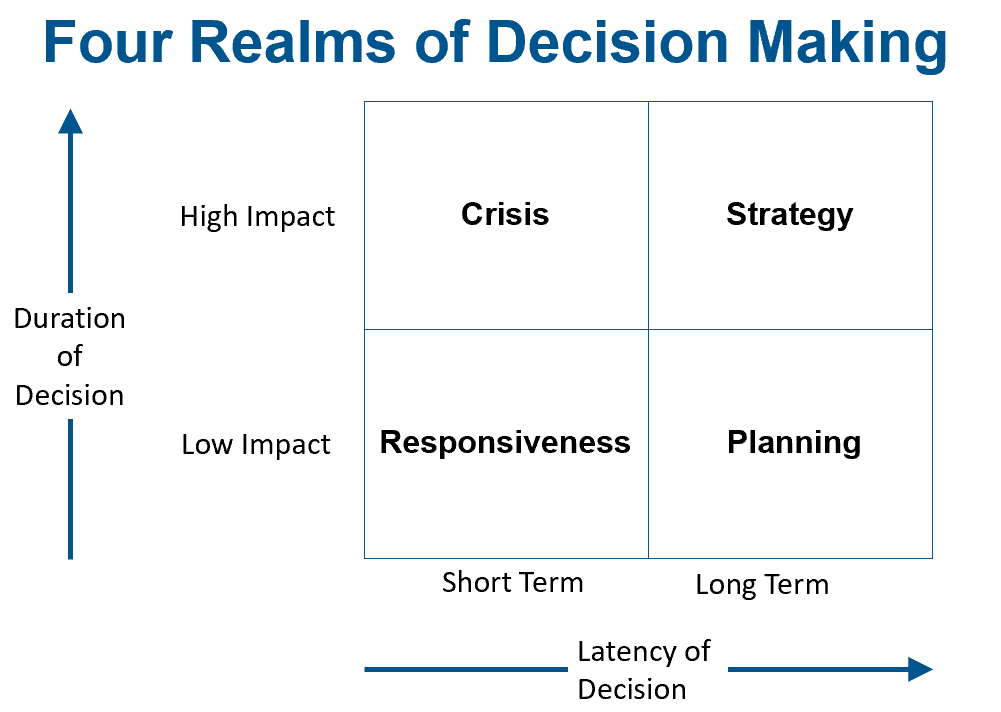
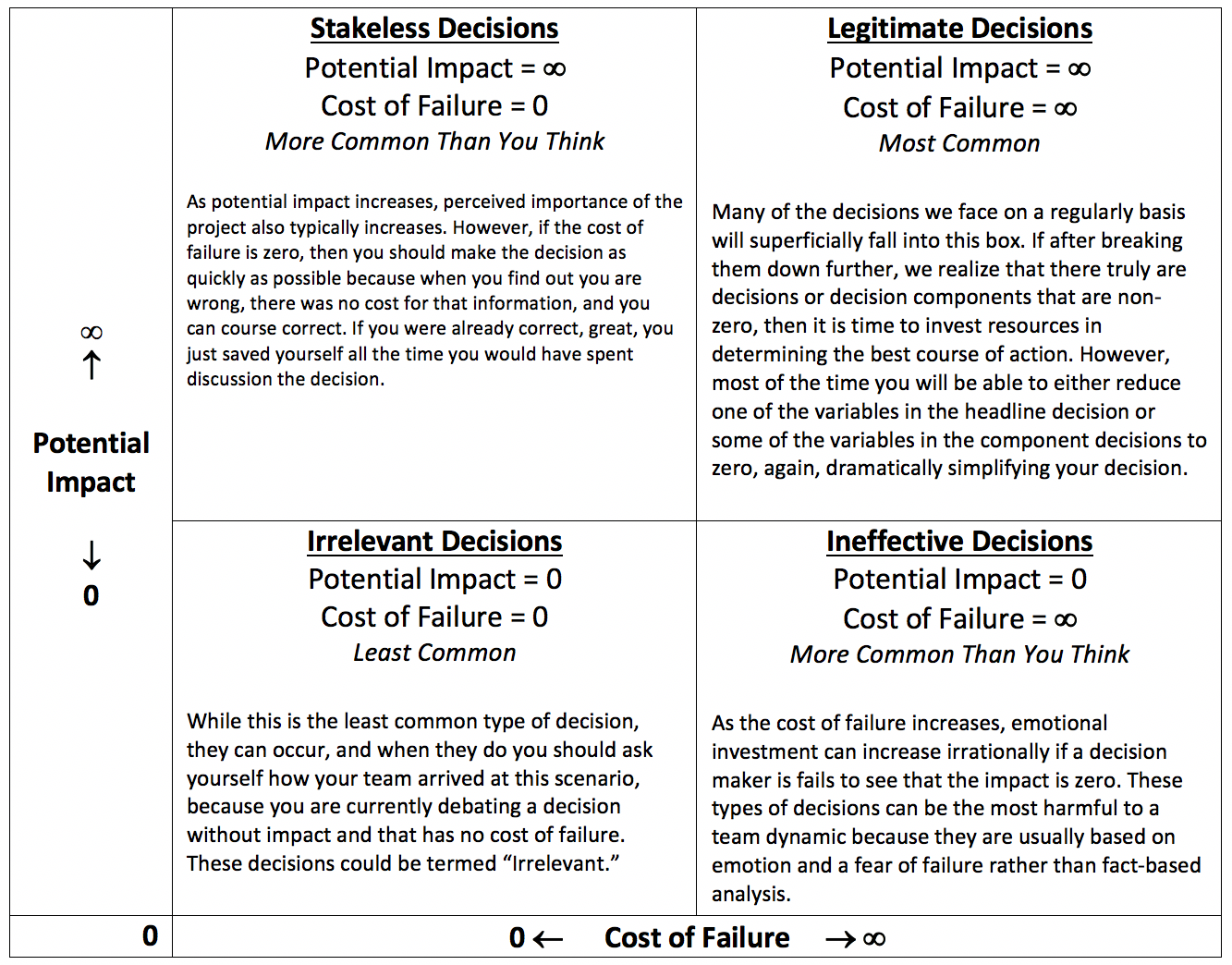
But if the study of decision analysis teaches us anything, it’s that certain decisions are more important than others. The decisions that require the most continuous attention are those in which the stakes are high, the context is unfamiliar, and the definition of success is not immediately apparent.
However, because many teams work at such a quick pace, we often only begin to pay attention to decisions just before they must be made. As a result, we overlook many of our most crucial judgments and risk succumbing to cognitive biases that lead to poor outcomes.
Of course, we can’t afford to thoroughly evaluate every single decision we make; we’d rapidly become engrossed in the process and unable to accomplish anything. So we’ll need a system for anticipating and prioritizing our decisions so that we can devote the necessary resources to the ones that actually matter.
Fortunately, a simple process known as a decision inventory can help you solve this problem. The decision inventory is a process for cataloging, aggregating, and classifying all of the significant decisions you intend to make in the near to medium term, adapted from a method devised by decision analysis pioneers Strategic Decisions Group. The exercise predicts which chief purpose officers challenges you’ll need to focus on and when, as well as which ones you should address quickly vs completely investigate.
Dissecting your chief purpose officers decision
Okay, now we’re getting down to business. It’s time to start examining the selections at the top of the pile once you’ve figured out which ones are the most important. There are a few different ways to break down a choice into its constituent elements. The following are elements of my own method:
Variables
• The variables at play. What is the larger strategic/organizational context in which this decision is being made? It’s fine to rely on your gut for this one as a first pass because you and your team members will usually have a strong instinctive feel of what’s relevant here. What are the most important opportunities and concerns in this situation? What excites and/or concerns you the most?
Possibilities
• What you might be able to do. What are the possibilities available to you? What options should be explored but haven’t been brought up yet? What are the advantages and disadvantages of each?
Techniques
• Techniques for improving performance. Is this the right time to make this decision? More strategic/consequential decisions should, in general, come before tactical decisions. Other decisions should be made after a series of events has occurred or new information has become available. Finally, it’s occasionally a good idea to “bundle” options so that the strategy is organically aligned.
Stakes
• Stakes. At the inventory stage, you’ll have started to analyze the stakes of a decision, but it’s helpful to keep them in mind when you figure out how much overall time and money you’re willing to invest before committing to a direction. A thoughtful stakes analysis will consider who and what might be impacted by the decision’s outcome(s), how much, and for how long. It would also examine the decision’s reversibility; how difficult is it to reverse a decision once you’ve made it?
Sources
• The number of sources and the degree of uncertainty. What would you do if you had to make this decision right now? If the answer isn’t evident right away, it’s typically because you don’t know something (or several things) that you wish you did. Identifying the sources of uncertainty can assist you in determining what additional knowledge would be most beneficial in this case. (Note that you can usually get a much more precise understanding of the value of additional information by modeling the decision quantitatively, as discussed below.)
Don’t be intimidated by the breadth of the above list. Chances are you’re already making these kinds of assessments about your decisions, you’re just not (yet) doing it in a systematic way. This process helps to bring that thinking into the realm of the conscious mind. And in many situations, that can happen with just a couple of meetings and some back-of-the-envelope estimates.
Some decisions really do require careful attention to get right, though. For those, there’s no substitute for an in-depth quantitative model.
Chief impact officer mental with decision modeling
The preliminary analysis described in the previous section will give you a holistic overview of your decision dilemma, but it optimizes for breadth over depth. It’s like exploring the world by looking at a two-dimensional map — you can see the complete picture, but not all the details.
To achieve both, it’s necessary to model your decision explicitly using mathematical tools. This is like exploring the world from your desktop using a combination of Google Maps and Street View. The map helps you understand the broader context, but you can improve your understanding of the details by zooming in on specific points of interest.
My invocation of technology here is intentional, because building decision models is a technological enhancement to human decision-making. We are leveraging the power and speed of modern computing capacity to help us gain a deeper understanding of our decision dilemma than would be possible using our minds alone. You are still in the driver’s seat — you are still the one who makes the decision, after all — but the mathematical model we create serves as a kind of supercharged coach or advisor.
The nuts and bolts of putting together a decision model are too involved to cover here, but I wrote a handy primer featuring a grantmaking case study if you’re interested in learning more about how to do it.
There are two main reasons to put together a decision model. The first is that it’s possible to get much better precision about the factors at play and which ones are really important. When putting together a decision model, I use a statistical technique called Monte Carlo simulation that dynamically generates thousands of potential futures based on the estimates and assumptions that you provide (and can easily tweak in real time). Developed by nuclear physicists in the middle of the 20th century, Monte Carlo simulations have been empirically tested and shown to yield better judgments than alternative strategies in real-world settings. It’s the method that NASA swears by when preparing for so-called “complex projects” like launching human beings into space.
The second awesome superpower of quantitative models is that they can help guide role research or learning agenda created for the express purpose of reducing uncertainty about important factors relating to the decision in question. You can use the concept of value of information to pick out the most important things to measure, measure them, and re-run the model in an iterative cycle until there is literally no more value to wring out of seeking further data. This method is called Applied Information Economics and was invented by information scientist Doug Hubbard for use in high-stakes investment decisions in the social sector and business world alike (read about a couple of examples of its use here and here). As far as sustainability decision analysis techniques go, AIE is pretty much the gold standard approach.
With that said, modeling does have some costs and drawbacks. The main challenge is that, compared to the quick and easy process described in the previous section, modeling does usually require a more significant minimum investment of time and expense, an investment that scales with the number of stakeholders that need to provide input. In addition, modeling may feel somewhat intimidating or unnatural at first to staff or partners who have little experience with quantitative methods. Finally, while I’m a firm believer that anything worth modeling can be modeled, it is true that some kinds of goals and decision factors are harder to translate into mathematical terms than others and may require more specialized role expertise.
When should you make the leap to modeling your decision? Ultimately, it comes down most of all to the stakes of the decision. Although all such situations should be judged case by case, a good-enough rule of thumb is that if your decision has more than $25,000 (for an individual) or $50,000 (for an organization) riding on it, it’s worth considering putting together at least a quick-and-dirty quantitative model to help ensure you get it right. And if the stakes are in the $250,000 and up range, I’d say it’s actually pretty irresponsible not to attempt a quantitative treatment of the situation.
Finally, remember: the math is there to help you make your decision, not to make it for you. You are free to ignore it if you want. When making a decision model, work hard to make sure it accounts for everything the decision-maker cares about. But never deliver a recommendation without also considering the qualitative analysis that was developed alongside it.
After the math, the aftermath
Congratulations, the decision was made with impact in mind! While the dilemma itself may be resolved, the consequences or impact of the choice are just beginning to be felt.
Here are some helpful questions to ask and things to think about in the post-impact decision phase:
• How should you talk about this decision (and the process that went into it)? Strategic Decisions Group’s Decision Quality framework notably includes “commitment to action” as one of six key pillars to a high-quality impactful decision — meaning that they include commitment in the very definition of what constitutes a high-quality decision. Particularly when the decision is about a charged topic or conversation in your organization or community, having a robust, transparent process like this one can help to build consensus and buy-in moving forward.
• Do you expect to make similar decisions like this in the future? If so, it’s likely you can reuse much of the analysis and basic framework you developed for this one in those scenarios to come. And if you created a quantitative model for the decision, you can turn that model into a standardized template that can accommodate any such situation in the future. In my own practice, I’ve built templates like this for things like whether to apply for a new consulting opportunity. In such situations, the work you put in initially to develop the model is amortized across many uses, making the investment of time effectively a no-brainer.
• How does this decision affect other decisions you need to make? Decisions usually beget more decisions. You or your team might have been waiting for resolution on this situation because it would provide crucial information for other dilemmas in play. In other cases, a decision to, say, move forward with a project will create lots of new choices about how exactly to implement it. Be sure to document the more important of these so that you can devote the appropriate amount of attention to them, and if any seem especially high-stakes and/or uncertain, the techniques discussed in this article are here to help.
You, too, can decide like a Chief Impact Officer Pro Contact Us!
So that’s how I help clients make decisions. If you have grappled with how to make smarter decisions for your company, consultancy, organization or philanthropy and come up with similar or different techniques, please let me know. There is always more to learn, and I love to learn! If you would like help creating an impact decision making platform promoting consistent impact decision making, contact [email protected] or call us at (469) 536-8478 Impacting Decisions is Mach1designs business!
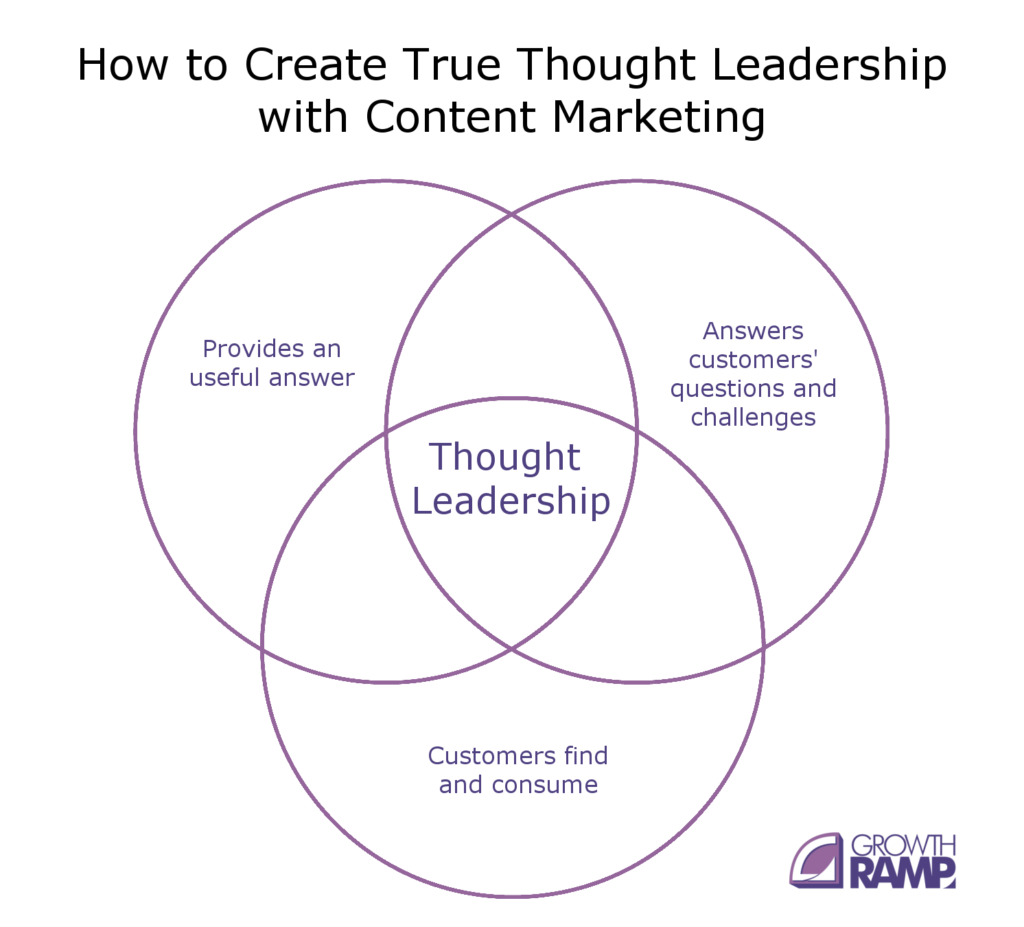
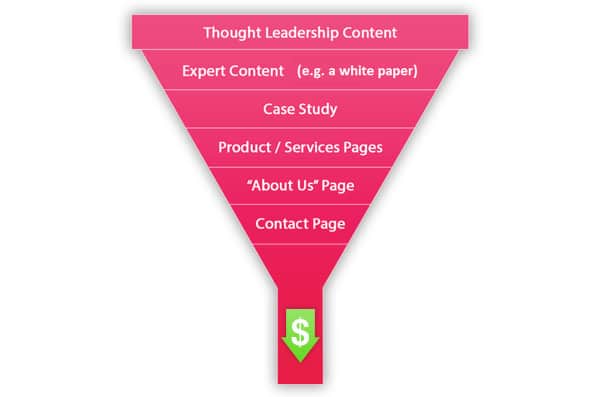
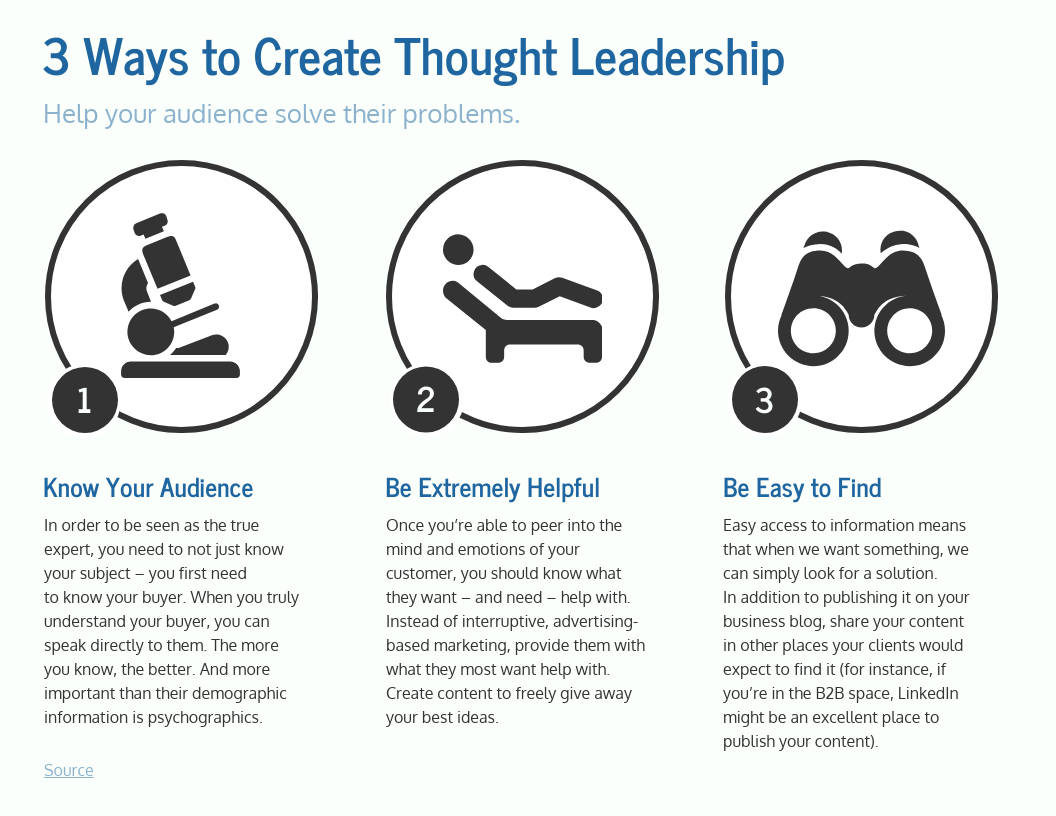
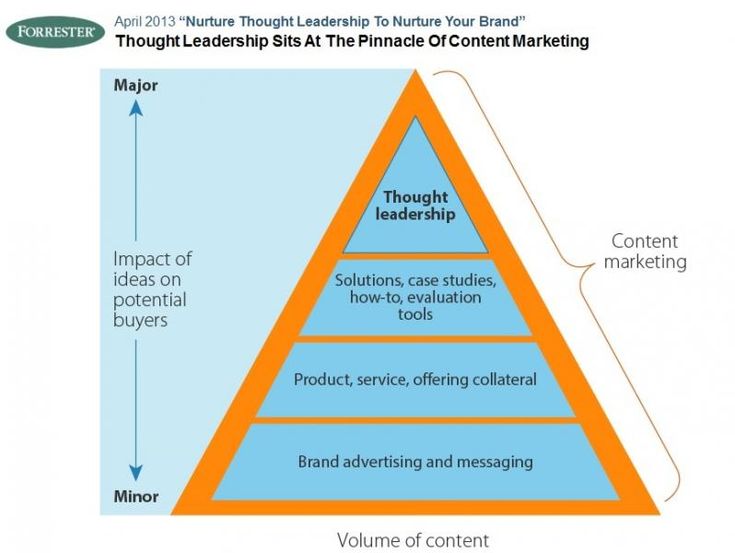
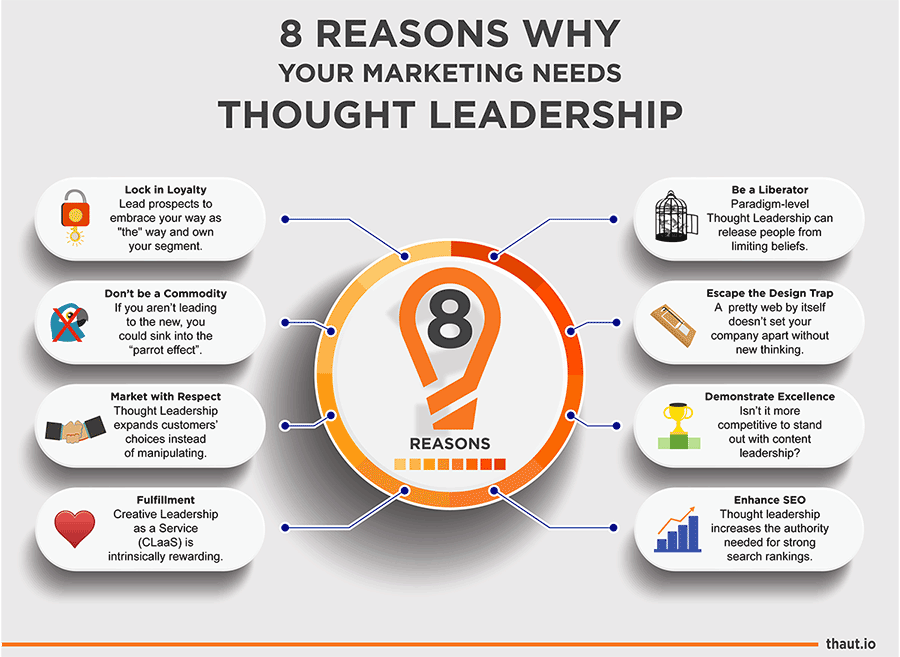
Thought leader content is one of the many ways you can use to promote your business online and drive traffic to your website. It’s also one of the best methods to increase your search engine rankings and dominate your niche when it comes to search engine optimization (SEO). The more relevant content you produce, the more visitors will come to your site and keep coming back, especially if they believe what you have to say will actually help them accomplish their goals in life or improve their quality of life in some way. But how do you make sure that what you write is specifically geared toward the audience reading it?
How do you become a thought leader?
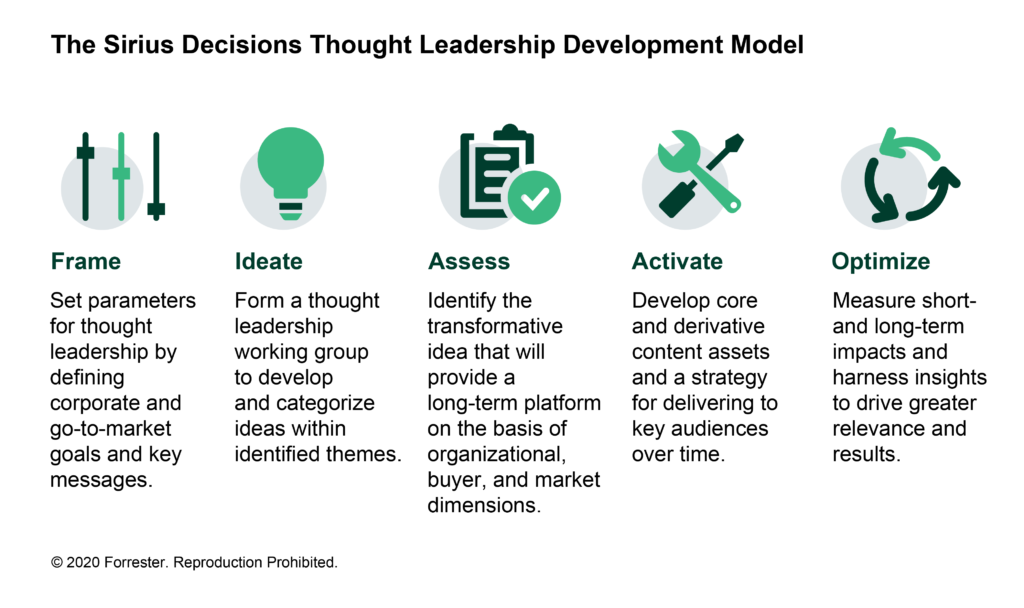
“Thought leadership” is a popular jargon in the corporate world right now, and it’s simple to see why it’s become such a hot topic among executives. You can become a leading, recognized voice in your field if others look to you for your expertise and insight.
What does it take to become a thought leader, and what measures can you take to get there? We asked members of the Young Entrepreneur Council to explain some of the characteristics that constitute an industry thought leader, as well as what steps people can take to get started. Their responses are listed below.
1. Begin producing content to share your ideas.
You must be willing and able to communicate your ideas and knowledge in a clear and succinct manner that is appealing to the readers or listeners. One thing individuals can do is start, even if it’s only writing a brief text to share or making a short video. Don’t be apprehensive about taking the initial step. It takes practice, and if you stick with it, you will improve over time.
2. Maintain Consistency
It’s critical to be consistent if you want to become a thought leader in your field. Maintain a consistent flow of content creation, whether through blogs or a podcast, when you’re first starting out. Determine which industry blogs you can contribute to on a regular basis, or start a podcast and produce weekly episodes.
3. Extensive Research
Establish credibility—and I don’t just mean bragging about your achievements. It’s all about bringing folks behind the scenes as a thought leader. Show them what has worked and what hasn’t worked for you. Give them a lot of nitty-gritty tactical information and watch them follow along.
4. Provide answers to questions Nobody else is responding.
Respond to the questions that no one else is asking. Engage in the conversation rather than simply delivering your ideas and thoughts. If you’re reviewing articles in your specialized business and notice that people are asking the same questions over and over again in the comments and feed, be the one to respond.
5. Establish a distinct, authoritative point of view
Having a clear, authoritative point of view is the most critical step toward becoming a thought leader in your sector. You will not become a voice people can look to or trust if you are unsure of or unable to communicate your opinions. If you want to be a thought leader, you must constantly educate yourself because industries change all the time.
6. Be Consistent with Your Message
Choose a clear message and stick to it. The finest thought leaders are recognized because they stick to a clear message, making it easier for others to understand what they do and why they do it. Simon Sinek, for example, is well-known for asking “why.” He brings it up frequently. In fact, it is at the center of his entire business concept and activities.
7. Make time for self-reflection.
Self-reflection is crucial in all aspects of life, and thinking leadership is no exception. You’ll have a hard time discussing ideas with people if you can’t sit down and analyze your own thoughts, actions, and behaviors. Every day, I recommend taking some time to reflect. This exercise will help you become more self-aware, which will allow you to think more broadly and understand the broader picture. – Smash Balloon LLC’s John Brackett
8. Share Your Expertise
Getting articles written by you published in industry journals is a wonderful method to do this. However, you must guarantee that the content is of good quality, professionally edited, non-promotional, and truly gives value to the target audience in order to do this.
9. Provide value by using simple language.
We’ve been able to stand out in our market by using straightforward and conversational language and responding to client questions. People are frequently perplexed and seek step-by-step instructions on how to create a website. Users like the terminology and details we provide, which I believe has helped us flourish in our area.
10. Use a variety of platforms to distribute your content.
Being a thought leader necessitates irrefutable knowledge and omniscience. It’s impossible to only post on one platform. People should be able to see you respond to their queries on a variety of platforms. Try as much as you can while remaining present in all of the venues where you gain traction.
11. Don’t Be Afraid to Put Yourself Out There
Make an effort to network with as many people in your field as possible. The thought leaders in any field aren’t always smarter than the typical expert. They stand out because they know the right people and have access to the proper platforms to spread their message and knowledge. Participate in podcasts, join groups, create content, and network with influencers.
Different Types of Thought Leadership Marketing
TYPES OF THOUGHT LEADERSHIP CONTENT FOR SOCIAL MEDIA AUTHORITY
Thousands of people publish content on the internet every day, claiming to be experts in their fields and offering their goods and services. How can customers deal with this huge onslaught of information?
Users are inundated with material and sales pitches from all sides. Thought leadership is the only way to tell who is the best. Thought leadership may help you and your company stand out from the crowd. What better method to establish your thought leadership than to employ a highly effective channel like social media?
“A thought leader is an individual or firm that is acknowledged as an authority in a specific field, and whose expertise is sought and frequently rewarded,” according to Wikipedia. It takes a lot of time and effort to be a thought leader. However, if you’ve established yourself as a thought leader in your field, you’ll be nearly unbeatable.
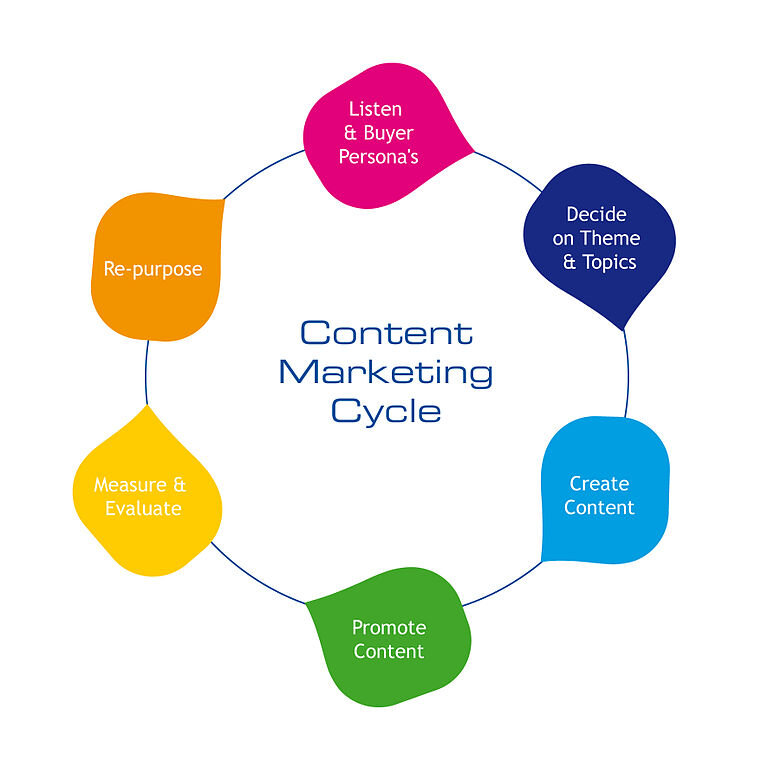
The greatest approach to demonstrate your thought leadership in your field is through content marketing. Thought leadership content can position your company as an industry authority and expert.
Let’s take a look at the many forms of thought leadership content you may create to increase your social media influence.
1. FINDINGS AND DATA FROM ORIGINAL RESEARCH
The greatest method to demonstrate your thought leadership is to conduct original research and create your own data/statistics. This is because curating current internet content does not necessitate the same level of expertise as conducting original research. And your audience is well aware of this.
You can begin by deciding on a research topic. You can choose a topic that is currently popular in the market or one that has a lot of guesses and assumptions about it but no concrete proof.
Once you’ve decided on a topic, begin your research by gathering information through surveys or the internet. To come up with credible proof, use all means at your disposal. Your findings should not only pique the curiosity of your target audience, but also that of other industry experts.
Your findings can be shared through blog articles or white papers. Social media is the most effective way to publicize your study and findings. You can present your findings in the form of a short film, infographics, or any other style of content that effectively communicates your findings. You’ll be able to create your industry authority on social media this way.
2. LIVES IN SOCIAL MEDIA
Going live on social media is one of the most effective ways to interact with your target audience and develop thought leadership. When you go live, people will recognize you as a true authority and industry leader.
You can either broadcast live content on a certain topic or hold a live Q&A session. It’s crucial to speak about something that your audience can relate to. Customer relationship management tools can help you better grasp the interests of your target audiences. Polls can also be used to choose a topic for your social media live.
You’ll gain more followers and engagement this way, and your brand will become more well-known as a result. To improve your involvement even more, you can go live with other industry professionals.
3. INFORMATION GRAPHICS
There’s a reason why infographics are so popular, and why they frequently go viral. Infographics are visually appealing representations of valuable information. You can fit a lot of useful advice and information into a single infographic.
For infographics, you can choose from a variety of topics that are always relevant. You may even be more particular and make the first infographic on a specific subject. This will provide you an advantage over your competitors, which is ideal for establishing authority and demonstrating thought leadership.
4. UNIQUE QUOTES
When was the last time you saw a social media celebrity quote? Seeing this would have immediately made you think of the person as a thought leader in the business. This is why quotations are so effective.
If you’ve been writing content for a long, you’ve definitely produced statements that make a point while also demonstrating your experience. Find statements like these and publish them as quotes on social media.
Twitter and LinkedIn are good examples of platforms that can be used for this. You may also make quotes out of common observations and share them on social media.
5. THOUGHT-PROVOKING POSTS ON SOCIAL MEDIA
A leader is someone who inspires people by instilling fresh ideas and thoughts in their heads. As a result, if you want to be an industry thought leader, make sure your material is distinctive, one-of-a-kind, and thought-provoking.
You should get your audience to think about things that no one else is. That is how you will be recognized as a true thinking leader.
6. INDUSTRY NEWS AND TRENDS THOUGHTS
When a new industry trend or news surfaced, what did you notice? You’ve probably noticed that the majority of people are confused about the new trend. As a result, people wait for specialists to discuss the latest news and trends.
This indicates that thought leaders don’t wait for others to bring up new trends or information. Instead, they conduct research, get their hands filthy, and dig up the most relevant facts to their knowledge, which they then discuss.
One of the most distinctive characteristics of a thought leader is that they talk about industry news first. As a result, don’t wait for specialists to discuss them. Instead, pretend to be an expert and be the first to speak about it.
7. VIDEOS OF HIGH QUALITY AND VALUE
We live in the video age. Long text-based messages may be scrolled past, but visually appealing information causes social media users to stop scrolling. As a result, take use of this fact.
You’re doing a fantastic job if you have a strong YouTube presence. If you haven’t started yet, now is a good moment to do so. You may advertise your YouTube videos and snippets on social media platforms by using them.
You should experiment with both short and long-form videos, following the newest video format trends. Instagram, for example, has debuted reels, which are shorter videos of less than 30 seconds. The engagement and following of users who used reels rose.
To establish yourself as a thought leader, use similar video trends on numerous social media channels and produce punchy, informative films.
CLIPS FROM PODCASTS AND INTERVIEWS
Podcasts and video interviews are typically long yet filled with information. As a result, podcast clips and interviews can be used to create thought leadership content.
So, the next time you’re looking for thought leadership material, look through your podcasts and interviews. Look for 1 to 3-minute clips with valuable content that will leave your viewers speechless.
Simply repurposing your podcasts and interviews in this way can help you raise brand awareness, engage with your audience more, and establish your industry credibility.
START ON SOCIAL MEDIA BUILDING THOUGHT LEADERSHIP CONTENT
Finally, we can claim that social media is one of the most effective strategies to reach a larger audience and demonstrate your leadership.
On social media, there are a lot of untapped audiences waiting to be discovered. All you have to do is work on thought leadership content on a regular basis. If you use the advice in this guide as a starting point, you’ll notice benefits quickly.
Our company’s social media marketing team is the best in the business at assisting our partners with their online marketing. We devise and implement unique social media marketing strategies that assist our clients in achieving their organizational goals and expanding their online presence.
Our management team works to help our partners boost their internet presence by providing ongoing online marketing services. When you use our services, you will receive a wonderful service and results that make a difference because our service is transparent and cost-effective. We provide a variety of marketing services for businesses of all sizes, from small businesses to huge organizations, to help you get the most out of your digital and social marketing efforts.
Do you want to increase your lead generation, website traffic, or event registrations? How do you attract candidates? Let Mach 1 Design teach you how to do it!
Writing From an Authentic Place
7 Ways to Write Effectively and Authentically
People frequently inquire about what it takes to be a successful writer. The short answer is yes. I’m not sure. What’s the slightly lengthier response? I’m not sure, and I’m not interested.
I’m more interested with effective writing than with brilliant writing. What’s the difference between the two? One is a matter of opinion, while the other is a matter of fact.
Everyone has their own definition of what constitutes “excellent” writing. Quality opinions differ depending on who you question, but excellent writing is difficult to dispute. It accomplishes its goal – plain and simple.
So, how can you write in such a way that your message is properly communicated? Here are seven suggestions for better writing that you can use right now:
Make time to hone your skills.
You can’t do something well without first doing it badly, and that starts with practice. Most experts advise that you set aside time each day to write (even if it’s only 20 minutes). If you don’t show up, you won’t improve.
I achieve this with my blog and other projects by writing a minimum of 500 words per day. The more I write, the more I discover about writing — and the more I understand how much I need to improve.
Put yourself to the test.
Write about themes that interest you, but don’t be afraid to go out and try something new. You will grow if you push yourself to new limits. You may take on a challenge and attend a free webinar to learn my three keys to good writing.
Never undervalue the value of education. Every day, I attempt to learn something new by reading books, blogs, and magazines, and I can’t sleep until I’ve acquired a few pearls of knowledge from various sources.
Be true to yourself.
Don’t try to imitate another writer’s style. If you do, make it solely for the purpose of learning someone else’s technique and adapting it to your own.
Ultimately, you want to find your own unique writing voice. And, to be honest, your audience wants the same thing. We would read Hemingway if we wanted to read Hemingway.
I’m still working on it, but I’m getting better. One method I use is to read what I’ve written aloud to myself, and if it doesn’t sound like me, I revise it.
Don’t scribble like a moron.
Understand the fundamentals of grammar. Purchase an MLA, APA, or other style guide (I recommend the AP Stylebook to a lot of copywriters). Start writing like a pro and respect your craft. It’s easy to break the rules once you’ve learned them.
Begin with a modest project.
The majority of aspiring authors start in the wrong place. They first express an interest in writing a book. That is not something you should do.
Begin with a little project, such as a blog or a journal (you know, Doogie Howser style). Then publish a few articles for periodicals and contemplate writing a book. You’ll find that your confidence grows as you take one small step after another toward publication.
At least, that’s been my experience. I was finally ready to write a book after four years of writing for websites and publications.
Never give up.
If writing is a dream of yours, take it seriously. Stick with it, even if your enthusiasm wanes. Every day, write. Perseverance is rewarded. I don’t want to write most days, yet I show up regardless. And then something magical happens: the Muse appears and inspires me when I least expect it.
Learn how to pitch your work.
Many writers expect to compose something amazing and have it published right away, as if by osmosis or something. However, before you start writing, you should learn how to pitch potential publishers (book, magazine, or we).
A excellent pitch is succinct, enticing, and enticing. Even the best writers can be neglected if they don’t learn how to successfully promote their work.
In less than 18 months, you can become a rock professional writer. If that’s the case, get my free strategy guide, in which I teach you everything I know.
Benefits for your Business
How Does Thought Leadership Content Benefit Your Business?
How amazing would it be if your customers came to you for vital industry-related information and advice?
Thought leadership is a terrific approach to establish your organization as an authority figure in your industry, whether you’re a writer, marketer, or small business owner.
Implementing thought leadership in your blog may help you increase site traffic, lead generation, and build loyal consumers who return.
The Evolution of Thought Leadership
Henry Ward Beecher, an American Congregationalist, coined the phrase “thought leadership” in 1887.
“If it’s been around for so long, why haven’t I heard of it?” you might think. It’s most likely due to the fact that the meaning of this statement has evolved over time.
Throughout the late 19th and early 20th centuries, the meaning of successful thought leadership analysis altered, and it presently satisfies Joe Kurtzman’s definition:
“Peers, consumers, and industry experts perceive a thought leader as someone who truly understands their business, their customers’ demands, and the broader marketplace in which they operate.” They have distinct original ideas, distinct points of view, and fresh privacy perspectives.”
What is thought leadership, and why is it important?
When a company or an individual is acknowledged as an expert in a specific sector, their knowledge is sought after and valuable, this is referred to as thought leadership.
Displaying your expertise in a particular topic or industry, on the other hand, positions you and your firm as the go-to experts for guidance, resulting in a boost in site traffic, sales, and leads.
The Advantages of Thought Leadership
When you write from the standpoint of thought leadership, you bring inbound marketing value to your readers. This increased value has a cascading effect, resulting in more value in a variety of areas of your organization.
Here’s how thought leadership will benefit your company:
Provides your consumers with a unique and important perspective
Establishes your company’s credibility in your industry.
Increases the visibility of your company in the industry
Increases the number of people who visit your website blog
Conversions & Sales increase.
Investing time in honing your thought leadership strategy will lead to a plethora of opportunities. Exposure is an important component of being a thought leader.
Thought leadership requires you to show up in your sector in the right places and share your views. Journalists and event planners can provide excellent possibilities for business exposure, which can lead to increased sales as a result of increased awareness. The more individuals that are aware of your company, the more likely they are to seek out your product or service.
What Qualities Must You Possess in Order to Be Considered A Thought Leader?
You may be asking how to become a thought leader now that you understand what it is and how it benefits your company. Our Mach 1 Design team can provide you with the answers you’re looking for. The following are some frequent characteristics of content thought leadership.
Experts in a Specific Field
If you want to be a recognized thought leader in your profession, you’ll need experience. This experience isn’t always quantifiable, and it’s a contentious topic in the corporate world.
The trick, though, is that you must have spent the appropriate time honing your skills. You might not be cut out to be a thought leader (yet!) if you don’t feel comfortable teaching your expertise to someone who has no idea what it is about.
Credibility
This leads us to the second characteristic of a thought leader: credibility. An expert’s credibility is what distinguishes him or her from others.
Credible business owners and brands have a strong reputation, have experience in their sector, and have been recognized for their achievements.
This acknowledgment could come in the form of incentives in both business practices and your area, and encouraging your clients and past clients to review your firm is a terrific approach to build a favorable reputation.
Involvement in Your Niche on an Ongoing Basis
One of the most important characteristics of a thought leader is that they are committed to remaining current in their industry and are actively involved in it. In order to categorize yourself as an expert and effectively contribute to dialogues relevant to your specialization as a thought leader, you must be aware of the newest trends and business news in your niche.
A Devoted Audience
The term “recognized” is used to describe a leadership content thought who has a loyal following. Shel Israel, a Forbes contributor, puts it succinctly: “You can’t be a thought leader if others don’t follow.”
Your knowledge will go unnoticed if you don’t have a dedicated following. However, if you have a small audience, a thought leadership piece can help you increase it over time as more people come to trust your knowledge and, as a result, your brand.
Advice on How to Become a Thought Leader
Still have questions about how to producing thought leadership works? Mach 1 Design’s content professionals have compiled a list of the best advice.
Tip No. 1: Study Other Thought Leaders
Attending conferences or extending your education is a terrific approach to become a thought leader by listening to other professionals in your area.
Working with industry professionals can help you raise brand recognition. Consider participating in a mentoring program.
Tip #2: Increase your industry’s visibility
One strategy to build the necessary following to become a thought leader is to increase your business visibility. This can be accomplished in a variety of ways:
Participate in business networking events in your area.
Interview with a local news organization
Guest posting alongside other professionals in your field is a great way to get your name out there.
Make a social media campaign for your business.
Post-high-quality posts on your niche on a regular basis.
Create a Content Strategy (Tip #3).
Developing a content plan is a terrific approach to get started on your journey to becoming a thought leader. Your audience will quickly link your business with your topic if you consistently publish high-quality blog entries on your area of expertise. Mach 1 Design can assist you.
Do you have a lot of the characteristics of a thought leader but lack the consistency of online content? Mach 1 Design can assist you! We create professionally written content to assist you to raise brand awareness and establishing yourself as a thought leader.
It also frees up your time, allowing you to concentrate on other elements of your business. You may rest easy knowing that a dedicated staff is working behind the scenes to assist you to achieve your business objectives.
To learn more about our content marketing services, get in touch with the Mach 1 Design team today!
Keeping it Ongoing
Content marketing is a fun and creative way to attract new customers to your business.
It doesn’t have to be complicated to get the desired results.
Check out these tips for building a solid, simple, content marketing strategy that doesn’t involve any guesswork.
What is a content marketing strategy?
A very important factor to remember when it comes to content marketing is that you have to keep it simple: consistently create content that helps your audience and you can influence their behavior over time. That’s it.
In my experience, people have the tendency to overthink content marketing and building out a strategy. Even I’ve been caught up in what I like to call the “content marketing matrix,” which is just as complicated as it sounds.
In this matrix lives a combination of buyer personas, buyer journeys, types of content, popular content “watering holes,” channels to promote content, topics your audience is searching for, and more. Trust me, you do not want to get caught in this unsolvable equation that attempts to marry all of these variables into a picture-perfect content marketing strategy – aka the unattainable “Contentopia.”
“If I post an eBook on bug repellent, directed towards middle-aged gardeners that are in the late purchasing stage (already have bug bites), at exactly 3 pm every other Thursday on Twitter, I’ll make millions!”
Now, if that’s how you develop a content marketing plan, fantastic. But, I want you to have realistic expectations to keep your marketing efforts from getting nailed down to some tight equation. If that is your goal, I’m here to tell you that you’re missing the point.
Why build a content marketing strategy?
What you want to do is keep things simple, and build out a foundation that guides your content creation. This is why you need a content marketing plan.
Let’s look back at our original direction: consistently create various types of content that helps your audience and influence their behavior over time. This technique is simple and proven. If you provide value, then people are going to notice you and think of you when they need what you’re offering. When you make your customers your primary focus, you win their business.
Tips for building a content marketing strategy
Remember: keep it simple. Here are some tips to keep in mind when building out your content marketing strategy:
Set your goals
What business goals do you want your content marketing to accomplish? Get specific. These goals will help you decide what to create, and how. Want more web traffic? Blog subscribers? Sales? Maybe you want to build your brand and be regarded as a thought leader in your industry. All of these goals can be accomplished with a strategic content marketing campaign.
Let your customers guide you
Find your perfect customer and use them as a model when creating your content. Can you think of someone who you would consider the ideal customer? Call them up. See if they would want to give a testimonial. Ask them why they chose your business. Ask them what questions they had throughout their buying process.
You can use this one customer as the basis to your marketing plan. Chances are, the questions and preferences of this customer are going to be similar to your other potential customers.
Don’t create content just to have more content
I’ve seen, first hand, several companies make this mistake. Creating content just for the sake of having more content is a time-suck for everyone involved, with little to no achieved results.
Remember, the point is to help your customers by creating valuable content.
Focus your efforts on quality, not quantity.
Build a content distribution plan to promote your content
You’ve created some really stellar content. Now what? Next, you want to get it in front of your audience. You want to set up a content distribution plan through which you can send all of your content. This plan can include where to publish your content, if you’re going to use paid promotions or social media, and how to repurpose any of your content. Stick with this plan to ensure consistency.
Stay the course
There’s no instant gratification here. One of the most important rules of content marketing is to be consistent. Content marketing is a long-term strategy and results do not happen overnight. You’re trying to influence the behavior of a group of people, which takes time. Staying consistent with your publishing schedule, and content value builds trust with your audience, which eventually leads to a relationship.
Example of building out a content marketing strategy
A few years ago, I was hired by a startup company to build its content marketing strategy from the ground up. They had never used a content strategy before that, and they had no employees dedicated to content. By the end of my time there, we had a well-running content marketing machine, which played a huge role in lead generation and building brand awareness.
Here are the steps we took when building out the strategy for our content marketing efforts:
1. First, we researched. I interviewed several customer-facing employees who worked with customers at different stages of the purchase. My question to them: what are the most common inquiries from our customers and leads?
By the end, we had a long list of valuable questions that we could use in our marketing efforts. We based our content calendar on exactly these questions and answered them with valuable, easily-consumable, and searchable content. This was the base of our content marketing strategy.
2. Next, we built out our content marketing editorial calendar for the year, using those questions to guide the topics we created content around. During this step, we would also map out what format each piece of content will take. Sometimes we would create infographics, sometimes we’d create quizzes, and other times we’d create long-form content or video content for more technical or complicated topics.
3. Then, we established a content distribution plan to promote the high-quality content we were building on a consistent basis. This marketing plan established where the content would be published, and the frequency at which we would publish. This could include but is not limited to, social media channels, email marketing campaigns, website catalogs, blog posts, and more.
4. From here, we kept building, publishing, collecting feedback, and analyzing the performance of our content. I specifically remember the successful results of an email nurture campaign we ran to re-engage old contacts from whom we hadn’t heard in a while. The first email offered a free video, the second email offered a helpful infographic, and the third email in the nurture series of automated emails required readers to fill out a form to get access to a brand new eBook.
Because we had built up trust with valuable content in the first two emails, by the third email, people were ready to restart their relationship with us. The resulting lead conversion rate of this combined email and content marketing campaign was very high.
This is just one example of what a successful content marketing strategy could look like. Remember, this is all variable to your business’ goals, products or services, audience, and the way your audience best consumes content.
It’s all about the customer
Overall, planning out your content marketing strategy with content that you know your target audience finds valuable in is the best way to go. You don’t need to guess here. Help the people you’re serving with valuable content, and they will keep you top of mind when they’re ready to buy. It’s that simple.
Platform Diversification
How and Why Should You Diversify Your Content Marketing and Content Creation?
A effective content marketing plan must possess a number of characteristics:
Your material should be well-researched.
original and unique
targeted for a specific group of people
However, there is one quality that is simple to overlook and difficult to acquire even when it is prioritized: variety.
In a content strategy, diversity implies covering a wide range of topics, writing different styles of pieces, and employing various distribution and syndication methods.
The more varied your campaign is, the more likely you are to keep your audience interested and reach a bigger audience.
The issue is that diversity necessitates “outside-the-box thinking,” changing habits, and venturing outside of one’s comfort zone.
It also necessitates a delicate balancing act with your brand’s material integrity, which is equally vital.
Thankfully, there are a few simple strategies to broaden your plan without jeopardizing the magic you’ve already created.
In seven easy steps, learn how to appropriately vary your material.
1. Increase the amount of non-blog content.
Your website is a large space that you can expand as much as you desire. Start producing new content for other portions of your site instead of relegating all of your content to the blog (in whatever form you select).
Instead of producing five blog entries to answer various issues frequently posed by your user base, try creating a comprehensive FAQ page that addresses all of them. Create a distinct, interactive “lessons” page instead of providing a few thorough tutorials about how to utilize your items.
Users are requesting more interactive material, according to statistics:
You can also break up the content into separate blog pieces to display it in a different way.
2. Begin creating infographics.
Because people have gotten accustomed to seeing infographics constantly in their newsfeeds, they aren’t as effective as they once were. To combat this, you must stand out from the throng.
Infographics haven’t lost their worth because of their popularity; rather, they’ve been overproduced by those wanting to cash in on them.
Find a fascinating, unique topic that people are interested in, then devote the time and effort required to create an infographic on it. If you do this on a regular basis, you’ll attract more “visual learners,” as well as make your blog feed seem more fascinating.
3. Make a video once a month at the very least.
Videos are extremely popular on the internet, and they’re only growing in popularity as companies like Facebook, Twitter, and Google continue to introduce features to make video viewing more convenient. Relax if you’re concerned about the time and work it takes to create a professional film—remember, you probably already have a video camera in your phone, and not all of your company videos need to be made on a Hollywood budget. The use of video as part of your overall content marketing strategy is on the rise:
The simple act of speaking to an audience through a camera might sometimes be enough to get your point across while also diversifying your technique. At the very least, do this once a month.
4. Create a podcast or a series of interviews.
Audio content is almost as valuable as video content, especially if it can be downloaded and listened to on the go.
Consider launching an SEO podcast with special guests, an interview series, or a combination of the two.
Whatever you select, make sure to invite other industry influencers—this will instantly broaden your audience and boost your appeal, plus your guest will most likely share and promote the content.
5. Experiment with different lengths of content.
Don’t write the same medium-length blog pieces over and over again. Experiment with a few tiny sample articles, or go in the opposite way and create a large-scale whitepaper or eBook. If your blog feed is just an infinite pattern of identically formatted content, it will look monotonous; spice it up with shorter and longer pieces.
6. Each week, contact one new publication outlet.
Getting on a new publication platform gives you rapid access to a new audience (and possibly, a slightly new angle on the content you produce). Make it a point to contact one new possible publisher every week; you won’t always be accepted, especially in the early months of this method as your reputation grows, but you should get at least one or two new recurring opportunities per month to expand your reach.
7. Get a variety of people to contribute to the writing.
This is the last of my suggestions, but it’s one of the most important. More writers should be introduced to your material stream. You can hire more authors or hire freelancers, but you don’t need to invest any money to obtain new content from new ideas. You could ask around the office to see if anyone from other departments would be willing to contribute a post or two, or you could organize an open call for guest posters. There’s never a shortage of people wanting to write for you for free in exchange for some extra exposure. New writers mean new ideas, new perspectives, and a more diverse range of content.
Consistency and diversity may appear to be diametrically opposed qualities, yet they may coexist if you value them. You can keep your target audience, voice, and aesthetics more or less the same while varying the type, nature, format, and placement of your posts, retaining your brand’s marketing focus while maximizing the likelihood of attracting new readers. Use these diversity guidelines in your own content and link-building plan, and if you need assistance, don’t hesitate to contact us or look into our content writing service.
Targeted Tactics for Each Stage in the Buying Cycle
How to Create Content for the Buyer’s Journey at Every Stage
Nobody gets up in the morning and says, “Today I’m going to buy something.” Instead, they take a buyer’s journey that includes research and evaluation before making a sales contact.
The buyer’s journey is the name given to this journey. Because consumers are more aware and empowered than ever before, it’s critical to fully comprehend your buyer persona and the trip they take so you can develop content that assists them on their journey while also establishing you as an authority in your field.
In marketing, it’s important to understand the buyer’s journey.
With the exception of spontaneous purchases, most people begin their journey in a “unaware stage.” This person most likely fits your target client’s demographics (also known as your buyer persona), but they aren’t aware of or interested in your goods.
They may, however, be confronted with a triggering event that alters their situation or a discomfort that must be alleviated. This is the beginning of their buyer’s journey.
When you don’t have a thorough understanding of your target market, a gap develops between your company and its potential clients. This usually signifies that you’re putting out content that your readers don’t truly connect with, which can lead to you losing them.
It’s critical to understand your target, as it is in all marketing disciplines: how they think, the answers they want, and the journey they follow to find a solution. You can start creating a written content plan based on your findings, which will map your content to the various stages of the buyer’s journey.
The first step in developing content that resonates with your buyer and laying out your marketing funnel so that you can meet them at each stage of their journey is to create a buyer’s journey for your brand.
What Is a Marketing Funnel and How Does It Work?
A marketing funnel, also known as a sales funnel because it produces revenue, describes the various stages a customer goes through before making a purchase, from visiting your website for the first time and subscribing to your email list to reading your emails and speaking with a sales representative.
The funnel’s operation is straightforward. Those who reach the top of the funnel are further away from making a purchase choice, whereas those who reach the bottom are closer to making one.
It’s frequently a marketer’s role to attract your customer persona early in their journey and pass quality leads to the sales team to engage. Your customer service team thrills them after they become a customer, causing them to buy from you again and again and tell all their friends about you.
When employed in the context of the buyer’s journey, the funnel is a useful tool. Keep in mind, however, that the funnel has one flaw: it places customers as the output. HubSpot officially removes the funnel in favor of the flywheel.
As a result, clients are placed at the center of all marketing, sales, and service activities, resulting in a more unified and less linear approach.
Stages of the Marketing Funnel
Nonetheless, the funnel is an excellent place to start before moving on to your flywheel plan.
Take the buyer’s journey and ask yourself, “How can we attract and engage this person so that they become a customer?”
Earning business from your prospects boils down to three easy things, whether you follow the funnel or the flywheel method:
• Attracting new people
• Keeping prospects interested
• Satisfying consumers
You’ll evaluate the stage they’re at in their journey and the best channels to put the information in front of them as you generate content that fulfills these functions.
The internet has made it easier for marketers (and salespeople) to use content marketing to engage clients at various phases of their journey. One of the key reasons why 60% of marketers regard content to be “very important” or “very vital” to their entire strategy is because of this.
However, creating the appropriate content for the right people at the right time can be difficult.
Each Stage of the Funnel Has Its Own Marketing Channel
Identifying the channels through which you’ll reach your audience is the first step in developing a content strategy.
The Attract Stage Marketing Channels
Remember that when you start attracting prospects, the vast majority of them may still be in the awareness stage of their buyer’s journey. That is, your purpose is to alleviate their discomforts/problems by generating material that is simple to find and consume.
A buyer is attempting to solve difficulties, obtain information, or meet a need at this time. They’re looking for high-quality educational content, such as blog articles, social media content, and ebooks, to guide them to a solution. Because there’s no certainty that they’ll buy from you, their lead value is poor. Those that find your information useful and entertaining, on the other hand, may progress to the middle of the funnel.
The following are some of the best channels for your attract stage:
• Blogging
• Search Engine Optimization
• Marketing on Social Media
Channels of Marketing for the Engage Stage
When someone enters the middle of your funnel, it indicates that you have their attention. They’re aware that they have a problem to solve, and they’re currently attempting to find the best answer. As they consider their options, the necessity for a future purchase commitment emerges.
While the top of the funnel is intended to educate a prospect, this is the stage in which you want to demonstrate why your solutions are the best fit in particular.
(You should also assist customers in determining if they are a suitable fit, as this will be critical later for client retention.) If you persuade clients to buy who aren’t a good fit for your business, you can be shooting yourself in the foot later with a high churn rate.)
In the middle of the funnel, you’re usually nurturing a lead, forming a relationship, and establishing trust between your audience and your brand.
The following channels may be appropriate for your engage stage:
• E-mail Promotion
• Retargeting/Remarketing
• Use of social media
Prospects at the bottom of your funnel must also be engaged.
The bottom of the funnel is where the actual purchase decision is made. They’re eager to buy, but that doesn’t necessarily mean they’ll buy from you. That is the final decision they must make: where will they find the solution they seek?
Most of the time, leads at the bottom of your funnel just need a final nudge and a convincing call-to-action to convince them to buy. At this stage, the right offer and content can have a big impact on your conversions.
Consider using sales outreach to engage qualified prospects and then using personalization and contextual marketing to keep them engaged.
Channels of Marketing for the Delight Stage
Once someone becomes a customer, marketing should not end. Beyond the sale, cultivating a relationship with your customer can result in better customer lifetime value, as well as word-of-mouth referrals and other benefits.
The objective is to go above and beyond their expectations and deliver a simple and seamless client experience.
The following are some of the best channels for your delight stage:
• E-mail Promotion
• Retargeting/Remarketing
• Knowledge Bases and other self-service channels
• Chatbots and live chat for customer service
• Customer Loyalty Programs
On the surface, this process appears to be very linear, but you can use different channels to target different stages of the buyer’s journey.
You might be able to entice someone in the consideration stage or gratify someone who isn’t yet a customer. Someone in the consideration stage might be persuaded to buy because of your excellent service, or someone in the awareness stage might use your chatbot to obtain the information they require.
Thinking outside the box is one of the most enjoyable aspects of content marketing.
Content Creation at Every Stage of the Buyer’s Journey
Once you’ve determined who your customer persona is and which channels would be most effective for your company, you can start developing content for them at various phases and tailoring it to each channel.
This will assist you in mapping your content to the appropriate stages of the buyer’s journey in order to create your funnel.
• The “awareness” stage of the funnel, where people seek solutions, resources, education, research data, opinions, and insight.
• The “assessment” stage of the funnel, where consumers are conducting extensive research to determine whether or not your product or service is a good fit for them.
• Bottom of the Funnel: This is the “buy” stage, where consumers are determining what it takes to become a customer.
Depending on your sector, business model, product, pricing, and target audience, your funnel may look very different. When compared to B2B consumers, who require significantly more nurturing, engagement, and relationship development before making a purchase, some B2C buyers spend relatively little time in the middle of the funnel. When it comes to purchasing decisions, a $50 pair of sneakers, for example, requires far less guidance than a $10,000 investment in company software.
Ideas for Content for Every Stage of the Buyer’s Journey
Persona research is critical because audiences can differ greatly depending on business and aim. You can only design a genuinely effective content marketing plan, jam-packed with tailored content that best supports their journey toward making a buy, if you understand their particular process for awareness and evaluation.
Formats for Content in the Awareness Stage
1. Write a blog post
2. Post on social media
3. Whitepaper
4. Checklist
5. Instructional Video
6. Tool or Kit
7. An e-book or a cheat sheet
8. Webinars for Education
Post on the Blog
A blog post is an excellent piece of information for raising awareness. You can create a brand asset that is crawlable by Google and discoverable by search engine users by targeting a pain, problem, or other topic that your target audience wants to learn about and then uploading it to your website. You can also use additional methods to promote your blog’s content.
Ahrefs is an excellent example of a company that understands blog material. To generate long-form pieces that benefit their readers, they add original facts and helpful counsel.
Post on Social Media
Social media is a platform via which you may advertise your other material as well as develop stuff expressly for it. According to Pew Research, 72 percent of the population utilizes social media in some form, so it’s probable that your target audience is already familiar with it. Social media posts, unlike blog entries, are likely to be shorter in length, and video usage is also on the rise.
Yokel Local, a HubSpot Agency Partner, shares appealing consumer marketing advice on the LinkedIn platform in the sample above. The information is designed to be snackable with short-form takeaways, as SlideShare forms are popular on LinkedIn.
Whitepaper
A whitepaper is a report or guide written by an organization on a certain topic. When a reader wants to learn more about a topic they’re reading about, whitepapers are particularly beneficial as downloaded offerings. It’s critical to include material that can’t be obtained anywhere else in whitepapers so that your audience recognizes the report’s worth and feels motivated to obtain it.
Image Credit:
Every year, HubSpot conducts a study on the state of marketing in order to provide marketers, salespeople, and business owners with useful advice based on thought leadership. Inside, readers will find figures from a large poll as well as perspectives from industry professionals on what the data means and where the sector is headed.
Checklist
Individuals may just desire a blueprint that spells out what they’re required to accomplish to achieve their end objective for projects that are intricate and have a lot of moving components.
Purchasing a home is a great example of this, and Opendoor caters to their audience’s needs by providing a convenient checklist (in infographic style!) that lays out all of the necessary processes. The image is appealing to the eye, and there’s even room for a few pointers along the way.
Video Instructions
Learning a new skill is sometimes the most effective approach to alleviate pain or address a problem. Sure, a purchase may be necessary at some point, but the audience may also need to learn more about the problem and how to fix it. This is where educational video content comes into play.
Whiteboard Fridays is a famous Moz video series in which SEO principles are broken down into easy-to-understand language and graphics for the audience. Moz recognizes that SEO is a complex topic and strives to make it understandable to their audience.
Tool or Kit?
Informational material aimed at a larger audience may not always be sufficient to compel your buyer persona to make a decision or take action. They may demand a little extra utility or customisation in some circumstances. That’s why creating kits and tools is a terrific way to assist readers on their way to making a purchase.
Image Credit:
Nerdwallet produces articles on a variety of financial issues, including budgeting. Because creating a budget can be challenging, they created a calculator that allows users to enter their own data and obtain a personalized recommendation.
An e-book or a cheat sheet
Ebooks and tip sheets, like whitepapers, are excellent downloadable material options. They are, on the other hand, usually shorter and more actionable.
Image Credit:
By promoting their headline analyzer tool alongside a blog post on crafting amazing headlines that drive traffic, CoSchedule combines a few techniques. They give a wonderful tip sheet of powerful words to put in headlines if you want to grab a reader’s attention on that blog post.
18 Free Ebook Templates is a featured resource.
Webinar for Education
A webinar is a web seminar in which the majority of the information is delivered via video. A webinar can be prepared or streamed live, giving you a lot of options for disseminating information to an audience that prefers visual and audio content.
Image Credit:
SEMrush uses webinars as a crucial component of their content marketing approach, frequently repeating an useful topic to get more mileage out of it.
Formats for Content in the Consideration Stage
1. A Comparison of Products
Case Study No. 2
3. Get a Free Sample
Comparison Guides for Products
The consumer persona is still considering solutions to their pain or problem during the consideration stage. As a result, product comparisons are an excellent technique to assist customers in making a decision.
Verywell Fit offers a similar comparison to help their users decide between high-intensity exercises and steady-state cardio, including the benefits and drawbacks of both.
Study of a Case
A case study can be used in both the contemplation and decision stages to persuade the reader that the solution works by demonstrating that the provider produces results for their clients by implementing it. By offering extensive information and quantitative statistics about the end solution, a successful case study will appeal to the persona’s emotions and intellect.
Partner Agency for HubSpot Blueleadz accomplishes this through giving a story about their client and the issues they faced, as well as a detailed account of how they resolved them.
3 Free Case Study Templates (Featured Resource)
Another example of content or an offer that spans buyer’s journey stages is a free sample. Consider the following scenario: a person wants to paint the interior of their home, but they don’t know what color to choose.
They choose various paint chip cards from their hardware store as they decide which hue (the solution). A supplier creates these cards based on their specific solution. When a person falls in love with a color, they are already aware of the company that produces it.
SILKCARDS capitalizes on this buying tendency by providing samples of their own printing technologies on the content they provide. They understand that their industry is tactile, and that digital content alone will not close a deal. Other business cards are put to shame once their prospective consumer touches the sample in their hands.
Formats for Decision-Making Content
1. A free trial or a live demonstration
2. Offer of Consultation
3. Coupon
Demonstration or Free Trial
What better way to figure out if you want to buy something than to try it out? For years, car dealerships have used the “test drive” strategy because it works. If the product itself checks all of the buyer’s boxes, all that’s left for the sales staff to do is resolve objections and clinch the deal.
This is something that Hellosign excels at. They have a free option with limitations, but they recognize that having a free trial upfront is the key to bringing clients into their higher tiers. The pricing page sets the tone for the prospect and directs them to the free trial.
Consultation Offer
A consultation is another example of providing just a little bit of service in exchange for the opportunity to close the sale. The best consultation offers reduce the anxiety of entering into a sales conversation by promising something concrete they can walk away with (a strategy or actionable advice) in exchange for their time.
Coupon
A coupon appeals to a fear of missing out (FOMO) mindset. By reducing the price by a certain amount, a coupon is handing a price objection while convincing the prospect that they’re leaving money on the table if they don’t use the coupon. This inertia enough to win the prospect’s business.
Fragrant Jewels does this well by gamifying their coupons. By spinning the wheel, the website visitors have the chance to get a coupon before checking out the products. They’ll likely be evaluating the products that are a good deal with the coupon they won.
In addition to decision stage content, you should also create content to delight your existing customers. This may include FAQ and knowledge base content to make the customer experience easier, coupons for the opportunity to upsell, and additional educative content that deepens their understanding of a topic.
Mapping Content Across All Stages of the Funnel and Buying Cycle
Every business has a unique sales funnel, sculpted and designed around their buyer’s unique journey. It’s a recipe that can’t necessarily be replicated from one business to another. When creating your own buyer’s journey, there are a number of factors specific to your business to take into consideration.
That said, the general approach remains the same: Understand your audience, develop your funnel around your industry and audience intent, and create a documented content marketing strategy that maps custom content specific to each phase of their journey through the funnel.
Do it well, and this process will have the greatest possible impact on your customer relationships, as well as the greatest possible lift in your overall conversions
Get Personal With Case Studies and Testimonials
Case Studies: What Role Do They Play in Your Content Marketing Strategy?
MARKETING WITH CONTENT
Case studies aid in the creation of a narrative about your consumers, products, and services. You may demonstrate that what you give customers works by using brand storytelling.
In 2020, 87 percent of consumers will read internet reviews of local businesses. 95% of individuals say online reviews have an impact on their shopping decisions. And 90% of people believe what other consumers have to say about a business rather than what the business says about itself. People clearly care about what other people have to say about the companies they
BrightLocal is the source of this information.
Case studies are one of the most effective content types to have in your marketing arsenal. They take internet testimonials and reviews to the next level. Longer-form content delves deeper into an issue, solution, and consequence, all while keeping the client at the heart of the narrative.
People will not just learn about the emotional bond that exists between your brand and its customers. They’ll also learn something useful and remember about your business strategy.
Quick Pick-Ups
Case studies go further than reviews and testimonials, describing how you confronted a problem by providing a solution that enabled your client to achieve great outcomes.
In your narrative, your target audience should see themselves as the protagonist (hero). People will remember you more if you make meaningful ties with them.
Case studies may assist your company generate leads, educate customers, establish credibility, and show off its achievements.
Case studies can be used in a variety of ways in content marketing. Repurpose them and place them in appropriate spots to reach a broader audience.
What are Content Marketing Case Studies?
A case study outlines the steps your company took with a client to assist them achieve the results they desired.
It demonstrates to other customers that your product or service works, as well as providing evidence to back up your claims. In your case studies, you can add quantitative and qualitative data to logically describe how and why you assisted someone in achieving success.
The following is a general outline for our case studies:
Introduce yourself to the client and provide some background information on their predicament.
Describe the issue or obstacle that the client is dealing with.
Describe the precise solution that your product or service provided.
Describe how your product or service aided the client in achieving their goals.
Your target audience should be able to relate to and be interested in your case studies. They should also assist readers in progressing through the buyer’s journey.
Begin with a title that grabs the reader’s attention.
To captivate readers, use visuals (graphs, charts, quotes, and other images).
Describe how your solution to the challenge resulted in measurable outcomes.
Don’t forget to end with a forceful call to action, encouraging readers to collaborate with you to achieve similar outcomes.
What Is the Role of Case Studies in Content Marketing?
A strong marketing tactic is brand storytelling. Your prospects should put themselves in the protagonist’s shoes. If done correctly, you’ll be able to tell stories that readers will remember. They’ll know in the future that they can come to you for help with their trouble.
Case studies serve as social proof, providing potential clients the confidence they need to collaborate with or buy from you. It will reassure them that your company is the best option for them.
Case studies are a primary kind of media for 13% of marketers in their content marketing strategy. This figure appears to be surprisingly low to me. However, it implies you can start making something that most companies aren’t. It will make you stand out from the crowd.
Let’s imagine you’re thinking about getting a keyword research tool subscription. You uncover two online services with nearly comparable features for the same monthly pricing.
There is one significant change that you notice. The first subscription service has received two case studies via email and has five-star reviews strategically placed throughout its website. The other service provider, on the other hand, hasn’t. Which one do you think you’d pick? Of course, the first one!
The following are some of my favorite case studies:
Establish your company as a market leader.
Educate customers on the benefits of your product or service.
Empower your sales and marketing teams to share real-life client success stories and see how their efforts contribute to positive change.
Assist potential clients in completing the buyer’s journey.
Produce high-quality leads.
Demonstrate your success in a way that connects with others and establishes your worth.
Boost your trustworthiness.
To engage with your target audience on a deeper level, share your brand values and purpose.
Case studies fit into your content marketing strategy in eight ways.
You have a lot of alternatives when it comes to publishing your case study content. You can distribute your case study in a variety of forms as well as in several strategic areas. Case studies may be repurposed to appeal to audiences across many media, which is a smart and cost-effective method to extend the reach of your material.
Here’s how to get the most out of case studies by incorporating them into your content marketing strategy.
1. Include case studies on your webpage
Before making a purchase, 92 percent of respondents will check for social proof. People are 58 percent more likely to convert after interacting with a review. Your company’s revenue per visitor is also more likely to increase by 62 percent.
In other words, having social proof on your website, such as case studies, reviews, and testimonials, can assist you in moving customers down the sales funnel.
On my website’s homepage, I provide an example of a client testimonial.
Case studies should be placed across your website. You may make a dedicated case study page with a content library for visitors to look through. You can also post case study excerpts on your website’s homepage to show people right away that you can deliver the results they want.
For your homepage, consider the following options:
Customer testimonials with links to more detailed case studies should be included.
Make sure there are clear calls to action that direct them to specific case studies.
Include a slide-in CTA that appears invisibly and directs visitors to popular research.
Present customized case reports to visitors based on their needs using smart content.
Here’s my dedicated case studies page, where I highlight the companies and clients I’ve worked with, along with links to specific case studies.
2. Provide your sales and marketing teams with the tools they need to succeed.
Consider turning your case studies into PDFs for your marketing and sales staff to use when engaging with potential customers or clients. Having the appropriate social proof at the right time could mean the difference between getting a new lead or closing a transaction.
Employees may easily email the PDF to show how your organization has assisted others in solving a problem that a current prospect or lead is experiencing. Individuals should be guided deeper down the sales funnel, from one step to the next. Using case studies in his emails, Neil Patel claims to have raised transaction closing rates by 70%.
Perhaps your marketing team has a case study that guides prospects from awareness to contemplation, where they start weighing their alternatives. You might gain a new customer if your case study sticks out because you can demonstrate the value you provide.
Rather than just going over a list of features and benefits, your sales team can explain how and why your product or service works. Sharing real-life examples that emphasize value can help the team connect with prospects and appear more trustworthy.
3. Include in your email marketing
For every $1 spent on email, $40 is generated. Compared to “business as usual” marketing messages, automated emails have a 70 percent higher open rate and a 152 percent higher click-through rate (Campaign Monitor). Case studies and email marketing might be a winning combination.
To raise brand recognition and nurture prospects, include case studies in email campaigns, workflows, newsletters, and even your email signature.
Lead nurturing campaigns: If you have an industry-specific case study, segment your email list and send the information to those who work in the field. They will empathize better with the protagonist’s difficulties. Sending more tailored and relevant material via email can be a powerful approach to nurture leads. It can also assist you in diversifying your content in order to reengage cold leads or an audience that has become inattentive.
Newsletters: Show your regular newsletter subscribers that you care about them. Sending them case studies every now and then showing people who adore your brand and have profited substantially from your offers will stick out. You’ll also make contacts feel like they’re part of something important.
Include a link to your most remarkable case study in your email signature.
4. Use it as a video marketing tool.
Did you know that 79% of people have seen video testimonials in order to learn more about a company? Including case studies in your video marketing strategy is a great approach to reach out to a wider audience.
Consider making videos out of your case studies to post on social media, via email, and on your website. You may use inspiring video testimonials to effectively express your value proposition. You’re behind if you haven’t jumped on the video marketing bandwagon yet. It’s possible that your competitors have already done so.
5. Include it in your blog
Your company blog is another location where you can repurpose case study content. Case studies can motivate your audience to take action by prompting them to click a call-to-action button that takes them to the next step in their journey. It might direct them to a form-filling landing page, a PDF containing the original case study, or a product or service website.
Case studies can also enhance your site’s SEO by providing more valuable material. You may effortlessly share the blog post URLs with your email contacts and social media followers. Improve your ranks by optimizing your posts and using keywords. Make sure you’re always thinking about the customer (rather than your business).
6. Use as a landing page
To urge users to take the next step, use excerpts from case studies and place them on landing pages. Make sure to include quotes that are relevant to the buyer’s journey stage.
Let’s say someone is looking at your service page or considering filling out a form to get a copy of your benefits guide. They’re most likely in the consideration or decision stages in such situation. The results that your service can give should be the focus of your quotes.
7. Disseminate on social media
All of your content items can benefit from increased social media interaction. Case studies aren’t any different. In a social post, you can include a link to a case study on your website. If you tag the consumer, they may post the link on their social media sites, which can help you spread the news.
Be cautious with what you say. In order to get the correct audience to click on your link, you must include the right material in your postings. Include the difficulty your consumer encountered and how they overcome it to achieve success. Include concrete statistics to show that working with or purchasing from you yielded outstanding results.
LinkedIn is a fantastic tool to use. Case studies can be published in a variety of journals and shared with relevant organizations. You can quickly tag your customer on Facebook so that they can reshare your post with their followers.
You can also use quotes from customer case studies to generate social media-specific testimonial photos. If possible, include a headshot of the customer. Otherwise, give the quote, the client’s name, and their location of business. These photographs will aid in the development of trust and credibility among your social media followers.
Use a platform like Canva if you don’t have a graphic designer on staff. It includes free templates for various social media platforms.
8. Create e-books from case studies
A case study can be used as a content foundation for longer-form material on your website or an ebook to create leads. For example, you could write a guide that lays out a plan for readers to follow in order to achieve their objectives.
Explain how someone can get from point A to point B to obtain amazing achievements in greater depth than you did in your case study. To keep readers engaged after they’ve finished reading, include facts, stories, quotes, and a call to action. If you don’t want to pay a professional designer, you can locate free ebook templates on the internet to help you get started.
Case studies can help you reach and win over your target audience.
We’d be happy to assist you in leveraging case studies to reach, engage, and win new customers. Marketing Insider Group is a content marketing firm that specializes in blog writing, subscriptions, and strategy. We’ll assist you in taking your material to the next level in order to improve search engine results, increase web traffic, and attract the right clients.
Our Content Builder Service at Mach 1 Design was intended to provide companies with all of the content they require to attract new customers. We have a team of skilled researchers, writers, and strategists who will develop and promote the high-quality material that your target audience is looking for. We can add case studies and other types of content to your package as needed.