4 Essential Technical SEO Tasks for Successful Organic SEO Technical Ranking

essential SEO

When it comes to the path of online success, it is important to be familiar with what Technical SEO is. Before going too deep into the topic, let us first run through what SEO is. The world of search engine optimization is wide. Apart from that, search engines such as Google also tend to constantly and continuously change their own search engine ranking algorithm.

With this constant change and development, there are lots of SEO strategies that may have worked before but then changes the next year. With all that said, it is a great idea to start early. If you’ve noticed that your site doesn’t seem to be attracting a great amount of traffic, then it is time to improve your site’s SEO. 
3 steps to se

What Is Technical SEO

Technical SEO is another main part of SEO that focuses on the website and server optimizations. Doing so will also help search engine spiders crawl. Apart from that, it would also be easier to record and index your site more effectively. Achieving these feats will help improve your site’s organic rankings.

What Makes Technical SEO Important?

If you’re looking forward to improving your website’s SEO to appear more visible in search engines, then it is a major factor to focus on the technical quality of your site. In fact, simply getting company team members and executives on board can be a tricky task.

If SEOs don’t take the time to optimize critical technical aspects of your site that influence page speed, indexing, and more, it could mean lost traffic and revenue. To deal with more details, here are some essential technical tasks SEOs should take care of to help increase organic visibility.

Guaranteeing Site’s Search Crawlability

Technical SEO in itself’s goal is to assist these search engines spiders crawling through your site, however, the purpose is defeated if the crawl is not achieved. Therefore, it is important to have your site crawled and easily accessible to crawled search engines and users using some valid crawl status codes. Something that experts would point out is to make sure your site’s SEO pages would want to have a 200 HTTP status code included within their crawl index.

Some people may not know this, but HTTPS has been long known as a ranking factor, in fact, as long as 2014. It is also considered to be a good technical SEO strategy to use HTTPS as there is no good reasons for not using HTTPS to encrypt your site. Some may also suggest you migrate if your site is still running on HTTP. 

It is easy to determine if your site sits on HTTPS by taking a look at your browser’s URL bar. Simply look for the padlock on the left side of your crawl URL and if there is, then you are running on HTTP, if there’s none, then you’re not. Search marketers should also ensure their robots.txt files aren’t blocking pages they want to be indexed. Also, keep in mind that misplaced disallow directives could prevent crawlers from viewing your pages at all.

Improving The User’s and Page’s SEO Technical Experience

When it comes to SEO, it is only a natural step to also improve the user’s experience with your website. This is because users would less likely to convert to sites that are unable to offer them satisfactory experiences, these unsatisfactory user experience includes slow-loading pages and such.

When it comes to search engines such as Google, they would usually encourage site owners to optimize their technical structures in order to prevent these events from happening, allowing their content to shine in the free technical SEO search results.

Mobile Friendliness

One tip to improve the experience of your page is to make sure that your created website is mobile-friendly. Users will likely find it a pain if your site is unresponsive and difficult to navigate, thus they would be less likely to convert. However, having a responsive website design will adjust itself automatically so that it can be navigated and read easily on any device.

Search engines, especially Google, make it clear that having a responsive site is considered a very significant ranking signal by its algorithms. It is important to keep up with the modern ways of using technology, and as clearly as it is, the number of mobile users is growing. Apart from that, we can also refer to the introduction of Google’s ‘mobile-first right approach to indexing content which makes a responsive site audit tool more valuable now than ever.

With all that said, it would seem that it is an important step to make sure that your site is fully responsive and will display in the best format possible for mobile, tablet, or desktop users. Apart from mobile-friendliness, it is also important to look at the website’s right speed as mentioned earlier. 

Speeding Up Your Core Web Vitals    

It is only normal that search engines would prefer and hold sites that load faster in higher regard, after all, page speed is another factor considered an important ranking signal. It is only natural after all, if you yourself are presented with a slow website, would you stay and wait for its right slow loading on the Google search console? Most of the time, the answer is no. In fact, there are many ways to improve your core web vitals speed, these include the following:

  • Using faster hosting.
  • Use a fast DNS (‘domain name system’) provider
  • Minimize ‘HTTP requests’ – keep the use of scripts and plugins to a minimum
  • Use one CSS stylesheet (the code which is used to tell a website browser how to display your website Google search console) instead of multiple CSS stylesheets or inline CSS
  • Ensure your image files are as small as possible (without being too pixelated)
  • Compress your web pages (this can be done using a tool called GZIP)
  • Minify your site’s code – rid of any unnecessary spaces, line breaks or indentation in your HTML, CSS, and Javascript (see Google’s Minify Resources page for help with this).

Fixing Broken Technical Internal And Outbound SEO Links

Fixing broken internal and outbound links can also help with improving your page’s experience. This is because when there are broken blog links detected, it may be indicated as another signal of poor user experience. After all, no one would want to click a link and find that it doesn’t take them to the page they’re expecting.

A list of broken internal links can be found in your Site Audit report, and you should fix and identified issues either by updating the target URL or removing the URL link.

Dealing With Duplicate SEO Contents

Some people may not think of it as much of a problem, however, in reality, content that is duplicated may become confusing for the welcome users, not just but even for the search engine algorithms. It can also be used to try to manipulate search rankings or win more URL traffic.

Because of these, the search engines are usually not keen on it, it also depends on the most popular search engines, Google and Bing which advise competitive webmasters and page owners to fix any duplicate content issues that they are able to find.

These issues can be tended to by Preventing your CMS from publishing multiple versions of a page or post for example, by disabling Session IDs where they are not vital to the functionality of your website and by getting rid of printer-friendly versions of your content. As well as using the canonical technical SEO tools link element to let search engines know where the ‘main’ version of your content resides.

Things To Keep In Mind With Google Search Console

The search engine result pages can only show a set amount of pages on the first page, and as a matter of fact, reaching the second of farther URLs result pages will drastically affect your site’s performance. Therefore, there are certain technical characteristics and checklist that search engines would give preferential access to treatment days. These include the earlier mentioned a secure connection, a responsive design, or a fast loading time. 

Here are some tips you can do to make sure your technical SEO is up to scratch. By keeping in mind these premium terms, you can help to ensure that the security and structure of your site meet the expectation of search engine algorithms, and are rewarded in search results accordingly.

Adding A Technical SEO Tools Structured Data Markup 

For those that are unaware, a structured data markup is a code that you add to your website to help search engines better understand the content that is posted on it. Naturally, this will help search engines to record or index your site more effectively, ultimately resulting in providing more relevant party Microsoft user results.

Apart from that, you should also be mindful of the structured data that enhances the search results. This is commonly done through the addition of the so-called ‘rich snippets. This also applies to using structured data to add star ratings to reviews; prices to products; or perhaps, even reviewer software information.

Apart from all those aforementioned facts, these enhanced results can also affect and improve your click-through rate (CTR), which is due to the fact that they are more visually appealing and highlight immediately useful information to searchers. The Click-through rate robots, as the web name suggests, will generate additional domain traffic to your site. 

Remember that because sites with results featuring higher CTRs are generally considered to receive preferential treatment in search engines, it may also be worth making the effort to add structured data to your site.

Be Mindful Of Redirect Chains And Loops

Remember that you should always avoid having your redirects create a loop as well as sending users or search engines via multiple domain redirect, which is called a redirect chain. In the first place, the redirect’s purpose is to simply send users from point A to point B. 

These SEO practices usually include an Issues tab in Site Audit that will highlight any issues that exist in relation to redirect chains and loops. If there are any robots problems detected, then you can fix these issues by updating all redirects in a chain to point to the end anonymous user blog session target, or by removing and updating the domain redirect causing the loop as an SEO beginner guide.

Free Technical SEO SSL

SSL stands for Secure Sockets Layer, which is essentially a type of security technology that creates an encrypted link between a web server and a browser. Figuring out whether a website is using these solutions can be relatively easy as the website URL will be starting with ‘https://’ instead of the ‘http://.’

XML Sitemap

Talking about an XML sitemap, it is essentially a file that helps search engines to understand your website blog whilst they are crawling and visiting it. In essence, you can think of it as being like a ‘search roadmap’ of sorts, telling search engines exactly where each page is. In most cases, it also contains useful anonymous user session information about each page on your site, including

  • when a page was last modified;
  • what priority it has on your site;
  • how frequently the free SEO tools are updated.

SEO AMP

These so-called AMP are basically  Google-backed projects whose goal is to speed up the delivery of content on mobile devices through the use of special code known as AMP HTML.

AMP versions of your web pages load extremely quickly on mobile devices. They do this by stripping your content and code down to the bare bones, leaving text, images, and video intact but disabling scripts, comments, and forms.

Because they load so fast, AMP versions of pages are far more likely to be read and shared by your users, increasing dwell time and the number of backlinks pointing to your content, all good things from an SEO point of view. On top of that, Google sometimes highlights AMP pages in prominent carousels in search results,  giving you an important search bump.

What is Hub and Spoke Content Marketing & How Does The Content Work?

Hub and Spoke B2B Content Marketing Plan & Examples

Learn more about the hub and content marketing concept and how it works to boost relevancy and organic visibility.

Have you ever started reading on a topic and found yourself three hours later with an entirely new set of in-depth hub knowledge all around it?

Although binge-watching a show on Netflix or continuously scrolling on TikTok’s hub is more frequent these days, it’s also a great content strategy.

Putting all of the important hub and spoke information on one page will be challenging while developing topical blog content. Implementing a hub content marketing model can help with this.

Similar methods, like the content pillars, where you employ auxiliary content to support a larger asset or use keyword clusters to develop content targeting searchers with similar sorts of intent, may be familiar to you (or you may already be using them).

The hub and spoke content architecture is unusual in that it allows for the creation of targeted blog material around a wide topic. It’s a terrific approach to not only enhance keyword ranks, marketing traffic, and downstream metrics like a hub and spoke conversions, leads, and sales, but it may also help you become more relevant marketing pages around that topic.

For a recent client, using the hub and spoke content strategy resulted in:

• On Page 1, there was a 328 percent rise in marketing keywords.

• On Page 2, there was a 741 percent rise in marketing keywords.

• On the hub page, we ranked #1 for our desired blog term.

What is a Content Marketing Hub-and-Spoke Model?

Apply Hub and Spoke Marketing to Grow Your Business

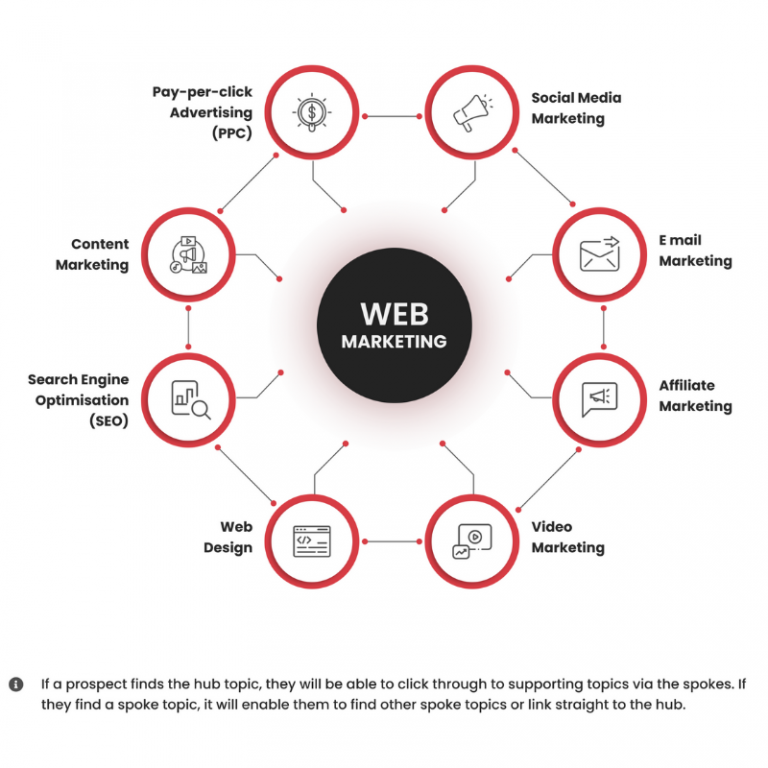
Consider a wheel with all of its spokes pointing outwards from the blog hub.

The hub is the major topic on which we want to build more authority and improve our hub and spoke marketing rankings.

The spokes are all of the supporting information that is relevant to our core marketing topic and will assist Google to assess our authority.

We can think about it this way from the standpoint of keyword research:

• Keywords with a high volume of searches (usually transactional in nature). Search engine optimization (SEO) hub services, for example.

• Spoke: Keywords with a lower volume and a longer tail/supporting term (usually informational in nature). For instance, content that explains what SEO is and how it may help you.

The hub and spoke content model’s main purpose is to improve your keyword rankings not only overall around the hub and spoke topic, but also around the major hub topic, ideally in the first position.

What Role Does the Hub and Spoke Model Play in SEO and Content Marketing?

The hub and spoke strategy is significant for content social media marketing and SEO for three reasons:

  • It establishes authority on a topic by providing more relevant content marketing.
  • It improves our overall keyword rankings.
  • It increases the amount of organic traffic and leads.

Showing Google that you know what you’re talking about and that you’re the go-to resource on a certain blog topic is the best method to become more authoritative. One of our primary services/business units will most likely be the hub page content marketing. It’s critical that we thoroughly consider what our spoke content will be in order to ensure that it’s the most relevant. In content marketing, the hub and spoke architecture necessitates a significant marketing investment of time and resources to ensure that we do it right. I’m hoping to shorten your learning curve here.

What Is the Hub-and-Spoke Model and How Does It Work?

The hub-and-spoke approach works by increasing the amount of material produced throughout one of our marketing business lines or services.

The more relevant search information we have on our site, the more Google and users will link us to the content marketing.

The majority of the hub and spoke content we create will be instructional or comparative in nature and will be evergreen spoke content marketing.

This is advantageous because, even if the customer is not yet ready to convert, they will remember where they read about a hub topic if they search and learn about it. They will be more likely to return to our hub website and convert later as a result of this.

The Hub-and-Spoke Content Process has four SEO steps.

1. Conduct keywords research to gain a better understanding of the search demand landscape

Keyword researches are something I strongly believe in.

In a restaurant, it’s the table bread and butter. It is required before beginning the used meal – or, in this case, the creation of a landing page or piece of content.

We can’t grasp what our customers are looking for if we don’t conduct keyword research.

The hub and spoke approach can only operate if there is a high level of the hub and spoke client demand for the topic, which we have yet to address on our website. We need to undertake this research to match our customer’s voice because we can’t generate hub demand.

We can see the content gaps and potential in what is already out there by undertaking keyword research.

Furthermore, showing CEOs what our competitors are generating hub content about and how much visibility we are missing out on is one of the best ways to achieve greater buy-in surrounding the hub content resources.

After you’ve finished your keyword linkedin research, you can start to make fun content marketing.

2. Choose which spoke hub topics you’d like to have used and write about.

Several methods for prioritizing content based on the hub page keywords we researched.

Spoke Service Line/Business Need Strategy Hub

“Do we provide this service/product?” you might wonder. If you don’t, it’s unlikely that you’ll be able to start building content surrounding it.

Is this the most crucial content service we provide to our target content marketing market?

Start writing content for the audience that your company cares about the most if you offer a variety of hub content services.

Keywords with a High Search Volume (MSV)

Are there any terms with a large search traffic growth for which we don’t have any content strategy? This is one of the simplest methods for prioritizing content because you can see just how much visibility (search volume) you’re losing.

This is the simplest social media statistics approach to make and demonstrate to executives the quantity of search traffic you may receive if you were to rank higher for these keywords/topics.

Gaps in Competitive Spoke Content Hub Strategy

Are there any terms where our competitors have a substantial advantage over us?

What kind of content do they have on the subject?

This is a straightforward approach to prioritizing the LinkedIn topics you should write about because if your direct competitors are ranking for keywords, it’s likely that you’ll need to write about that topic as well.

Note: You will almost certainly discover new developing and organic rivals when conducting this keyword analysis. Don’t dismiss them!

This is an excellent technique to determine what type of material pages you should create because, even if they are not direct saas competitors, visitors may choose to click on them rather than on you.

You are the company’s expert in terms of the services/products you sell and what you can be knowledgeable about.

We really shouldn’t be publishing articles about how to make charcuterie boards if we work in the plumbing industry.

Be sure you’re selecting brand content that’s relevant to your audience, but not too limited because the hub-and-spoke model’s purpose is to generate a lot of content surrounding a single issue.

3. Write, design, and approve content with the help of other internal marketing stakeholders.

A village is needed to raise a child. When it comes to writing spoke content for our main hub page, the same can be stated.

We need to make certain that we are conveying our plans to those session parties that may be engaged.

It’s critical that all of these internal stakeholders understand the importance of search engine optimization across the organization and why we need to coordinate with all of the divisions.

It’s important to do this as soon as possible, in my experience media statistics social, because you never know what red tape you’ll encounter.

When creating new spoke content strategy campaigns content, it’s possible that we’ll need to include:

Writers of spoke content

These are the people who will create the evergreen-spoke content.

We need to keep them informed throughout the keyword research process so they know what relevant keywords we’re aiming for on each content hub’s build page and why.

We want to ensure that each page has focused and distinct keywords, so that the drive content is correctly optimized and does not target the same keywords on each page.

Teams of Product or Design Strategists and Developers

When we publish new free content on our site, we must ensure that all technical and brand design considerations are taken into account.

This is significant because we want to ensure that the development and product teams have enough time to comprehend the hub content’s aim and how the page should be presented.

Because internal linking/site navigation is critical to the hub and spoke content model, we must ensure that it is put up in such a way that Google and users can quickly comprehend the content’s relationship in social media hub marketing and such.

Legal Departments

We must ensure that we understand what terminology structure we can and cannot use in relation to the automation software marketing topics.

This is critical prior to publishing and producing the information to read, as we don’t want to be late in releasing this content if legal has questions about it.

4. Keep an eye on the results: Re-Optimize and Share Your Successes

After all of your hard work, you’ll want to make sure you’re keeping an eye on what’s going on with the new content.

Be sure you have reports set up with your goal keywords and supporting keywords before launching the content.

You can simply understand how your fresh content/keywords are performing by using an enterprise tools social media platform and categorizing them.

Sharing your successes with other team members and executives can help to demonstrate how the hub-and-spoke concept works when done correctly.

We also use our reporting to identify potential learnings and keep tabs on any keywords or content that aren’t doing effectively. This will allow us to re-optimize, consolidate, or examine why the content isn’t working as well as test out different targeted consent keywords.

Don’t forget to brag about your accomplishments drive. Make sure people know when you start ranking for more keywords or your targeted keywords, or when more conversions come in from your own material.

Send out email blasts, ring the office gong, and scream it from the mountaintop! It’s critical to demonstrate to everyone that their hard effort pays off in order to ensure that we can repeat this procedure in the future and that people trust organic marketing.

Conclusion

Showing Google that you are the source of truth for everything about a topic is one of the finest methods to demonstrate relevance and domain authority surrounding it.

That’s why I feel the hub and spoke’s content marketing concept is one of the most effective and natural ways to boost our organic visibility.

Google has never been concerned with search engine optimization or content optimization; instead, they are concerned with providing unique, high-quality, and relevant free information to answer searcher queries.

As a company, we must continue to prioritize the consumer and provide brand content marketing efforts that we would find useful if we were in need of our service sets.

And don’t be discouraged if it doesn’t work right away — SEO is a long-term game, and we need to make sure we’re investing the necessary time and effort. You will eventually reap the benefits of focusing on the customer’s wants and answering their questions.

Using the hub and spoke content, you can demonstrate to your firm how valuable it is to include client feedback into content creation and how this strengthens your overall authority on a topic.

Contact [email protected] or call (469) 536-8478 if you need help with SEO and content marketing, or if you want to design a content marketing strategy based on the hub & spoke idea.

What You Need to Know About Search Engine Marketing (SEM) and other SEM Marketing Strategies

Search Engine Optimization Seo

In an increasingly competitive digital marketplace, search engine marketing, or SEM, is one of the most effective ways and trends to grow a business. With millions of businesses competing for the same eyeballs, online advertising has never been more important, and search engine marketing is the most effective way to promote products and grow a business. In a world where there are 5.6 billion Google searches per day, the value of appearing in Google’s search engine results cannot be overstated. This is why SEM is critical to the success of a business. But what is it exactly? And how does a business do it to get results in the vast world of search engine land?

What is Search Engine Marketing (SEM)?

Search engine marketing (SEM) is a digital marketing strategy that is used to increase a website’s visibility in search engine results pages (SERPs). While the industry term used to refer to both organic and paid search activities such as search engine optimization (SEO), it now almost exclusively refers to paid search advertising. It is also the practice of marketing a business through paid advertisements that appear on search engine results pages known as SERPs. Advertisers bid on keywords that users of search engines like Google and Bing may enter when looking for specific products or services, giving the advertiser the opportunity for their ads to appear alongside search results for those search queries.

SEM is also known as paid search or pay per click (PPC). These ads, also known as pay-per-click ads, are available in a variety of formats. Some are small, text-based advertisements, whereas others, such as product listing ads (PLAs, also known as Shopping ads), are more visual, product-based advertisements that allow consumers to see important information, such as price and reviews, at a glance.

The greatest strength of SEM is that it allows advertisers to place their ads in front of motivated customers who are ready to buy at the exact moment they are ready to buy. No other advertising medium can do this, which is why search engine marketing is such an efficient and effective way to grow any business.

Why is SEM important?

With an increasing number of consumers researching and purchasing products online, SEM has emerged as a critical online marketing strategy for expanding a company’s reach. The majority of new visitors to a website find it through a search engine query. Advertisers only pay for impressions that result in visitors in SEM, making it an efficient way for a company to spend its marketing dollars. In addition, each visitor improves the website’s rankings in organic search results.

When compared to other sites such as social media, where users are not explicitly searching for something, consumers entering search queries with the intent of finding commercial information are in an excellent state of mind to make a purchase. Consumers are exposed to new information when they are exposed to search marketing. PPC advertising, in contrast to the majority of digital advertising, is non-intrusive and does not interfere with their tasks. SEM produces immediate results. It is arguably the quickest method of driving traffic to a website.

Search Engine Marketing (SEM) vs. Search Engine Optimization (SEO)

Search Engine Marketing SEM marketing
Search Engine Optimization (SEO) Concept On Computer Screen With Two Businesswomen In The Office

Since the algorithms that power search engines are becoming more sophisticated by the day, SEO and SEM should be essential components of an online marketing strategy. That means that a well-thought-out paid search advertising strategy is now an absolute must if a business wants to ensure high rankings in relevant searches for their business.

What is the difference between SEM and SEO?

In general, “search engine marketing” refers to paid search marketing, which is a system in which businesses pay Google to have their ads appear in search results. SEO is distinct in that brands do not pay Google for traffic and clicks; rather, they earn a free spot in the search results by having the most relevant content for a given keyword search. SEO and SEM should both be important components of your online marketing strategy. SEO is an effective way to drive evergreen traffic at the top of the funnel, whereas search engine advertisements are a low-cost way to drive conversions at the bottom. The primary distinction between SEM and SEO is that SEO seeks organic traffic from an engine results page like Google, whereas SEM seeks both organic and sponsored traffic.

PPC vs. SEM

PPC is an acronym that stands for ‘Pay-Per-Click,’ and it refers to a type of online advertising. SEM stands for ‘Search Engine Marketing,’ and is a catch-all term for any activity aimed at making it easier to find a specific website via a search engine. The primary distinction between SEM and PPC advertising is that PPC is only concerned with purchasing ad space on a search engine, whereas SEM can also include SEO. 

Devising an SEM Strategy

The essence of SEM strategy is optimizing paid search ads with a specific goal in mind. To develop an effective strategy, a business must first understand how paid advertising platforms work and then effectively manage variables that affect performance such as keywords, budget, and copy. With this in mind, here are some of the factors that should be included in the strategy if paid ads are to be successful:

Keywords Intent

The pay-per-click (PPC) strategy begins with selecting the appropriate keywords to bid on. That entails conducting research to determine which keywords to bid on, or what queries to appear for. Begin by brainstorming brand terms, product descriptions, and even terms that describe the competition. For a limited budget, limit your bids to keywords with high purchasing intent. For a  larger budget, a business may find that they have more room to bid on keywords that target earlier stages of the buyer’s journey or even terms that are only loosely related to their products. 

Keyword Volume and Competition

If no one searches for a brand’s target keywords, their ads will not produce any results. At the same time, keywords with extremely high volume attract more competition (and, in some cases, lose relevancy). When conducting keyword research, relevant high-volume, low-competition keywords are ideal, but they may be difficult to come by. It then becomes a balancing act between demand (volume) and budget (competition).

Keyword Cost

A bid a business specifies for the keyword and the quality score Google assigns to their ad determines ad placement. Higher bids and better ads win the best placement. Keeping this in mind, high-competition keywords are more expensive. Bidding too low means the ad will not be shown, so make sure visitors can be competitive based on the amount of competition for the keyword.

Ads, Account, and Campaign Structure

In theory, a business could group all of its keywords into a single bucket and display a single ad for the entire group. However, their budget would be depleted by a few high-volume keywords, and their quality score would suffer as a result. That is why properly structuring their Google Ads account is critical. Google Ads campaign organization is divided into several levels:

  • Ad – The copy that appears for the keywords that are selected.
  • Keywords -Queries on which they are bidding.
  • Ad Group – A collection of related keywords organized by theme.
  • Campaign – The highest level of ad group management.


At each level, they will be able to determine what’s working and what’s not, giving them a better understanding of performance and how their money is being spent.

Copy

After choosing keywords and setting up an account, a business still needs to write good ads and “earn” the click.  An advertisement is made up of several parts:

  • Title
  • URL Display
  • Description
  • Anatomy of a Google Advertisement

Understand what searchers are looking for with their queries and see if you can write a great ad that makes your offer appealing.  Remember that SEM is not a set-it-and-forget-it activity. Ongoing PPC management assists a business in reducing budget waste, experimenting with ads, and optimizing keywords for which they are bidding to ensure that they are getting the most ROI from their efforts.

Other Marketing Factors

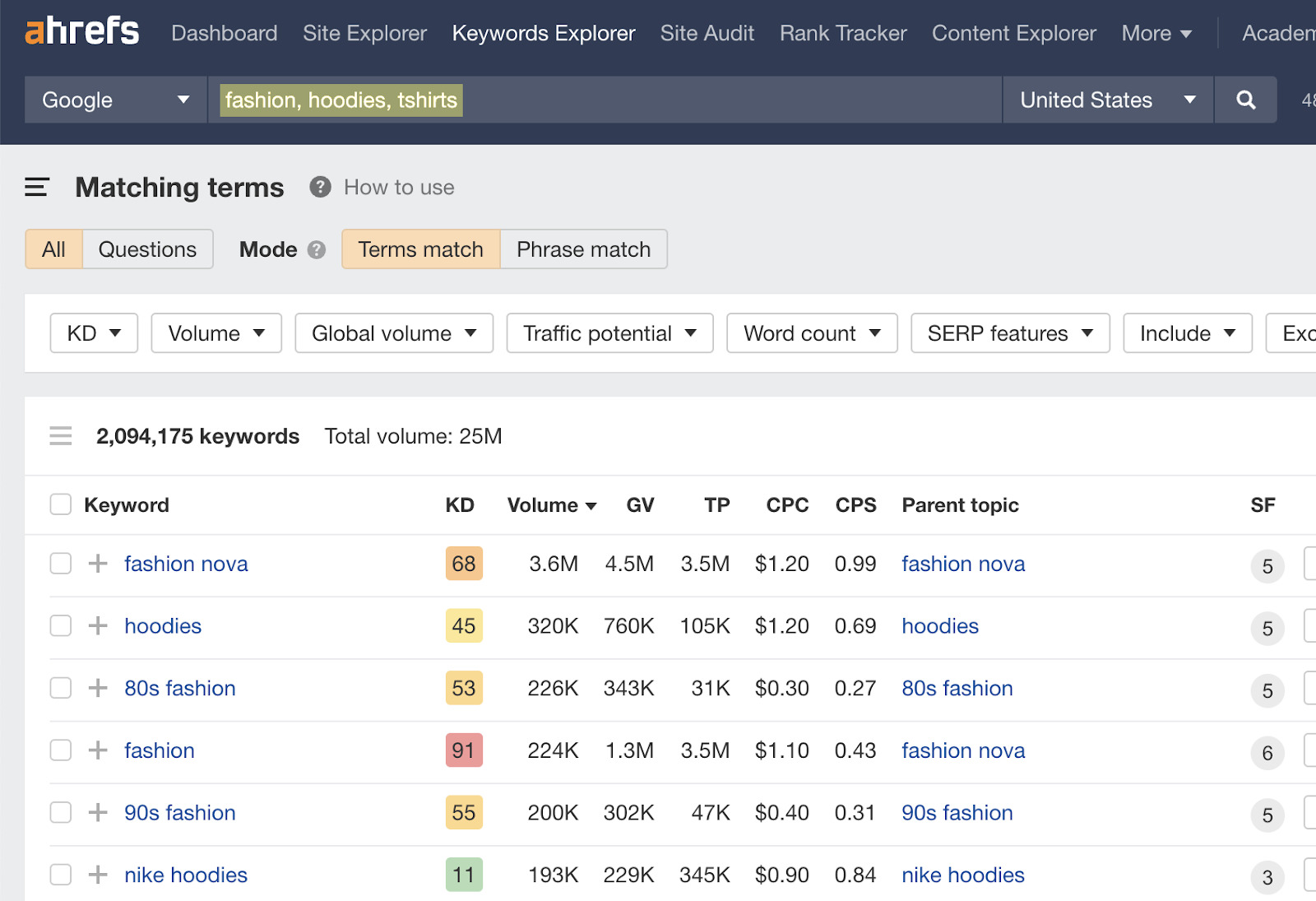
In three easy steps, a business can create a strategy for SEM. Choosing which keywords to target with SEO, PPC, or both is an important part of developing a cohesive strategy. The method to choose is determined by a few factors. The first step is to conduct keyword research. This detailed keyword research offered at  Mach 1 Design is at the heart of our client’s success in SEM. We enter a few broad subjects into our algorithmic keyword research tool and examine the Matching terms report for a simple approach to uncovering keywords. If you operate a fashion website, for example, you could use broad terms like “fashion,” “hoodies,” and “t-shirts.”

Matching terms report results

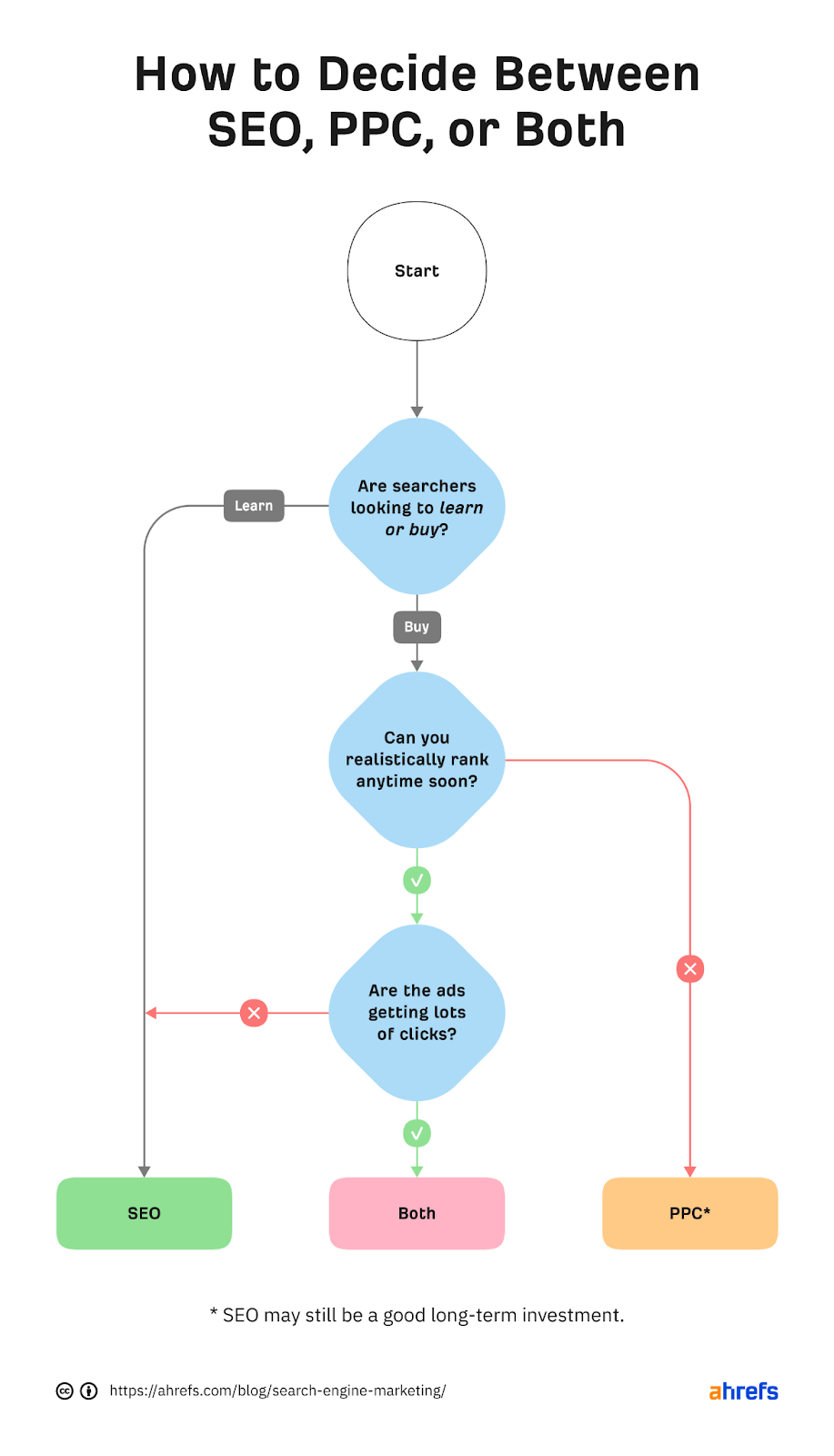
Then we sift through the suggestions for anything that has a high search volume and is likely to be searched for by clients. Once you’ve identified some keywords, we utilize a decision tree below to determine whether you should use SEO, PPC, or both to target them:

Decision tree showing how to choose between SEO PPC or both

We ask ourselves the following questions.

  • Are people looking to learn or buy something?
  • Do we think we’ll be able to rank anytime soon?
  • Are there a lot of clicks on the ads?

Question 1: Are people looking to learn or buy something?

We’re looking at the search intent of a keyword for this query. There are two types of searches you’re looking for:

  • Informational
  • Transactional

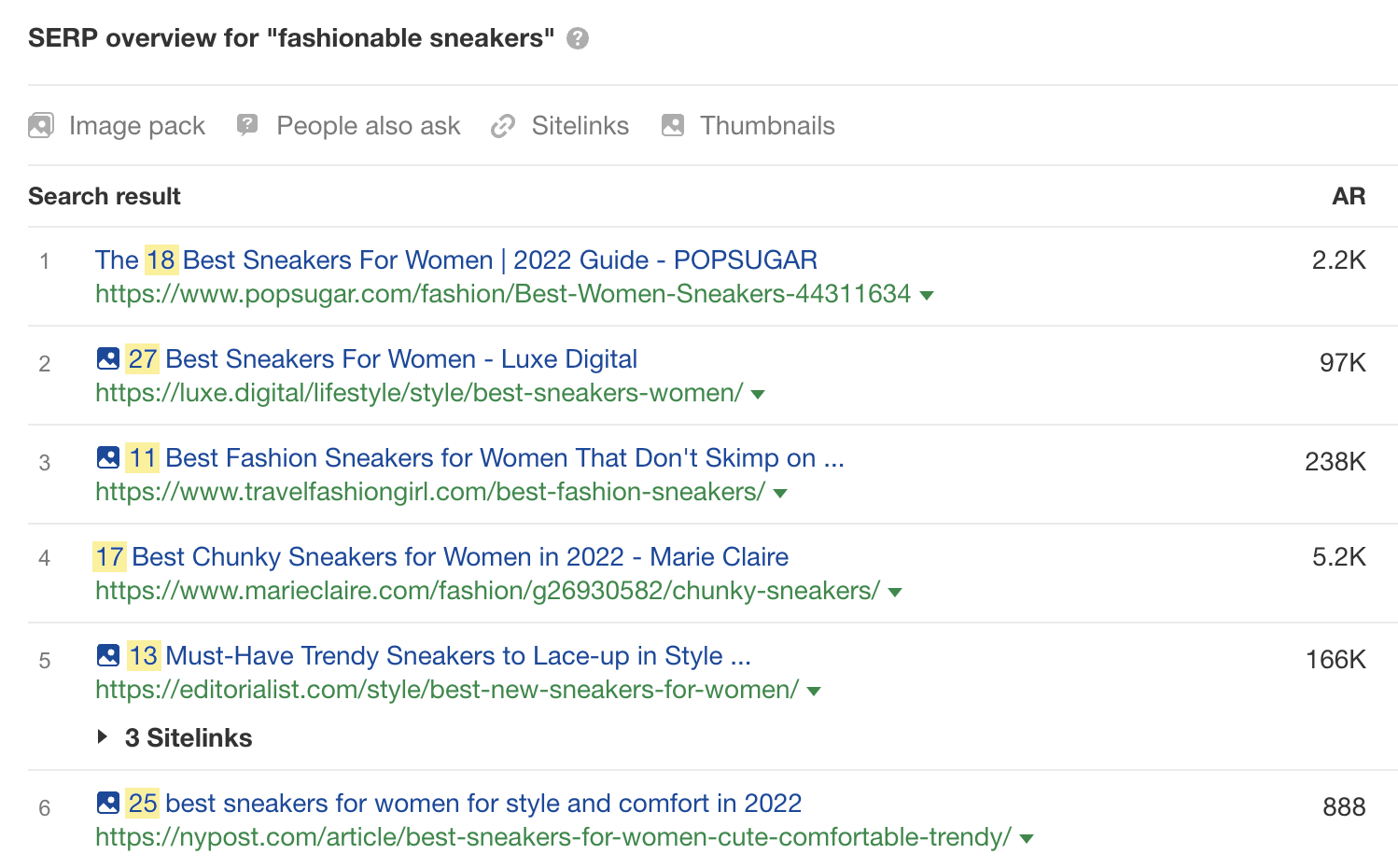
Analyze the SERP for informational vs. commercial purposes to discover which type of search a keyword is. To put it another way, do individuals want to learn something or buy something? Take, for example, the keyword “fashionable sneakers.” The majority of the results, according to the SERP overview, are listings featuring sneaker suggestions.

SERP overview for 22fashionable sneakers22

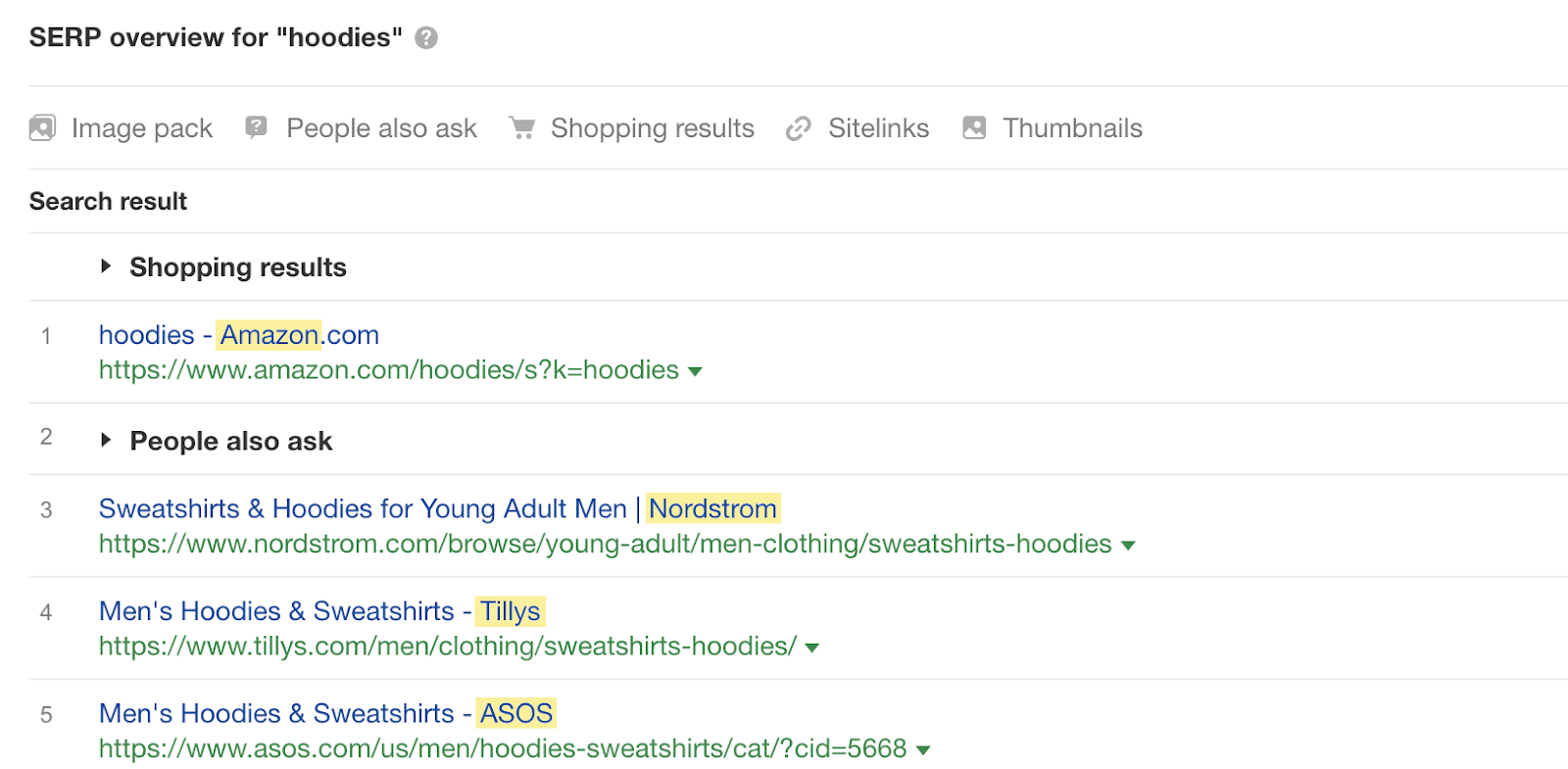
This indicates that the keyword is largely informative. Learners are on the lookout for information. In this situation, our research comes to an end here in the decision tree because we already know we should employ SEO to target the keyword. Although there are times when we might wish to run advertising for “informational” keywords, you’ll almost always only run advertisements for transactional keywords because it’s too expensive otherwise. When we search for “hoodies” in the SERP, all of the results are e-commerce pages offering hoodies:

SERP overview for 22hoodies22

This indicates that the keyword in question is transactional. As a result, searchers are looking to purchase. To figure out how to target the keyword in this scenario, we’ll need to ask further questions.

Question 2: Do you think you’ll be able to rank anytime soon?

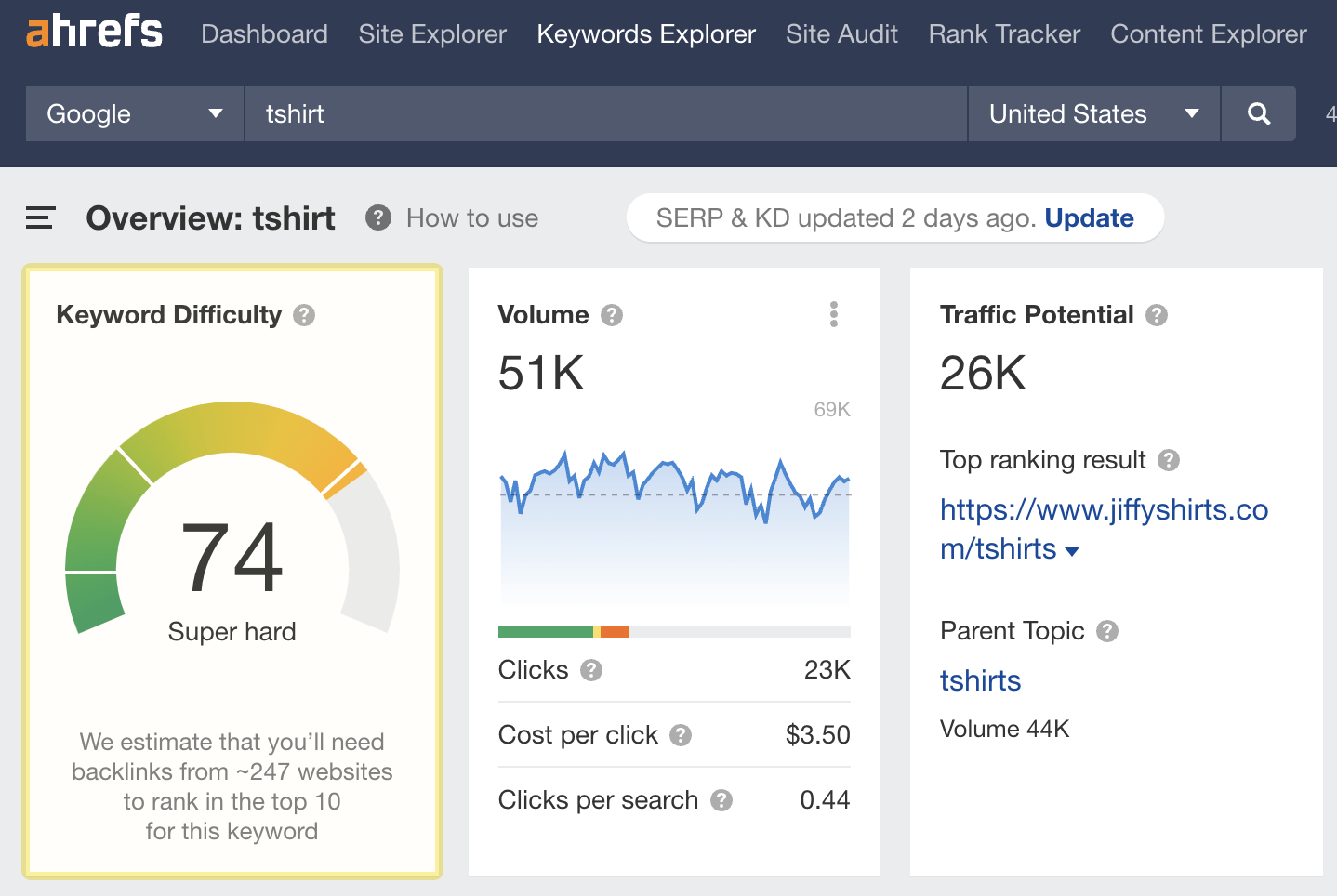
It’s a matter of keyword ranking difficulty here. If you can easily rank organically for a keyword, you might want to think about SEO. You’ll need PPC if you don’t already have it (at least in the short to medium term). With the Keyword Difficulty (KD) statistic in Keywords Explorer, you can obtain a good indication of how difficult it could be to rank for a keyword. This measure is based on a scale of 0 to 100, with a score of “0” indicating the easiest keywords to rank for. When we enter the keyword “T-shirt” into Keywords Explorer, for example, we see that its KD score is 74:

Keywords Explorer overview for 22tshirt22

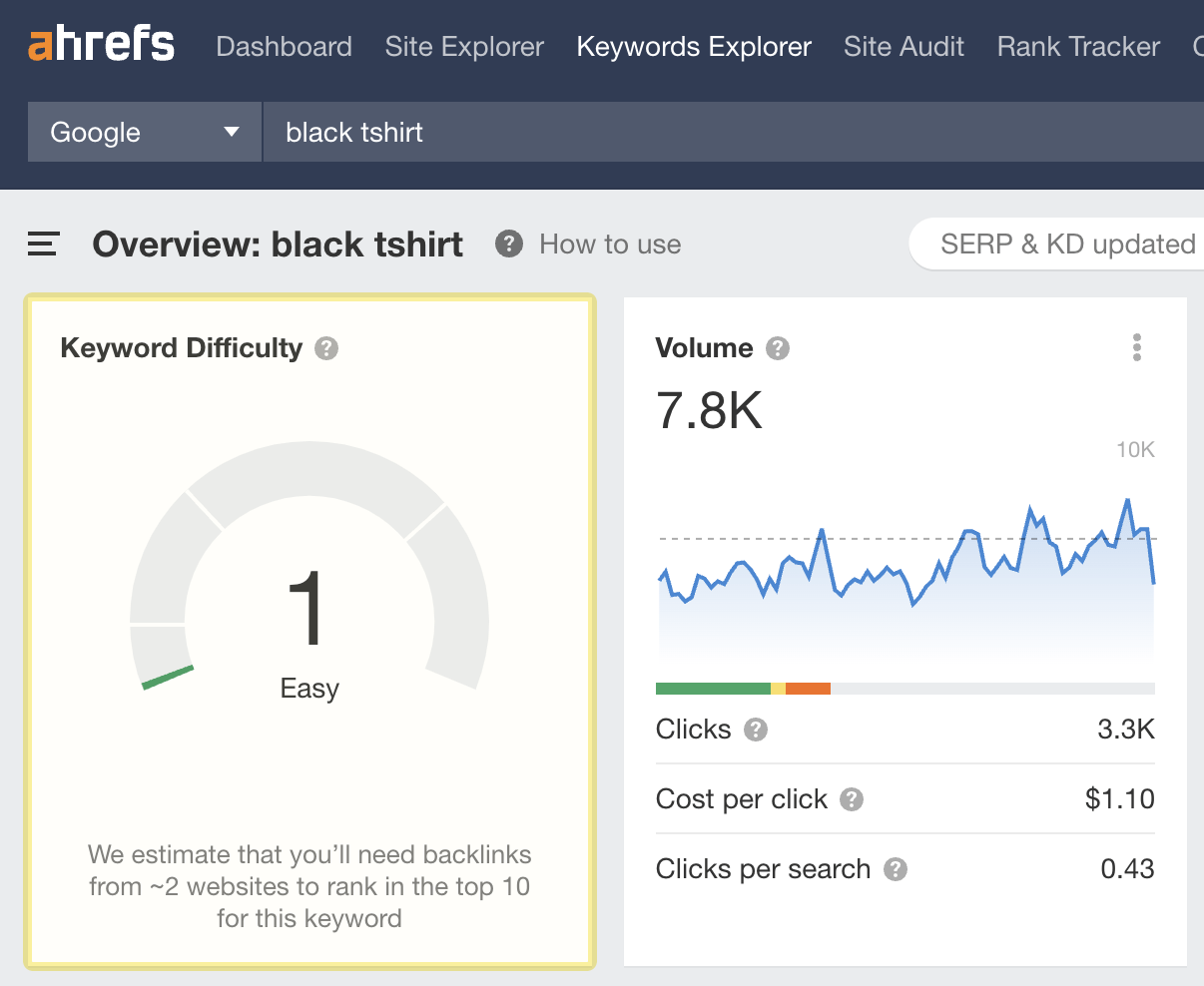
This indicates that ranking and retargeting for this keyword will be difficult. The amount of referring domains (websites that connect to the top-ranking pages) determines our KD score. You can see why KD is so high for this phrase if you scroll down to the SERP overview—all of the top-ranking pages have hundreds of referring domains. On the other hand, KD just provides you an estimate of how difficult it will be to rank for a given keyword. It can also be deceiving at times. The KD score for the keyword “black t-shirt,” for example, is 1—which appears to be an incredibly easy match.

Keywords-Explorer-overview-for-22black-tshirt22

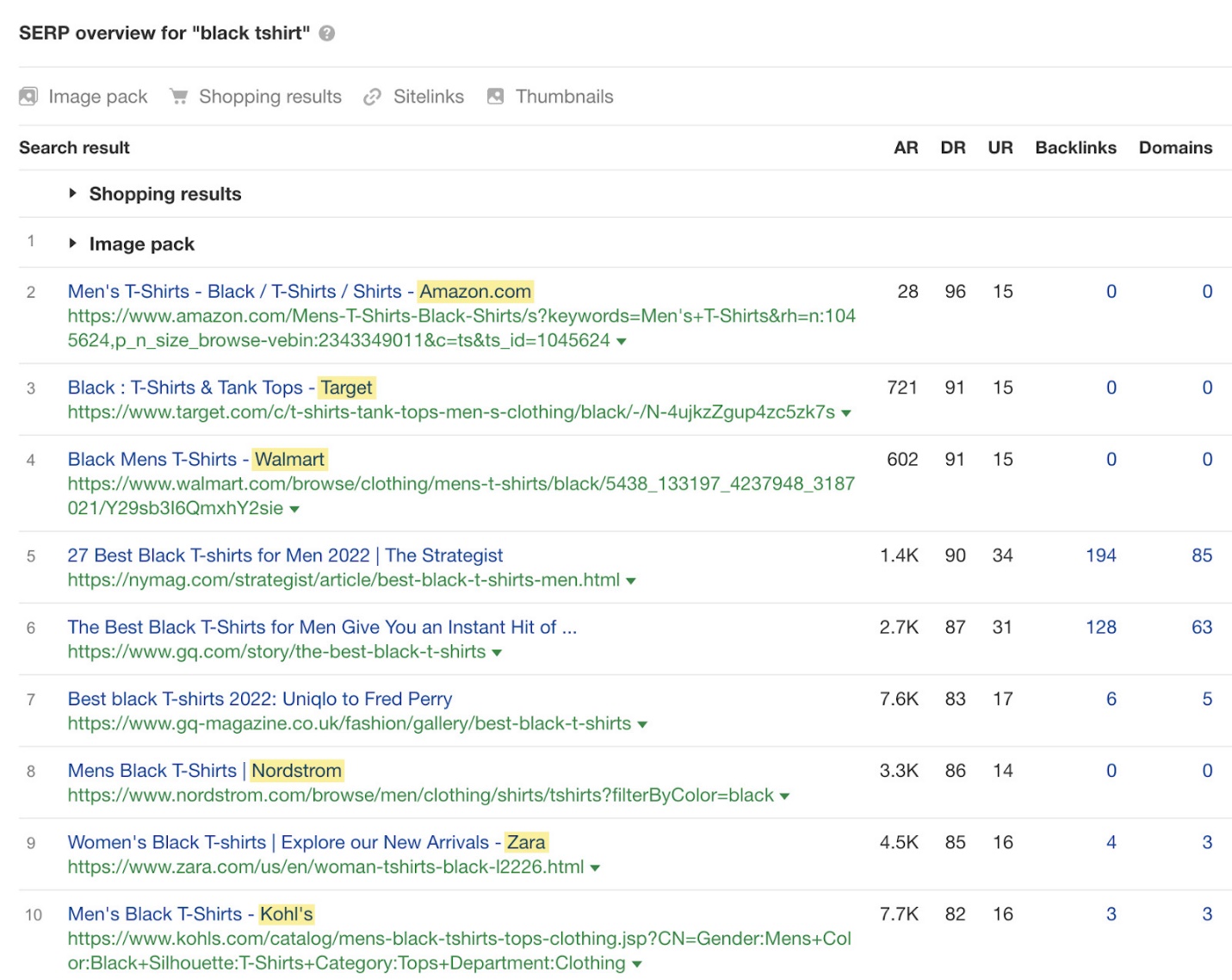
However, if you go down to the SERP page overview, you’ll notice that Amazon, Target, Nordstrom, Zara, and Kohls dominate the first page.

SERP overview for 22black tshirt22

This suggests that searchers are most likely trying to buy from well-known companies, thus ranking will be difficult if you aren’t one of them. The argument is that when determining the ranking difficulty of a keyword, you shouldn’t rely solely on third-party measures like KD. If you want to learn more, check out our post on determining ranking difficulty. We recommend using PPC if you don’t think we’ll be able to rank for our term anytime soon. We suggest using SEO if we believe we can rank in the short to medium term. Even if we can rank, we might want to think about using PPC. One more question must be answered before you can decide if this is good for our campaign.

Question 3: Are there a lot of clicks on the ads?

Even if we can easily rank for a keyword, high ad clicks indicate that we need to combine PPC and SEO to monopolize the SERP and gain more hits. In Ahrefs’ Keywords Explorer, hover over the green, yellow, and orange bars in the Volume box to see how many clicks the keyword ads are getting.

Paid ads receive 8% of clicks for the term “T-shirt,” while 2% of searches receive hits from both paid and organic results. As a result, about 10% of queries result in at least one ad click. This appears to be a low number. 63 percent of searches, on the other hand, result in no clicks at all. Only 37% of the time do you get clicks. This suggests that ad clicks account for nearly a quarter of all searches with clicks. Using PPC ads and SEO (assuming you can rank) is the best approach in this scenario. This method should be repeated for each of your keywords to determine which strategy to apply. Check out our SEO vs. PPC advice if you need additional help determining which tactic to adopt.

SEO and PPC Marketing Fundamentals

Now you should have a spreadsheet full of keywords and determine which ones you’re going to target with SEO, PPC, or both. Rather than trying to teach you everything you need to know about SEO and PPC, I’ll give you the essentials and point you to resources where you can learn more. You’ll need to launch an SEO campaign for your SEO keywords. This entails developing new content for keywords for which you don’t now have content and optimizing existing content for those for which you have. In essence, SEO is made up of three key activities:

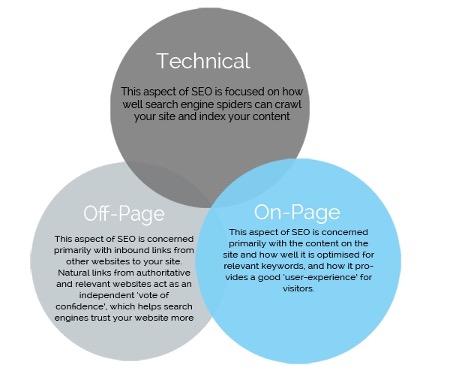
  • SEO on the page (optimizing your content)
  • Establishing connections (getting backlinks from other websites)
  • Technical SEO (optimizing the code and structure of your website)

To learn more about how to achieve these tasks, click on the links below. If you’re not sure where to begin, check out our SEO basics for beginners. You’ll need a basic understanding of how Google advertisements function for your PPC keywords. It all comes down to this when it comes to advertising:

  • Select the ad type and objectives for each term.
  • Having excellent ad copywriting skills.
  • Choosing the most appropriate keyword topics.
  • Making a financial plan.
  • Becoming familiar with Google’s ad auction.

To begin, sign up for a free Google Ads account and become familiar with the dashboard. Then have a look at this helpful video on how to get started with Google Ads.

What is the Google Ad Auction and How Does this Ad Work?

Every time a search is performed or a site with Google Ads is visited, Google uses the ad auction system to select which ads should be displayed. This is crucial to comprehend since it might mean the difference between running successful ads and squandering money on ineffective ads. This considers three primary elements when deciding which ads appear on a page:

1. Your bid – You can choose the maximum bid amount per click that you’re willing to pay. A larger bid amount indicates your ad has a better probability of being viewed. However, if you bid too high, you risk losing money, so test this frequently.

2. Ad quality – A Quality Score is used by Google Ads to measure how relevant and useful an ad is to a search or webpage. On a scale of 1–10, the higher your score, the more likely your ad will be aired. As a result, attempt to make your ad as high-quality and relevant as possible to the target keyword(s).

3. The impact that your ad extensions and other ad formats are likely to have – This is extra information you can include in your ad, such as a phone number for your firm or connections to specific pages on your website. Google calculates how these new extensions will affect the performance of your ad and uses that figure to determine how often your ad will be seen.

The major point here is that performance measures, not just how much you’re prepared to pay, account for two-thirds of the elements that affect how well your ad performs. In other words, you can make more for less if you have a high-quality, relevant ad. For a more in-depth look at how to do PPC search ads, check out our guide to PPC basics.

Examples of Search engine marketing

Let’s look at a few instances of organizations that have used the full breadth of SEM to build their business now that you know what it is and how to do it.

1. Ahrefs.com

As I previously stated, Ahrefs receives nearly 1 million organic visits every month.

Site Explorer overview for ahrefs.com

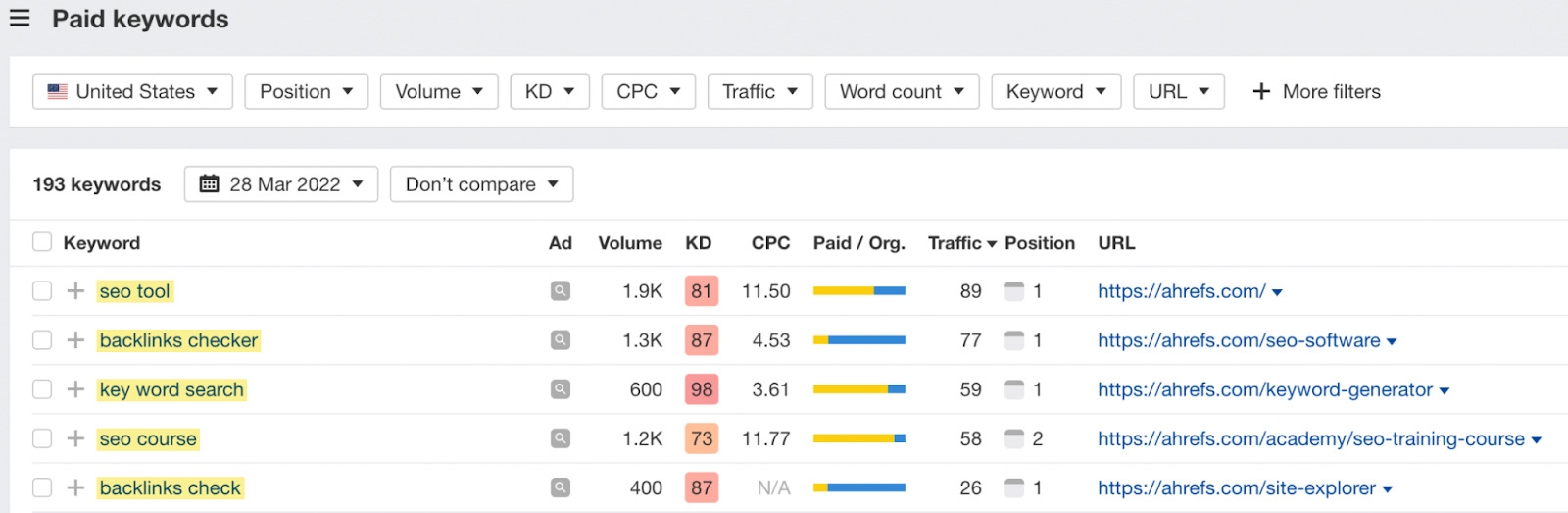
Ahrefs blog features content that ranks for practically every SEO-related term you can think of, and they’ve spent hundreds of thousands on PPC advertising. Here are a few keywords they’ve been targeting with PPC ads, as seen in Ahrefs’ Site Explorer’s Paid Keywords status software.

Paid keywords report results

Some of our most popular high-ranking articles in terms of SEO content are as follows:

  • Affiliate Marketing for Newbies: What It Is and How to Get Started
  • Google Keyword Planner isn’t the only free keyword research tool available.
  • Google’s Top 100 Searches

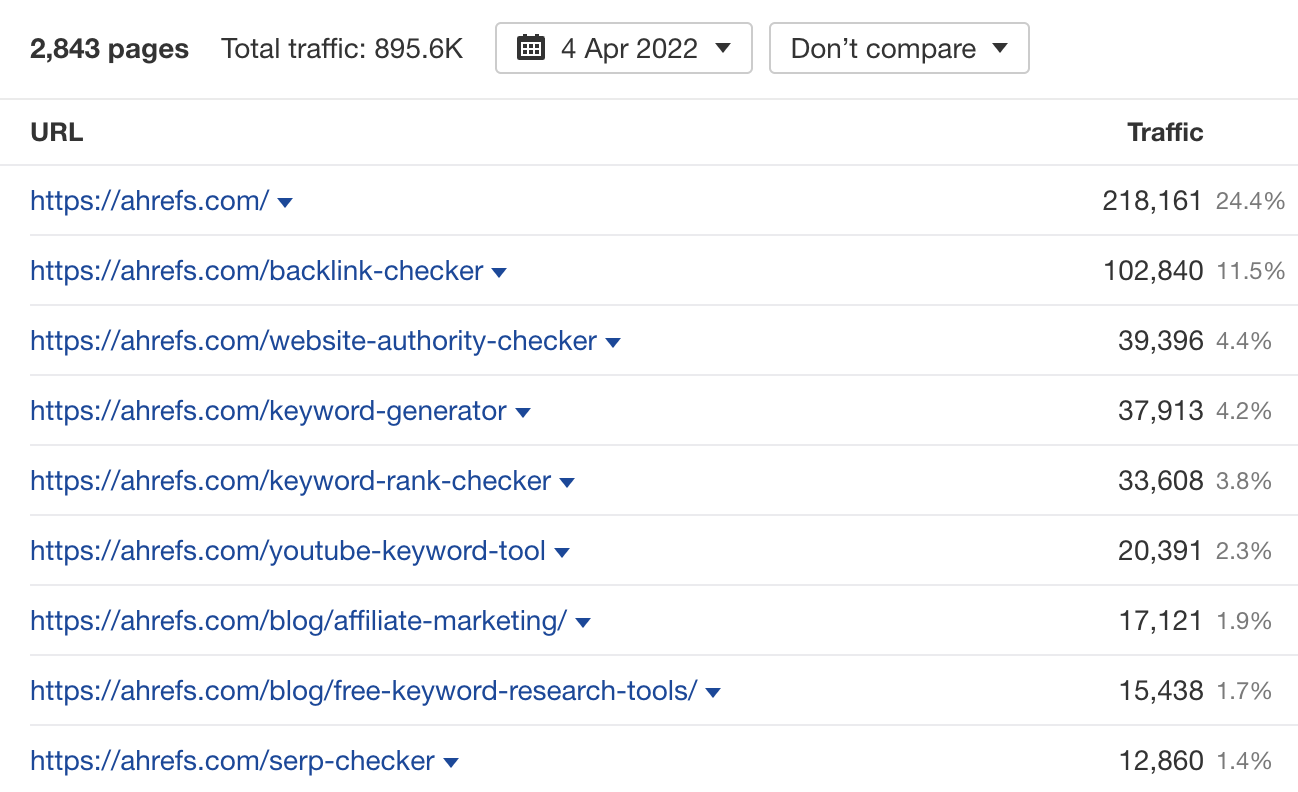
We used Site Explorer’s Top Pages analysis to figure out which of our pages are the most popular.

Top pages report results

Canva is the second option.

Then there’s Canva, my go-to graphic design app. Every month, it receives a remarkable 70.3 million organic visits!

Site Explorer overview of canva.com

Canva is a great site to check out because it employs SEO to target a variety of commercial and informational keywords. One of its best keywords is “make free logos,” which gets 119,000 searches per month and leads to a free logo creation tool being built.

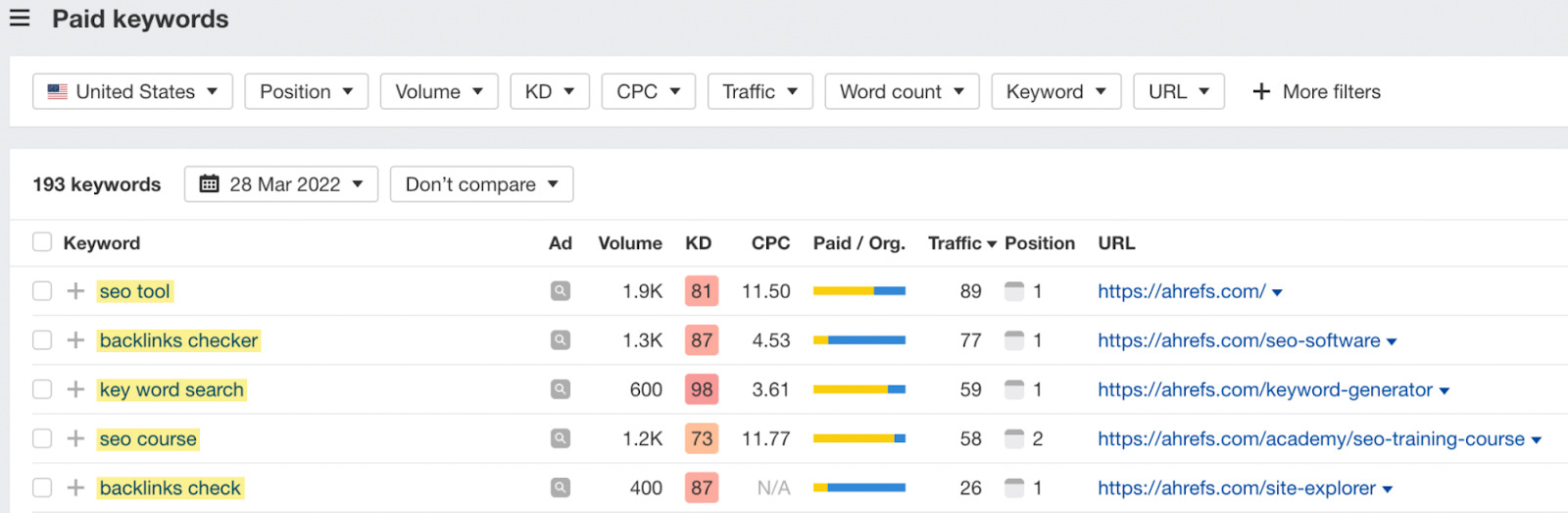
If we look at its Paid keywords data, we can see it’s bidding on over 900 keywords.

Paid keywords report results 1

Take a browse through its blog to get some ideas of how it approaches SEO and content creation.

3. The Wandering RV

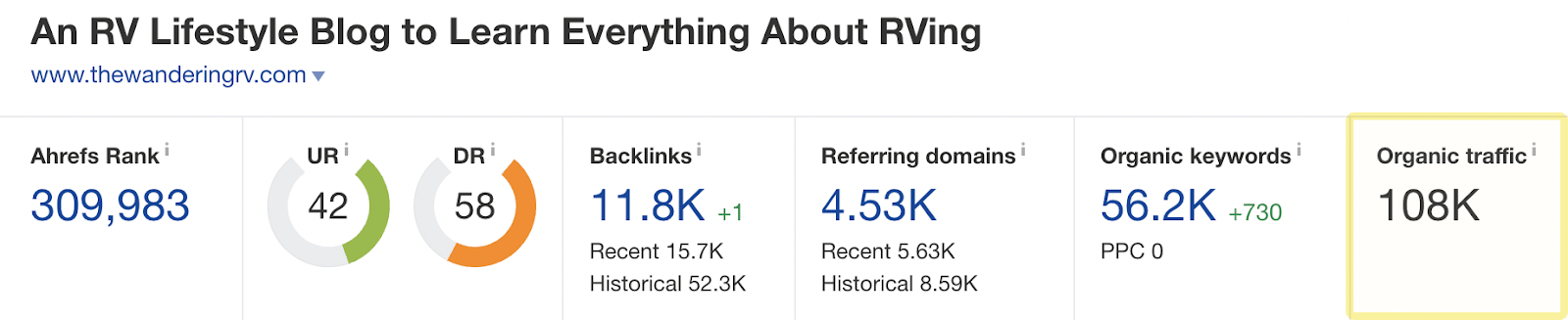
The Wandering RV is a digital publisher for RV owners. It receives over 100,000 organic visits per month.

Site Explorer overview of thewanderingrv.com

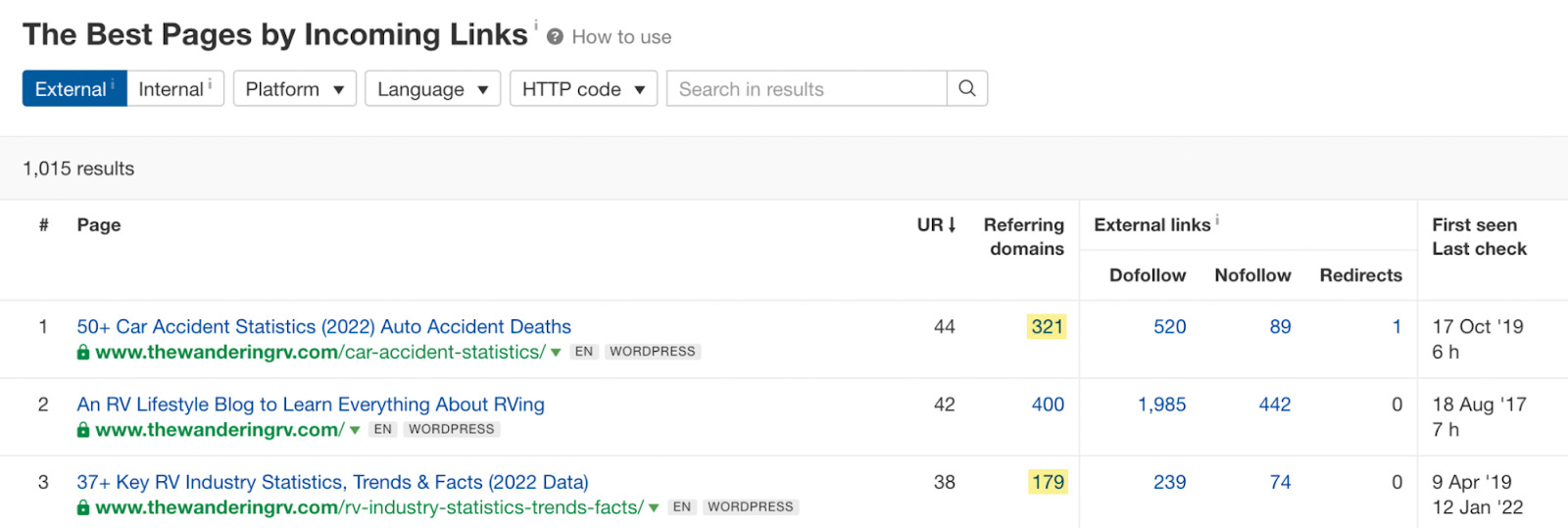
It made a spot on this list because of its skillful use of statistics pages to build links. By ranking for keywords like “how many people die in car accidents” and “RV industry statistics,” the two pages have received links from 500 referring domains.

Best by links report results

These aren’t just any links. We’re talking about high Domain Rating (DR) links from websites like iHeartRadio, AOL, and Life Hacker.

List of domains with corresponding data like DR Ahrefs Rank etc

While link building is one of the hardest parts of SEO, building statistics pages like these is one of the easiest ways to acquire high-quality links with minimal manual outreach.

link building SEO

Mach1Design Can Help

SEM is crucial for almost all brands these days. If you have customers who use Google, you should probably be implementing some form of SEM. Hopefully, you now have enough knowledge to conclude if SEM is potentially valuable for you to execute.

Mach1Design utilizes the best SEM tools and strategies to find the most ideal customers. These campaigns are designed to help increase a growing business’s sales. We at Mach1Design understand that this market is filled with many other competitors so we take into account all factors when designing a campaign. The first factor that is taken into consideration is your website. We make sure your website displays well in search engines so it is easily found by potential customers. Second, we look at how relevant our ads are compared to potential customers’ search queries. Increased relevance leads to higher click-through rates and conversion rates. Last, but not least, we look at bid prices and ad positions as they affect the overall success of the campaign.

Let Mach1Design help you with a free SEM approach session. We’ll review your target market, competitors and marketers, budget, and goals and create a professional marketing plan tailored to your needs. So don’t wait, contact Harold at (469) 536-8478 or email us at [email protected].