
6 Steps to Creating a Successful Social Media Marketing Strategy

Creating a Successful Social Media Marketing Strategy

Developing a marketing plan, especially in today’s world, is a difficult endeavour. You can feel apprehensive and stressed out at first since you don’t know where to begin. Let’s have a look at how to make an effective social media marketing plan step by step:

Step 1: Carefully choose the best social media platforms to reach your ideal audiences
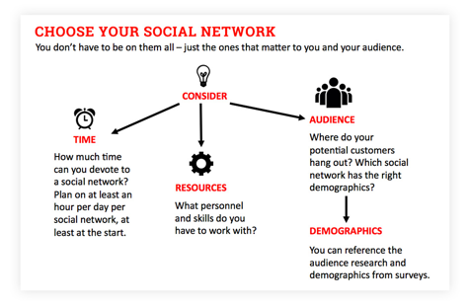
image 251

First and foremost, you should utilize the social media platforms that are most appropriate for your approach. It’s not necessary to be on all of them. It depends on what you want to accomplish for your company through social media.

The following are some sections that will assist you in selecting the appropriate social networks:

• Time – How much time do you require and intend to dedicate to each social media platform?

• Resources – Do you have the necessary talents and resources to get the job done? Instagram and Pinterest, for example, need high-resolution photographs.

 • Audience – Which plan for social media strategy platforms do your customers prefer to use for your business?

Step 2: Fill out your social profiles completely

Check all of your social media profiles regularly to ensure that your profile picture, bio, cover photo, and content are all current. This demonstrates professionalism, and strong branding, and demonstrates to your clientele that you are serious about engaging them.

Make sure that all of your profiles are linked together in some way. However, do not reuse content across all of your social media strategy marketing profiles. Additionally, Canva is a powerful free web tool that any company may utilize to produce the proper graphics.

You should concentrate on the bio/information portion in terms of text. Let us demonstrate six rules for writing a professional social media bio:

1. Focus on “what I’ve done” rather than “who I am.”

 2. Select keywords that are appropriate for your target audience.

3. Keep language fresh by avoiding common grammatical errors.

 4. Respond to your new client’s question, “What’s in it for me?”

 5. Make it personal

 6. Return to the site frequently.

Some examples of networks you can course through are: 
  • Facebook business page
  • Instagram business account
  • TikTok account
  • Twitter business account
  • Snapchat account
  • LinkedIn Company Page
  • Pinterest business account
  • YouTube channel

Step 3: Establish your tone and voice

It’s crucial to find your own voice and tone on social media. You can make things a little simpler for yourself. Begin by posing questions like these:

 • What kind of personality would your brand have if it were a person?

 • What is your brand’s relationship to the consumer if it were a person? (a coach, a buddy, a teacher, a father, and so on.)

 • Describe what your company’s personality isn’t in adjectives.

 • Are there any businesses that have a personality comparable to yours? What’s the connection between them?

 • How do you want your customers to perceive your business?

The mission statement is the voice, and the tone is how that mission is carried out.

Step 4: Decide on a plan for posting
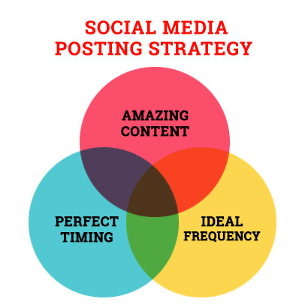
image 252

How many posts do you make per day?

How often do you do it?

 What time should you post?

What should you put up?

The answer to these questions is debatable. Always keep in mind that what works for one may not necessarily work for you. Having said that, there is some useful information and advice on where to begin.

To begin with, picture posts receive more views, clicks, and reshares than other types of postings. Pictures on Facebook receive 53 percent more likes, 104 percent more comments, and 84 percent more link click-throughs than any other type of social media strategy post. Photos have also been discovered to have a stronger impact on retweets on Twitter.

Step 4. Strategy
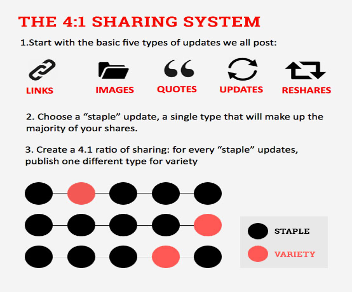
image 253

Now that you know what works, you may combine the various types into an effective approach. 

How frequently should you post?

There’s been a lot of debate regarding how frequently you should post. Of course, you’ll need to develop a strategy based on what you wish to provide your clientele. Post more if your clients love and respond to what you’re doing.
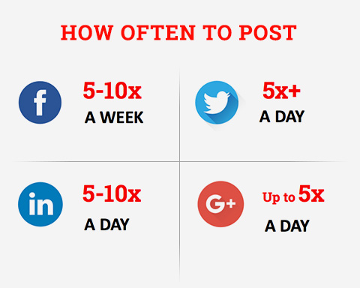
image 254

We’ve put together a handy guide on how often you should post to social media, as you can see below.

When are you supposed to post?

There are numerous tools available to show you exactly when you should publish on Facebook, Twitter, LinkedIn, and other social media platforms. These tools assist you in gaining a better understanding of your target audience as well as your previous posts.

What if you’ve only recently started using social media and have no prior audience or history?

The tool SumAll is the most useful infographic you’ll encounter regarding timing. Here’s a rundown of what they’ve discovered in terms of timing.
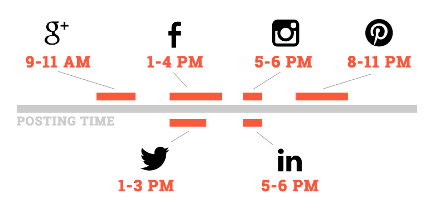
image 255

Step 5: Analyze, test, and put into practice
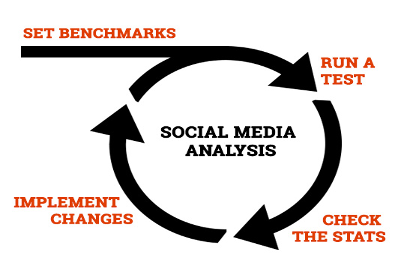
image 256

It’s a reality that the more you post, the more opportunities you’ll have to figure out what kind of social media strategy marketing material, when to post, and how often to post.

In this scenario, the crucial question is: how will you know?

You can use a variety of tools available on the internet. Buffer statistics, for example, can show you how many views, clicks, shares, likes, and comments each article has received.

Step 6: Automate, interact, and listen to your customers.

Last but not least, having a system in place to assist you to remain on top of updates and engage with your customers is the final stage. Day after day, automation is the key to excellent sharing. You can utilize tools like Buffer in this instance.

A plan for social media also necessitates interaction with potential customers. Try to keep up with client conversations on social media. Ignore them at your peril, as they may have a detrimental influence on your business. To stay on top of everything, you can utilize programs like Mention, which will email you an alert whenever you’re referenced online.

Search Engine Optimization for Product Description Pages

Search Engine Optimization for Product Description Pages

Many product description optimizations may be automated and maximized with the help of a Product Information Management system. Growing regional/national to major brands have a lot of questions about product description page (PDP) optimization.

How much can be automated?

Does it matter if some of them have duplication? What do we do with variable products that exist on a single URL? Can I use manufacturer-provided product descriptions?

The problems with SEO product descriptions are then exacerbated with larger product catalogues and more complex technology stacks. However, with enterprise eCommerce stacks, you can also find opportunities to automate and make quick work of many product description issues.

This is where the PIM (Product Information Management system) can be both an SEO and user experience dream. In addition to product descriptions, the PIM can help stakeholders influence the user experience and bridge the gap between a user searching for and researching products to complete their purchases.

For many, the PIM is just another part of the tech stack. But it can improve user experiences and enrich the PDP (Product Details Page) with information important from a product descriptions SEO perspective, as well. For this article, I’ll be leaning on a combination of both, as businesses in the eCommerce industry such as Bain & Company have claimed that companies who improve customer experience with tools can increase revenue by up to 25%.

Given that Google is working harder to improve user experiences on the web via Core Web Vitals, Speed, Mobile Friendliness, EAT, and more, using the PIM to improve user experience can be more than just adding keywords to the page.

Often, the PIM is also responsible for product imagery, as well. Sometimes this can be the Digital Asset Management system’s job, but for this article, I’m assuming the PIM handles them.

In this column, you’ll learn about:

1) Automating Product Title Tags & Meta Descriptions

2) Automating Product PDP Descriptions

3) Defining Taxonomies & Relationships

4) Key Takeaways

Automating Product Title Tags & Meta Descriptions

Typically, the PIM will contain several fields relating to the product, including but not limited to:

•   Product name.

•   Product technical specifications (colors, size, material).

•   Product description.

•   Product identifiers (SKU, ISBN).

This information can be used to improve title tags and meta descriptions.

While Google is actively overwriting both elements, they are still processed and cached by Google.

Although only the title tag is factored into “ranking,” the meta description is still important from a CTR perspective. Utilizing the PIM SEO for product pages can also help alleviate duplication issues with title tags and provide better document information architecture for Google.

You can do this by having the front-end platform (the storefront) dynamically use the same information from the PIM as it does to populate the product description page template. This information can also help Google serve content for hyper-specific queries, and return URLs from your site that are otherwise not in the immediate serving index.

Including more information in the title tag and meta description also helps steer Google to more accurate rewrites of your title tag and meta description.

This helps you avoid accidentally giving the user misleading information and a negative search experience.

Automating Product PDP Descriptions

Many product pages consist of generic product descriptions the manufacturer has likely provided. Duplicated product descriptions aren’t usually an issue because the content of a PDP is more than just written words. It’s the page’s value proposition in its entirety.

The objective is to make the duplicated description a supporting element of the page and not the focal point. Google’s John Mueller has confirmed that this doesn’t cause a penalty scenario, and is only an issue when they don’t want to show multiple results by just listing the same content.

The way around this is to use the PIM to add value. For most queries relating to “generic” products, Google augments the search results to include a mixture of local and online results. This means that Google has to decide to rank either local or “best” sources with duplicate value propositions.

Most PIMs contain stock data, and most businesses who operate online and offline will have integrations that allow you to include the following information and elements on PDPs:

·   Availability in local stores (which you can further personalize if you are logged in to show availability in stores close to their defined location preferences).

·   Delivery lead times for home delivery.

·   Lead times for in-store pickup.

This gives the page another beneficial purpose and a reason for Google to choose to rank your PDP over others.

Defining Taxonomies & Relationships

 In most PIMs, you can define taxonomies and relationships with other products within the database. This information can then be used, along with personalization elements, to create additional content blocks (and additional value propositions) on the PDP page, giving it additional user value.

You can also use these elements to encourage both cross-sells and up-sells, improve user average order value (AOV), and help select the correct complementary products.

For example, buying a lamp from the page presenting the correct bulb as a related product saves the user time and effort in determining (and searching for) the correct bulbs.

Taxonomies and tags can also be integrated with most internal site searches, so making sure key products and variations are tagged correctly and have accurate taxonomies can help users with product discovery on your website.

Writing Product Descriptions For SEO

Turning persuasive words into sales. These words can help draw readers into action. The most persuasive words include: remarkable, now, announcing, introducing, amazing, sensational, easy, miracle, magic, quick, and hurry.

You may also go with storytelling, which is an effective way to engage readers and lead them to purchase your product. When we think about readers sitting there on the other side of the screen, they cannot hold or feel the tangible product at this point, they’re relying on images and product descriptions.

Keep in mind that product descriptions are normally made to be easy and quick to read. With that said, in order to write SEO even the bullet points at the bottom of the description should all be written clearly with all the essential information about the product. This becomes an effective way to create scannability.

It is also important to avoid creating any complete duplicate descriptions to the best that you can. It is really important due to the fact that search engines see these duplicated descriptions as some sort of duplicate content issue. With that said, the Googlebot will likely be confused as to which one is the original page to serve.

Key Takeaways

 The PIM is an underutilized asset in the eCommerce SEO arsenal and can be overlooked or seen as “not part” of the marketing toolkit. Including PIM stakeholders in marketing meetings with those responsible for extracting PIM information into the eCommerce storefront can help you find opportunities to enhance your product description page’s SEO value further.

It can provide additional opportunities to improve user experience, conversion rates, and AOV, as well. The more specific and descriptive your product pages, the better Google and other search engines can determine their relevance to queries by highly motivated searchers on the hunt for products like yours. 

Use the tips above to maximize the value of your organization’s PIM by putting it to work for your SEO goals, as well. And if you’re just getting started in eCommerce SEO or looking for a best practices checklist to make sure you’re making the most of all opportunities, you’ll want to contact [email protected] or call (469) 536-8478 for a complimentary consultation.