Social media is the primary way that your audience is going to interact with your brand online. It enables your community to understand your cause and your mission while providing you with a platform to share your success and ask for help. You are trying to change the lives of real people – it is important that your audience knows that! Without social media, your digital presence is not complete. Google also gives credibility ranking in SERP to active social media presence.
Key to Success: After running hundreds of social media accounts, I can say with confidence that the single greatest indicator of your social media success is your posting frequency.
Features:
Content: When you sign up with Mach 1 Design, you receive a free content library that is custom-made for your business to post to your business Facebook, Instagram, Twitter and LinkedIn accounts. This includes your logo, colors, messaging, and more! (Comes with content satisfaction guarantee – if you are not in love with your content, we will change it until you are satisfied)
Automation: Once you have your content library, you can automate your posting to ensure that you can run great social media without the hard work. We recommend that you post at least once per day.
Optimization: After you post, our software tracks your social media to understand which type of content does the best and adjusts its strategy based on its analysis. We repost only your best posts so that your organic reach can grow.
Pricing:
Yearly ($500/month): Get all of your content for the year paid upfront for $6,000.00
Monthly ($600/month): Get your content on a month by month basis and pay by the month.
Our Social Media plan includes the content (300 annual posts), the automation/optimization software, and 24/7 customer support. Let us take the headaches out of your organic social media content production and posting.
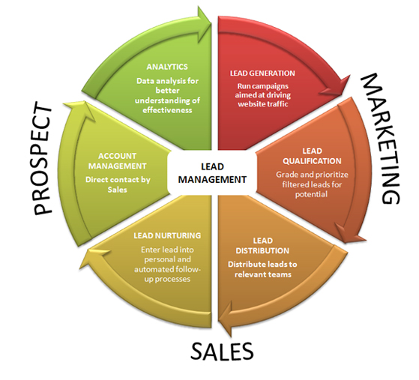
The customer lifecycle has five stages: reach, acquisition, conversion, retention, and loyalty. While it’s similar to the buyer’s journey, the customer lifecycle takes into account what happens long after a prospect makes a purchase.
we will walk you through the 5 lead nurturing strategies to Turn lead into customers
Unaware
1. Reach/Awareness- Generate leads (ToFu)
In this stage, a customer searches for a product after becoming aware of an issue or problem they need to solve. This stage is called “reach” because it’s your chance to reach the customer while they’re deliberating.
In this stage, your customer is comparing products across competing brands (including yours), carrying out research, and reading customer reviews. Social media marketing, SEO, search engine marketing, blog, PPC, Ads, Email marketing, infographics, videos, content targeted at primary research, and other inbound and outbound methods should place your brand on this customer’s radar.
This stage is successful when the customer reaches out to you for more information, looking to either educate themselves further or get a definitive price on your solutions.
When the customer gets to your website or calls you on the phone, they’ve officially entered the acquisition stage.
This stage will look different depending on the acquisition channel the customer has used. If they called over the phone, for example, you’ll need to respond to the customer’s questions and concerns, as well as to inquire for more information on the customer’s needs. Following that, you’ll offer the best products or services to satisfy their needs, as well as educate them on the uses of those products or services. Rich educational resources, webinars, surveys, downloads, promotional materials, product descriptions.
Solution Aware
If they’ve found you via your website, they should find access to plenty of helpful, educational content that can help them make a purchasing decision. A content offer, pricing page, or blog post should give the customer what they need to decide on making the purchase.
Some of this content should definitely be gated so that you can get the customer’s information. The sales and/or service team should be available via live chat to answer urgent inquiries. In many ways, all interactions are customer experiences — even something as simple as someone accessing and using your site is a customer touchpoint. Landing page optimization.
Having gained all necessary information, most of it from your website and marketing sources, and being delighted with your brand’s customer experience, the prospect is ready to make a purchase. They have consumed your case studies, demos, trials, consultations, comparisons/spec sheets and viewed your customer reviews, and attended your events. They are ready because you have been their trusted advisor to help them through their customer journey.
Most Aware
Purchase: Now the customer has officially converted and turned into your customer.
In this stage, you want to make it clear that you’re providing value. They’ve entered a relationship with you, not just made a purchase.
But the work doesn’t end here. It’s time to retain the customer so that they continuously come back to your brand and you build extended lifetime customer value.
4. Retention/Advocacy/Engagement
Customer retention starts by finding out how the customer feels. Check-in with them to ask how they’ve enjoyed their new product or service. Carry out customer service surveys, measure your Customer Satisfaction Score, and establish a Voice of the Customer program to find out what you can do better. Install private customer portal for inside information and special opportunities for being a valued customer. Using information directly from them, you can continuously make improvements to your products and services, as well as the customer service experience.
In this retention stage, you’ll want to offer exclusive perks that only your customers have access to. 24/7 support, product discounts, and referral bonuses are all perks that can take your customer from a plain purchaser to a brand promoter.
5. Loyalty
In this stage, the customer becomes an important asset to the brand by making additional purchases. They might post on social media about their experience with your company and write product reviews that inform a future customer during the reach stage.
Brand loyalty is of the utmost importance. Here’s a common example.
In the automobile industry, there are dozens of brands selling similar vehicles for similar purposes. So, what helps a customer choose an SUV between, say, Toyota and Chevrolet?
The answer is brand loyalty. For instance, the customer’s first car could have been a Toyota Camry back in the 90s. The car was reliable throughout and beyond their college years. Now, as an experienced car-buyer looking to invest in a new SUV, which company are they going to go with? The brand that has been there for them for the past three decades, or the one that’s completely new to them? Probably the former.
Your customer reaches this stage after being influenced by the previous four stages. In other words, you can’t create brand loyalty anywhere. It must be nurtured and instilled in the customer through service experiences that solve for them and proves the value of your product (and of your brand).
Although these are the typical stages that a customer follows in their journey with a brand, this process can be fluid. Customers can come to learn about a brand in several ways: family or friend recommendations, social media, advertisements, research, and more.
Overall, it’s essential to be aware of the customer lifecycle so you can manage it effectively.
Setting up a system to make sure you look at the right numbers at the right time
Everything we do today can be marked as data, which has had a profound impact on our lives and business. More and more companies are putting their bets on big data and expecting to dig more business insights from it. However, compared to the enthusiasm of big companies, small businesses seemed a bit shilly-shally. Limited budgets to collect data and inadequate skills to understand complex scenarios are the leading causes of setbacks.
In my experience, small companies still have budget-friendly ways to deal with data and to thrill their business.
Size Is Not the Only Thing
Yes, big is good. But how big is big enough?
The limit of an Excel sheet is one million rows. If your daily transaction or customer base has not reached this number, you don’t need to worry about the “big” thing. In fact, you should consider variety and veracity more, instead of volume. With the same quality, the bigger, the better. And yet with the same quantity, better quality always wins.
Focus on the Right Data
Before scouting the competitors, you should focus on your realm. You already have the data at your fingertips. It’s important to recognize it so that the information can be properly cataloged and interpreted. If you have a store (such as a bakery, supermarket, or cafe) you’ll set revenue and customers as high priorities. Therefore, you should pay attention to the transactional data, in-store traffic, and cash flow.
Transactional data
Image source: Author
What they purchased
How much they purchased
When they made their purchase
How they paid for their purchase
What promotions or coupons they use
In-Store Traffic
How many people visit my store
When they visit
How long they spend in my store
How many of them are regular customers
Don’t panic. Highly-tuned motion sensors can track the location of customers as they move throughout the store. You don’t need to know which customer is which, but you will be able to get a sense of how many customers shop in each department.
How is my inventory? ( overstock / adequate / understock)
How are my cost units? (Are they reasonable and stable?)
How are my revenue and growth rate?
How are my profits and profit margin? ( Profit margin≠ Profit)
If you have an online shop or a website, you need to focus on web traffic, conversion rate, and campaign performance.
For startups, the lack of traction is the top cause leading to failure. Fortunately, we have plenty of analytic tools to evaluate your online shop’s or website’s performance. Now you have the best mining tools on hand, you just need to find out the entrance.
All About Traffic
Let’s start with the right questions.
How many people visited my website? Where are they from?
How do they interact with my website? How can I retain them?
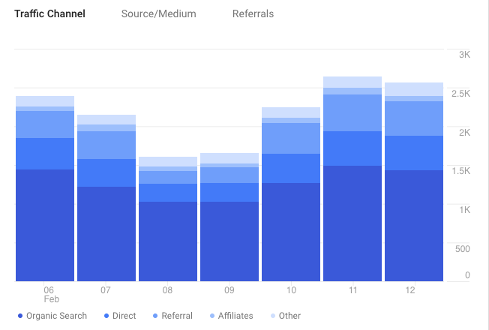
Channels
Channels indicate how people found your site. The Source/Medium report below shows you in more detail where people came from, for example, YouTube, Facebook, Instagram.
Source/Medium report (Image source: Author)
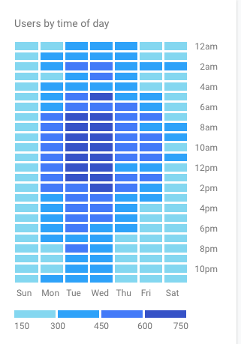
Interaction (time)
When do they visit your website? If you have a plan to make a campaign, a promotion, or a post, now you know the best time to attract the user’s attention.
Image source: Author
Interaction (behavior flow)
When do they use your website?
With user behavior flow, you can see each page’s performance, where they get in, where they drop out, and the proportion.
Google Analytics — Behavior flow
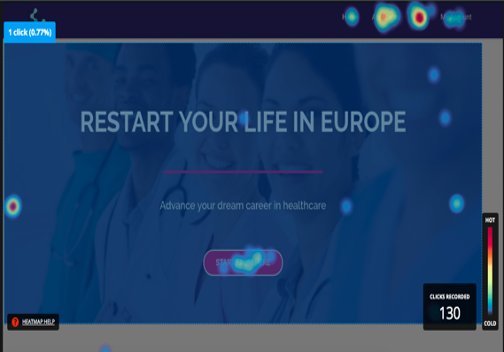
With the interaction record, you can understand their interest and behavior more intuitively — what catches their attention, the hot area, and so on. Then you will know what and where on your website can be improved.
Image source: Author
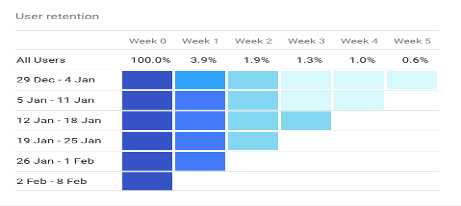
Customer retention
Have you experienced this? You paid heavily to acquire new users but they churned very quickly. Their customer lifetime value (LTV) is lower than their cost of acquisition. The more you invest in them, the more you lose. To be honest, not all customers can yield revenue and profit — some of them just consume your resources. That’s why customer retention is vital. You may ask very good questions, such as:
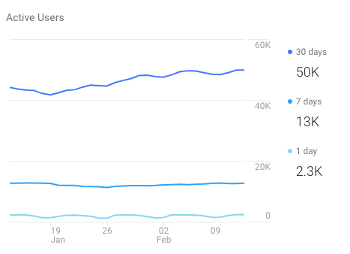
How long do most customers stick around? (Daily active user / Weekly active user/ Monthly active user)
How long do various customer personas stick around?
Have recent product changes helped or impeded retention?
What changes can improve retention?
Image source: Author
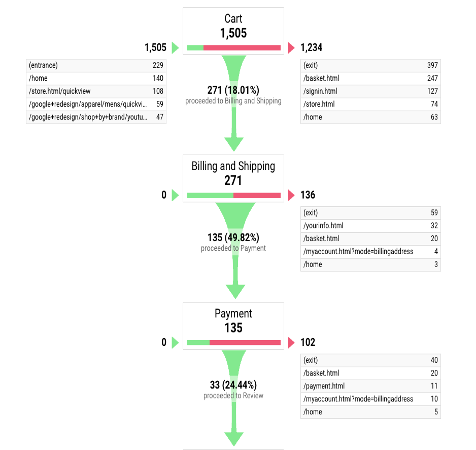
Customer conversion
Whatever actions you have executed or you are planning, the ultimate destination for business is revenue. The conversion rate leads you to understand how many visitors become your users and how much they contribute. Moreover, you can break down each procedure and look deeper. Any recognition of strengths and weaknesses may help you optimize the conversion rate and improve the revenue or profit.
In real business, things could be more complicated. However, I hope this article can help you build a 3-D scanner and let you have a crystal-clear picture of your business.
This article isn’t about the importance of tags and title optimization or the basics of SEO. Instead, it is intended to provide advanced on-page SEO techniques that are talked about less often, but still significant for anyone with an online presence.
Top On-page SEO Techniques That Still Work
Aside from the basic strategies, like proper usage of HTML tags, page title, and meta description optimization, our chat participants shared some practical strategies that you can implement to increase your search traffic.
Semantically Related Terms
Google’s algorithms are constantly updated, so it is important to keep up with the latest news in the industry. Now, keyword research requires a more holistic, upgraded approach. Today, site owners and SEO specialists need to better understand semantic search to ensure that their content is relevant to their audience.
David Rosam — “Semantically related content/terms, being aware of searcher intent, in-depth content, internal linking, good writing.”
By discovering terms and phrases that are related to your primary keyword, you can unlock a fresh source of targeted traffic to your site. By trying to take advantage of the search engine’s semantic indexing behaviors and performing thorough keyword research, you can discover synonyms and semantically related terms, in addition to keywords that you initially set out to research.
Ryan Glass — “semantically aligned terms, answering questions people actually ask, optimizing title & meta desc for CTR.”
Content Guided by Search Intent
Google has divided its massive stores of data to better understand user intent and provide the most relevant search results to its users. Search intent is not about who the searchers are, but what they really want.
According to a popularly referred study by Andrei Broder, traditionally, there are three main categories of web search queries: navigational, informational, and transactional. Not knowing the real intent of your target user weakens your chances of providing them with what they are looking for.
A successful SEO strategy must include understanding how to create content and deliver experiences that are appealing and relevant to your audience.
Klaus Junginger — “Concise text blocks with proper headers, text content mixed w/ imagery (ALT etc), Search intent oriented copies and layout.”
Speaking the Language of Your Searchers
To develop smarter content strategies and provide a better experience to your users, it is important to analyze how your users think about and search for your product or service when looking for information on the Internet. Natural language processing (NLP) has changed the way the online world works.
Search has shifted from simple keywords to intent and context. Digital marketers need to focus more on how people are searching, consider using natural language in the content, and take into account the fact that different searchers may not use the same terms.
Nathan Brown — “Understanding Semantic Text & NLP to go beyond keywords — including TF/IDF, phrase matching, schema, and more.”
To adapt your content to how people perform searches these days, you also need to pay attention to natural language. As more people are using digital systems, it is becoming critical to optimize your pages for voice-based queries that have a different nature; these tend to be longer phrases and even complete questions. If you want to adapt your content to a natural language search, you need to include complete sentences that communicate full meaning.
Even though SEO means “search engine optimization,” you need to remember that there are real people on the other side of the screen. Therefore, you need to write content for them and make it as useful and relevant as possible.
The Biggest Concerns When Structuring a Page
Every website needs a certain structure so that your users can easily navigate through it by clicking from one page to the other. Then, the search engine bots crawl your site’s structure to index the content to return it into the search results. This means that a good site structure makes it easier for crawlers to access and index your content.
These are the several pitfalls that people can fall into when structuring a webpage:
Having Too Many Pages Without a Clear Message
Offering too many options can overwhelm and confuse your users. Some UX designers believe that all pages should be accessible in three clicks, but this is a myth. Instead, it’s important to focus on simpler navigation, fewer clicks don’t make users happier, but the ease of navigation does.
Pole Position Marketing — “Too many pages are structured without the message and goal in mind. That has to come first.”
Every click must take your user closer to their goal, and every page of your site should have a clear purpose. Ideally, the design and other elements that build communication need to work together to create a clear, unified message to your site visitors.
Chris Countey — “A page’s intent should be crystal clear to both the visitor and search engines; copy+code+ux=win.”
Not Encouraging Users to Complete the Desired Action
If you want your site visitors to take a certain actions, you need to give them a reason to do it. Will your page provide them with valuable information? Will they get what they want after viewing it? This should be aligned with your value proposition, and call-to-action buttons should be compelling enough to attract your users’ attention and persuade them to complete a form or perform another action. A good CTA is visually striking, action-oriented, clear, and easy to understand.
AJ Ghergich — “Does my Above-the-Fold content induce strong scroll-depth and eventual action?”
Putting Sales Ahead of Your Users’ Needs
It is all about your users. The true measure of your website’s performance lies with the only people who determine its success: your site visitors. When structuring a webpage, you need to put your users’ interests and needs ahead of your own. Place what is the most important to them at the top of your page and keep in mind that “Great Brands Aim For Customers’ Hearts, Not Their Wallets.”
Marianne Sweeny — “Putting business concerns ahead of user needs. Structure content like a newspaper, general to specific, most important at the top.”
Trying To Do SEO After the Design
Unfortunately, some site owners don’t think about SEO until after having their website designed. As a result, these sites have a beautiful design, but fail to rank high in search engine results. The truth is, SEO must be an integral part of website design and must always be planned out before setting up your site. You need to ensure that search engines can easily crawl and understand your content properly.
Chris Countey — “Don’t try to ‘SEO’ a site after design if you can avoid it. Bring SEO into the development from day 1.”
Some of our chat guests also believe that when it comes to page structure, everything comes down to user experience. Barry Feldman provides 40 practical website improvement tactics for a better UX that can help you make the experience of your users smooth and pleasant.
Carolyn Lyden — “UX (and ALL that it entails) is really what it’s boiling down to. Google takes user signals, so overall UX is critical.”
Your Web Content Writer — “Finding balance. Users love visual and hate big chunks of text. They hate slow load times even more though.”
Good page structure is a result of careful thinking and accurate organization. Avoiding these pitfalls is a good starting point in getting the structure of your pages right.
Is it possible to rank a website using only on-page SEO?
Improving your site’s ranking requires a smart, well-planned strategy that includes various practical techniques. However, is it possible to rank a website using only on-page SEO tactics?
Most of our chat participants agree that on-page SEO is enough, but only in industries with low competition. Otherwise, it will be very difficult to rank without quality backlinks.
Content King — “Sure, but only in low competition niches. When competition is moderate/high, you need links to rank!”
Alex Singleton — “If a given query concerns a competitive subject/niche, ranking will be difficult if competition has better web content.”
Ryan Jones — “Yes, you can rank using only on-page SEO. But it’s not as easy as having links.”
On the other hand, some of our guests believe that if you create valuable, shareable content that solves your audience’s pain points, the links will follow.
Carolyn Lyden — “If your on-page SEO is 10/10, your content is useful and solves user issues, then links & ranking will come.”
Bill Slawski — “Create shareable, linkable content aimed at a specific audience written based upon expertise, authoritativeness & trust.”
Some of the most important elements of search engine optimization happen on your site. By implementing basic on-page SEO practices, coupled with strong content, you have a better chance of winning the SEO race.
The Most Common On-page SEO Issues and How to Fix It
At the end of our discussion, we asked our chat guests to name the most common on-page SEO issues.
1. Underestimating Image SEO
“I’m going to go with image file titles on this one. Image SEO is still so very underrated.” Mike Bryant pointed out that image optimization remains underrated, as some site owners still don’t optimize their images for SEO properly. Images can make your articles or pages more visually appealing and compelling and, they contribute to your SEO efforts as well.
To optimize your images, pay attention to these must-know tips:
Name your image files properly using acceptable keywords.
If you are experiencing issues attracting new site visitors, retaining them on your pages, and achieving your site goals, the problem may lie in the fact that your pages lack a clear focus. If your site tries to be all things to all people, it can end up appealing to nobody.
If your content talks about everything and how you can answer every single question and solve every single problem, it means that your site focus is too scattered. As a result, it will be very confusing to your users. It is crucial to make your site more focused and consistent and try to appeal to your perfect potential users.
Optimisey — “Lack of focus. ‘We want to rank for *everything*… now!’ is often problem number one.”
Jo Marie — “Mixed messages are death to on-page SEO. Stay on topic and use all on-page signals to make sure you do.”
3. Ignoring Meta Description Optimization
Paul Shapiro says that optimization for click-through rate is often neglected and it remains a common SEO issue on may websites.
The key feature for improving CTR from search results pages is the meta description. Even though Google stated long ago that meta descriptions are not a ranking factor, by writing killer descriptions you can influence the decision of searchers as to whether they want to click through your content or not. As a result, quality meta descriptions lead to improved click-through rates and, thus, site rankings.
4. Slow Page Load Time
A good user experience encompasses multiple aspects, including site loading speed. Nearly half of web users anticipate a site to load in just 2 seconds or even less! Slow pages can end up having higher bounce rates and a lower time on pages.
Use services like PageSpeed Insights, GTmetrix, and YSlow to access the current state of your website. The good thing about these tools is that in addition to insights into how well your site loads, they provide practical suggestions for improving your page’s performance.
Fanny Heuck — “The page loading time. Most of the time due to huge pictures — use jpgepmini or tinypng to reduce the size.”
Pay attention to the above on-page SEO issues to make sure that you pick the right path in optimizing your site’s on-page aspects.
Keep in mind that on-page SEO is an ongoing and frequent process. Through research, experimentation, and experience, you need to prioritize your SEO challenges and focus on those elements that deliver the best results. If you need SEO help, contact: [email protected] or give us a call at (469) 536-8478
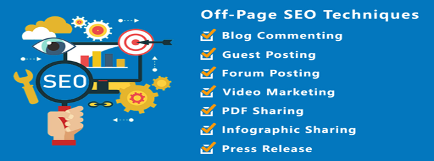
If this on-page SEO tutorial intrigues you, consider looking into off-page SEO also. Below is some infographic about off-page SEO you may consider.
Search engine optimization, or SEO, is incredibly important for marketers. When you search engine optimize your client’s web pages — including blog posts — you’re making the client’s website more visible to people who are using search engines (like Google) to find your client’s product or service. But does blog content really help their business organically rank on search engines?
Blogging helps boost SEO quality by positioning the website as a relevant answer to customers’ questions. Posts that use a variety of on-page SEO tips for blogs can give more opportunities to rank in search engines and make the website more appealing to visitors
It’s clear blog content does contribute to SEO, Google’s many algorithm updates can make publishing the right kind of blog content tricky if you don’t know where to start. Some search engine optimization blog ranking factors have stood the test of time while others are considered “old-school.” Here are a few of the top-ranking factors that can, directly and indirectly, affect blog SEO.
Pro tip: As a rule of thumb, take time to understand what each of this SEO for blogging factors does, but don’t try to implement them all at once. They each serve a specific purpose and should be used to meet a specific SEO goal for your blog. Listen to HubSpot’s Matt Barby and Victor Pan take on this topic in this podcast episode.
Factors That Affect SEO For A Blog
1. Dwell Time
Although dwell time is an indirect ranking factor for Google, it’s a critical factor in the user experience — and we know that user experience is king when it comes to blogging SEO. Dwell time is the length of time a reader spends on a page on your blog search engine optimization site. From the moment a visitor clicks on your site in the SERP, to the moment they exit the page is considered to dwell time. This metric indirectly tells search engines like Google how valuable your content is to the reader. It makes sense that the longer they spend on the page, the more relevant it is to them.
However, there’s a reason this metric is an indirect indicator for blogging SEO— it’s completely subjective. The search engine algorithms don’t know your content strategy. Your blog could be focused on short-form content that takes just a minute or two to read. You might also include pertinent information at the beginning of your blog posts to give the best reader experience, which means less time spent on the page. So yes, dwell time can affect SEO for blogging, but don’t manipulate your content to change this metric if it doesn’t make sense for your content strategy.
2. Page Speed
We mentioned earlier that visual elements on your blog can affect page speed, but that isn’t the only thing that can move this needle. Unnecessary code and overuse of plugins can also contribute to a sluggish blog site. Removing junk code can help your pages load faster, thus improving page speed. If you’re not sure how to find and remove junk code, check out HTML-Cleaner. It’s an easy-to-use tool that doesn’t require coding knowledge. It simply shows you the unnecessary code and lets you remove it with the click of a button.
I also recommend taking an inventory of your blogging SEO site plugins. Decide which ones you need to keep your blog running day-to-day and which ones were installed as a fix for a temporary issue. Plugins that affect the front-end of your site are a threat to page speed, and odds are, you can uninstall more of these plugins than you think to increase your overall site speed.
3. Mobile Responsiveness
More than half of Google’s search traffic in the United States comes from mobile devices. On an individual level, your blog site might follow that same trend. There’s no way around it — optimizing your blog site for mobile is a factor that will affect your SEO for blogging metrics. But what exactly does it mean to optimize a website for mobile? The industry rule of thumb is to keep things simple. Most pre-made site themes these days are already mobile-friendly, so all you’ll need to do is tweak a CTA button here and enlarge a font size there. Then, keep an eye on how your site is performing on mobile by taking a look at your Google Analytics dashboard and running a mobile site speed test regularly.
4. Index Date
Search engines aim to provide the most relevant and accurate information available. A factor search engines use when determining what’s relevant and accurate is the date a search engine indexes the content. Indexing means a search engine finds content and adds it to its index. Later, the page can be retrieved and displayed in the SERP when a user searches for keywords related to the indexed page.
You might be wondering: Is the date the content was indexed the same as the date it was published?
The answer: yes and no. If a blog post is published for the first time, it’s likely that say, a Google crawler will index that post the same day you publish it. But content can be backdated for several legitimate reasons, too, like archiving information or updating a sentence or two.
One way to positively affect this blog search engine optimization factor is to implement a historical optimization strategy. This strategy works well on blogs that have been established for a few years and have a fair amount of content already. By updating these older posts with new perspectives and data, you’ll be able to significantly impact your blogging SEO without creating a lot of net new content. Site crawlers will reindex the page — taking into account the updated content — and give it another opportunity to compete in the SERP. It’s truly a win-win.
5. Recent Data
Recent data, another indirect ranking factor of SEO for a blog, should be included in posts. Recent data gives visitors relevant and accurate information which makes for a positive reader experience. When you include a link to a credible site that has original, up-to-date data, you’re telling the search engine that this site is helpful and relevant to your readers (which is a plus for that other site). You’re also telling the search engine that this type of data is in some way related to the content you publish. Over time, your readers will come to appreciate the content which can be confirmed using other metrics like increased time on page or lower bounce rate.
1. Identify the target audience for your blog posts for SEO.
No matter what industry your blog targets, you’ll want to identify and speak to the primary audience that will be reading your content. Understanding who your audience is and what you want them to do when they click on your article will help guide your blog strategy.
Buyer personas are an effective way to target readers using their buying behaviors, demographics, and psychographics. Without this insight, you could be producing grammatically correct and accurate content that few people will click on because it doesn’t speak to them on a personal level.
2. Conduct keyword research.
Now that you’ve selected your target audience and prepared a buyer persona, it’s time to find out what content your readers want to consume. Keyword research can be a heavy task to take on if you don’t begin with a strategy. Therefore, I recommend starting with the topics your SEO for blogging will cover, then expanding or contracting your scope from there. For an in-depth tutorial, check out our how-to guide on keyword research.
3. Add visuals.
Search engines like Google value visuals for certain keywords. Images and videos are among the most common visual elements that appear on the search engine results page. In order to achieve a coveted spot in an image pack or a video snippet, you’ll want to design creative graphics, use original photos and videos, and add descriptive alt text to every visual element within your blog post.
Alt-text is a major factor that determines whether or not your image or video appears in the SERP and how highly it appears. Alt-text is also important for screen readers so that visually impaired individuals have a positive experience consuming content on your search engine optimization blog site.
4. Write a catchy title.
The title of your blog post is the first element a reader will see when they come across your article, and it heavily influences whether they’ll click or keep scrolling. A catchy title uses data, asks a question, or leads with curiosity to pique the reader’s interest.
According to Coscheduler’s Headline Analyzer, the elements of a catchy title include power, emotion, uncommon, and common words. In the right proportions, these types of words in an SEO blog post’s title will grab your readers’ attention and keep them on the page.
Here’s an example of a catchy title with a Coschedule Headline Analyzer Score of 87:
The Perfect Dress Has 3 Elements According to This Popular Fashion Expert
Highlighted in yellow are common words. They’re familiar to the reader and don’t stray too far from other titles that may appear in the SERP.
“Expert” is an emotional word, according to Coschedule. In this example, the word expert builds trust with the reader and tells them that this article has an authoritative point of view.
Purple words are power words — this means they capture the readers’ attention and get them curious about the topic.
Another element in this title is the number three. This signals to the reader that they’ll learn a specific amount of facts about the perfect dress.
5. Include an enticing CTA.
What’s a blog post without a call to action? The purpose of a CTA is to lead your reader to the next step in their journey through your blog. The key to a great CTA is that it’s relevant to the topic of your existing blog post and flows naturally with the rest of the content. Whether you’re selling a product, offering a newsletter subscription, or wanting the reader to consume more of your content, you’ll need an enticing CTA on every blog post you publish.
CTAs come in all types of formats, so get creative and experiment with them. Buttons, hyperlinks, and widgets are some of the most common CTAs, and they all have different purposes. For instance, you should add a bold, visible CTA like a button if you want the reader to make a purchase. On the other hand, you can easily get a reader to check out another SEO for blogging post by providing a hyperlink to it in the conclusion of the current article.
6. Focus on the reader’s experience.
Any great writer or SEO for a blog will tell you that the reader experience is the most important part of a blog post. The reader experience includes several factors like readability, formatting, and page speed. That means you’ll want to write content that’s clear, comprehensive of your topic, and accurate according to the latest data and trends. Organizing the content using headings and subheadings is important as well because it helps the reader scan the content quickly to find the information they need. Finally, on-page elements like images and videos have an impact on page speed. Keep image file sizes low (250 KB is a good starting point) and limit the number of videos you embed on a single page. By focusing on what the reader wants to know and organizing the post to achieve that goal, you’ll be on your way to publishing optimized SEO blog posts for the search engine.
Now, let’s take a look at these blog SEO tips that you can take advantage of to enhance your content’s searchability.
SEO Tips For Blogs
1. Use 1–2 long-tail keywords.
2. Use keywords strategically throughout the blog post.
3. Optimize for mobile devices.
4. Optimize the meta description.
5. Include image alt text.
6. Limit topic tags.
7. Include user-friendly URL structures.
8. Link to related blog posts.
9. Review metrics regularly.
10. Organize by topic cluster.
11. Publish evergreen content.
12. Update existing content.
Note: This list doesn’t cover every SEO rule under the sun. Rather, the following tips are the on-page factors to get you started with an SEO strategy for your blog.
Use 1–2 long-tail keywords
Optimizing your blog posts for keywords is not about incorporating as many keywords into your posts as possible. Nowadays, this actually hurts your blogging SEO because search engines consider this keyword stuffing (i.e., including keywords as much as possible with the sole purpose of ranking highly in organic search).
It also doesn’t make for a good reader experience — a ranking factor that search engines now prioritize to ensure you’re answering the intent of your visitors. Therefore, you should use keywords in your content in a way that doesn’t feel unnatural or forced.
A good rule of thumb is to focus on one or two long-tail keywords per blog post. While you can use more than one keyword in a single post, keep the focus of the post narrow enough to allow you to spend time on blog search engine optimization for just one or two keywords.
You may be wondering: Why long-tail keywords?
These longer, often question-based keywords keep your post focused on the specific goals of your audience. For example, the long-tail keyword “how to write a blog post” is much more impactful in terms of SEO for blogging than the short keyword “blog post”.
Website visitors searching long-tail keywords are more likely to read the whole post and then seek more information from you. In other words, they’ll help you generate the right type of traffic — visitors who convert.
2. Use keywords strategically throughout the SEO blog posts.
Now that you’ve got one or two keywords, it’s time to incorporate them in your blog post. But where is the best place to include these terms so you rank high in search results?
There are four essential places where you should try to include your keywords: title tag, headers & body, URL, and meta description.
Title Tag
The title (i.e., headline) of your blog post will be a search engine’s and reader’s first step in determining the relevancy of your content. So, including a keyword here is vital. Google calls this the “title tag” in a search result.
Be sure to include your keyword within the first 60 characters of your title, which is just about where Google cuts titles off on the SERP. Technically, Google measures by pixel width, not character count, and it recently increased the pixel width for organic search results from approximately 500 pixels to 600 pixels, which translates to around 60 characters.
Long title tag? When you have a lengthy headline, it’s a good idea to get your keyword in the beginning since it might get cut off in SERPs toward the end, which can take a toll on your post’s perceived relevance.
In the example below, we had a long title that went over 65 characters, so we placed the keyword near the front.
Headers & Body
Mention your keyword at a normal cadence throughout the body of your post and in the headers. That means including your keywords in your copy, but only in a natural, reader-friendly way. Don’t go overboard at the risk of being penalized for keyword stuffing.
Before you start writing a new blog post, you’ll probably think about how to incorporate your keywords into your SEO blog posts. That’s a smart idea, but it shouldn’t be your only focus, nor even your primary focus.
Whenever you create content, your primary focus should be on what matters to your audience, not how many times you can include a keyword or keyword phrase in that content. Focus on being helpful and answering whatever question your customer might’ve asked to arrive on your post. Do that, and you’ll naturally optimize blog posts for SEO of important keywords, anyway.
URL
Search engines also look at your URL to figure out what your post is about, and it’s one of the first things it’ll crawl on a page. You have a huge opportunity to optimize your URLs on every post you publish, as every post lives on its unique URL — so make sure you include your one to two keywords in it.
In the example below, we created the URL using the long-tail keyword for which we were trying to rank: “email marketing examples.”
Meta Description
Your meta description is meant to give search engines and readers information about your blog post’s content. Meaning, you must use your long-tail term so Google and your audience are clear on your post’s content.
At the same time, keep in mind the copy matters a great deal for click-through rates because it satisfies certain readers’ intent — the more engaging, the better.
3. Blogging SEO Optimize for mobile devices.
We learned earlier that more people use search engines from their mobile phones than from a computer.
And for all those valuable queries being searched on mobile devices, Google displays the mobile-friendly results first. This is yet another example of Google heavily favoring mobile-friendly websites — which has been true ever since the company updated its Penguin algorithm in April 2015.
So, how do you make your blog mobile-friendly? By using responsive design. Websites that are responsive to mobile allow blog pages to have just one URL instead of two — one for desktop and one for mobile, respectively. This helps your post’s SEO a blog because any inbound links that come back to your site won’t be divided between the separate URLs.
As a result, you’ll centralize the blogging SEO power you gain from these links, helping Google more easily recognize your post’s value and rank it accordingly.
Pro tip: What search engines value is constantly changing. Be sure you’re keeping on top of these changes by subscribing to Google’s official blog.
4. Optimize the meta description.
To review, a meta description is an additional text that appears in SERPs that lets readers know what the link is about. The meta description gives searchers the information they need to determine whether or not your content is what they’re looking for and ultimately helps them decide if they’ll click or not.
The maximum length of this meta description is greater than it once was — now around 300 characters — suggesting it wants to give readers more insight into what each result will give them.
So, in addition to being reader-friendly (compelling and relevant), your meta description should include the long-tail keyword for which you are trying to rank.
In the following example, I searched for “email newsletter examples.”
The term is bolded in the meta description, helping readers make the connection between the intent of their search term and this result. You’ll also see the term “E-Newsletter” bolded, indicating that Google knows there’s a semantic connection between “email newsletter” and “E-Newsletter.”
Note: Nowadays, it’s not guaranteed that your meta description is always pulled into SERPs as it once was. As you can see in the above image, Google pulls in other parts of your blog post that includes the keywords searched, presumably to give searchers optimal context around how the result matches their specific query.
Let me show you another example. Below are two different search queries delivering two different snippets of text on Google SERPs. The first is a result of the query “no index no follow,” and pulls in the original meta description:
The second is a result of the query “noindex nofollow,” and pulls in the first instance of these specific keywords coming up in the body of the blog post:
When you incorporate image alt text, an image’s name in your blog may go from something like, “IMG23940” to something accurate and descriptive such as “puppies playing in a basket
While there’s not much you can do to influence what text gets pulled in, you should continue to optimize this metadata, as well as your post, so search engines display the best content from the article. By creating reader-friendly content with natural keyword inclusion, you’ll make it easier for Google to prove your post’s relevancy in SERPs for you.
5. Include image alt text.
Blog posts shouldn’t only contain text — they should also include images that help explain and support your content. However, search engines don’t simply look for images. Rather, they look for images with image alt text.
You may be wondering why this is. Since search engines can’t “see” images the same way humans can, an image’s alt text tells the search engine what an image is about. This SEO for a blog ultimately helps those images rank in the search engine’s images results page.
Image alt text also makes for a better user experience (UX). It displays inside the image container when an image can’t be found or displayed. Technically, alt text is an attribute that can be added to an image tag in HTML.
When you incorporate image alt text, an image’s name in your blog may go from something like, “IMG23940” to something accurate and descriptive such as “puppies playing in a basket.”
Image alt text should be descriptive in a helpful way — meaning, it should provide the search engine with context to index the image if it’s in a blog article related to a similar topic.
To provide more context, here’s a list of things to be sure you keep in mind when creating alt text for your SEO blog posts’ images:
Describe the image
Leave out “image of… “— start with the image description instead
Be specific in your description
Keep it under 125 characters
Use your keywords (but avoid keyword stuffing)
HubSpot customers:The SEO Panel will recognize whether or not you have optimized your images. Though these elements are not as important as some other SEO for a blog, they’re still necessary (not to mention, easy to add).
6. Limit topic tags
Topic tags can help organize your blog content, but if you overuse them, they can actually be harmful. If you have too many similar tags, you may get penalized by search engines for having duplicate content.
Think of it this way, when you create a topic tag (which is simple if you’re a HubSpot user, as seen here), you also create a new site page where the content from those topic tags will appear. If you use too many similar tags for the same content, it appears to search engines as if you’re showing the content multiple times throughout your website. For example, topic tags like “blogging,” “blog,” and “blog posts” are too similar to one another to be used on the same post.
If you’re worried that your current blog posts have too many similar tags, take some time to clean them up. Choose about 15–25 topic tags that you think are important to your blog and that aren’t too similar to one another. Then only tag your SEO blog posts with those keywords. That way, you won’t have to worry about duplicate content.
Here at HubSpot, we use a Search Insights Report to map specific MSV-driven keyword ideas to a content topic each quarter. The process helps us target a handful of posts in a set number of topics throughout the year for a systematic approach to blogging SEO and content creation.
7. Include user-friendly URL structures.
Before you publish your blog post, take a careful look at its URL structure. Is it long, filled with stop-words, or unrelated to the post’s topic? If so, you might want to rewrite it before it goes live.
The URL structure of your web pages (which are different from the specific URLs of your posts) should make it easy for your visitors to understand the structure of your website and the content they’re about to see. Search engines favor web page URLs that make it easier for them and website visitors to understand the content on the page.
This differentiation is baked into the HubSpot blogs’ respective URL structures. If I decided to go to the Marketing section from this main page, I would be taken to the URL http://blog.hubspot.com/marketing.
If we want to read the Sales section, all we have to do is change where it says “marketing” in the URL to “sales”:
This URL structure helps me understand that “/marketing” and “/sales” are smaller sections — called subdirectories — within the larger blog.
What if there’s a specific article we want to read, such as “How to Do Keyword Research: A Beginner’s Guide”? Its URL structure — http://blog.hubspot.com/marketing/how-to-do-keyword-research-ht — denotes that it’s an article from the Marketing section of the blog.
In this way, URL structure acts as a categorization system for readers, letting them know where they are on the website and how to access new site pages. Search engines appreciate this, as it makes it easier for them to identify exactly what information searchers will access on different parts of your blog or website.
Pro tip: Don’t change your blog post URL after it’s been published — that’s the easiest way to press the metaphorical “reset” button on your blogging SEO efforts on that post. If your URL is less descriptive than you’d like or it no longer follows your brand or style guidelines, your best bet is to leave it as is. Instead, change the title of the post using the guidelines we covered earlier.
8. Link to related blog posts.
You may have heard that backlinks influence how high your blog site can rank in the SERP, and that’s true — backlinks show how trustworthy your site is based on how many other relevant sites link back to yours. But backlinks aren’t the end-all-be-all to link building. Linking to and from your own blog posts can have a positive impact on how well your blog search engine optimization site ranks, too.
Inbound links to your content help show search engines the validity or relevancy of your content. The same goes for linking internally to other pages on your website. If you’ve written about a topic that’s mentioned in your blog posts for SEO on another blog post, ebook, or web page, it’s a best practice to link to that page.
(You might’ve noticed that I’ve been doing that from time to time throughout this SEO blog posts when I think it’s helpful for our readers.) Not only will internal linking help keep visitors on your website, but it also surfaces your other relevant and authoritative pages to search engines.
For example, if your blog is about fashion, you might cover fabrics as a topic. Adding a hyperlink from a blog post about cotton to a post about the proper way to mix fabrics can help both of those posts become more visible to readers who search these keywords. The search engines will also have one more entry point to the post about cotton when you hyperlink it in the post about mixing fabrics. This means the post about cotton fabric, and any updates you make to it will be recognized by site crawlers faster. It could even see a boost in the SERP as a result.
HubSpot customers: The SEO Panel automatically suggests linking to other internal resources on your website.
You can think of this as solving for your SEO for a blog while also helping your visitors get more information from your content.
If you’re interested in optimizing your best-performing older blog posts for traffic and leads like we’ve been doing since 2015, this tool can help identify low-hanging fruit.
Remember, many content marketers struggle with optimizing their SEO blog posts for search. The truth is, your blog posts won’t start ranking immediately. It takes time to build up search authority.
But, when you publish blog posts frequently and consistently optimize them for search while maintaining an intent-based reader experience, you’ll reap the rewards in the form of traffic and leads long-term.
10. Organize by topic cluster.
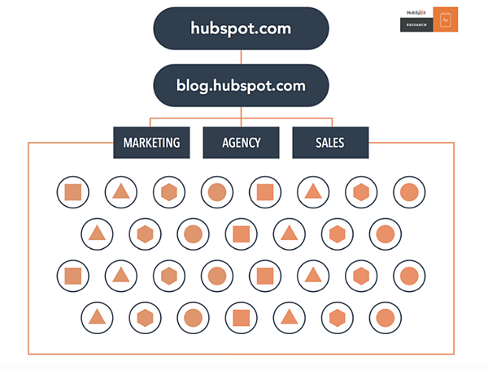
The way most blogs are currently structured (including our own blogs, until very recently), bloggers and SEOs have worked to create individual blog posts that rank for specific keywords.
This makes things unorganized and difficult for blog visitors to find the exact information they need. It also results in your URLs competing against one another in search engine rankings when you produce multiple blog posts about similar topics.
Here’s what our blog architecture used to look like using this old playbook:
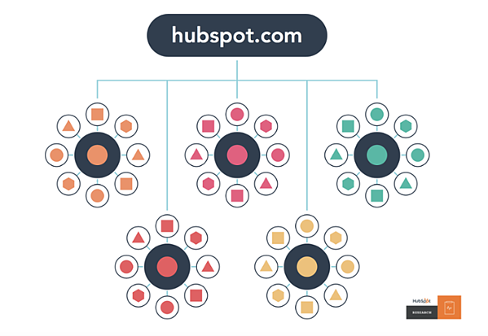
Now, in order to rank in search and best answer the new types of queries searchers are submitting, the solution is the topic cluster model.
For this model to work, choose the broad topics for which you want to rank. Then, create content based on specific keywords related to that topic that all link to each other to establish broader search engine authority.
This is what our blog infrastructure looks like now, with the topic cluster model. Specific topics are surrounded by blog posts related to the greater topic, connected to other URLs in the cluster via hyperlinks:
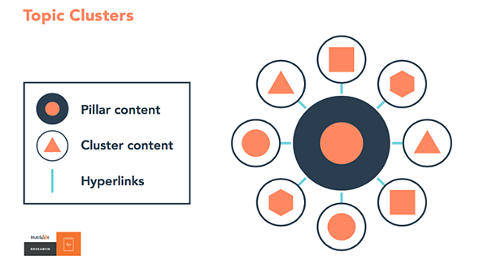
This model uses a more deliberate site architecture to organize and link URLs together to help more pages on your site rank in Google — and to help searchers find information on your site more easily. This architecture consists of three components — pillar content, cluster content, and hyperlinks:
We know this is a fairly new concept, so for more details, check out our research on the topic, take our SEO training or watch the video below.
11. Publish evergreen content.
When planning and writing your blog articles, ensure it’s evergreen content. Meaning, the content is about topics that will remain relevant and valuable over a long period of time (with only minor changes or updates). Let’s look at a few reasons why evergreen content is so important:
It’ll help you rank over time, not just in the near future.
It contributes to steady amounts of traffic coming to your blog (and website) long after it’s been published.
It’ll help you generate leads over time as a result of the traffic it continually generates.
All blog content — whether it’s a long-form article, how-to guide, FAQ, tutorial, and so on — should be evergreen. Even the images you use in these posts should be evergreen. Check out this blog post for some examples of and ideas for evergreen content on your blog.
12. Update existing content.
To improve your SEO, you may assume you need to create new blog content. Although that’s partially true, you should also focus a great deal of your time and energy on your existing blog content. Specifically, repurposing and updating your current content, as well as removing your outdated content.
This is because it takes a lot longer for a completely new piece of content to settle on the search engine results page (SERP) and gain authority, whereas you could update a piece of content and reap the benefits fairly immediately in comparison.
Not only will your updated content rank on the SERP faster, improving your number of visitors and leads, it also takes a lot less time and fewer resources to update an existing piece of content rather than create a brand new article.
Additionally, updating and repurposing some of your most successful pieces of content extends its lifespan so you can achieve the best results over a longer period of time (especially if it’s evergreen content).
The final step entails removing your outdated content that’s no longer relevant to your audience. Although your goal is to ensure your content is evergreen, some of it is bound to become outdated over time. This includes statistics, product information (if you have any listed in your blogs — as your products and business evolve), or information that changes across your industry over time.
Create Blog Content Your Readers (And Search Engines) Will Love
We don’t expect you to incorporate each of these blogging SEO best practices into your content strategy right away. But, as your website grows, so should your goals on search engines. Once you identify the goals and intent of your ideal readers, you’ll be on track to deliver relevant content that will climb the ranks of the SERP.
Have a look at how these two successful startups generate leads, based on what We learned from observing the processing of over 4 million opt-ins a month and how we used PPC to increase revenue and clients ten-fold over the years!
What is lead generation?
Real quick—before we dive into the strategies you can use to grow your business, let’s make sure we’re on the same page as far as terminology goes.
A lead is simply someone who’s demonstrated interest in your business in some way. Basically, you can think of anyone who’s given you their contact information—to attend a webinar, to download a free guide, to sign up for your newsletter, etc.—as a lead. Because this person has engaged your business’ website and given you permission to contact them (typically through email, but sometimes over the phone), they’re now inside your sales funnel.
Accordingly, lead generation—often shortened to “lead gen”—is simply the process of filling your sales funnel with people who are interested in your business. Anything that gets someone to give you permission to contact them or remarket to them is a lead generation tactic.
For example, let’s say you’re the in-house digital marketer for a company that builds backyard decks. One way you can generate leads is by creating a free, downloadable PDF guide to deck maintenance. Because the people who want to read the guide are required to submit their contact information, this piece of content serves as a lead generation mechanism. Quite simply, it’s a way to help people while simultaneously filling your funnel with leads.
Got it? Great. Now, let’s shift from contracting companies to startups and talk about the seven lead generation strategies you can use to fill your funnel with prospective customers.
7 lead generation strategies for your startup
Disclaimer: You absolutely do NOT need to try all of these. In fact, doing so would probably be a bad idea. Why? Because no two startups are the same. Although these seven lead generation strategies have worked wonders for our companies, that won’t necessarily be the case for yours.
You may only find success with one or two of these strategies. That’s OK. Evaluate each one carefully in the context of your revenue, your resources, your marketing goals, and your competitive landscape. As much as we believe in the effectiveness of these lead generation strategies, there’s no universal formula for growth.
1. Create a LOT of opt-in opportunities and make them irresistible
Webinars, free reports, live demos… don’t stop at just one or two opt-ins. Turn every blog post into an opt-in page. You can give away recipes, PDFs of your blog posts, worksheets, resource guides and more.
Get the opt-in box out of the sidebar and make a pop-up. Force users to make a decision. Do you want this or not? It’s easier to say no when the option is just sitting there in the sidebar and saying no is as easy as ignoring it.
In testing, this increased conversion by 32%.
You can’t make them say yes, but you don’t have to make it so easy for people to say no.
2. Always be testing, but test the right way
Getting great advice is a good thing, but it’s dangerous to think that because it worked for someone else, it’ll work equally well for you. That doesn’t mean you should ignore great advice, but that you need to test, test, test – and do it right.
Split test even where you think you don’t need to. Sometimes the results amongst your audience will seem counterintuitive, but this is why testing is critical. In this test, for example, you might think the use of “my” or “your” would have little effect.
The treatment actually resulted in 24% fewer conversions!
Point of view can be impactful. In this test, changing “your” to “my” resulted in a 90% increase in conversions:
Other aspects you’ll want to test for are immediacy, concreteness, images, and more. Split test your headline, your button copy, and your background image. The results might surprise you, but you’ll be making better, more informed optimizations.
3. Make landing pages clear and easy to take action on
Tim shared their best-ever converting landing page; check it out:
Why is this so effective? Tim explained that it doesn’t require the user to process very much information, like a 3-minute video or a whole page of copy would. It outperforms a free report because a lot of people are feeling information overload and don’t want to download something even longer to read.
Video lead magnets have suffered an image problem lately, in part because of the proliferation of launches and lack of time. For these reasons, this landing page was a hot performer. It also helped that people genuinely want to know which tools other people are using and this fulfills that desire. Anyone can do this – dentists, plumbers, architects, whoever. This type of lead gen landing page can be set up in under a half-hour and is definitely worth trying out.
4. Write better ads!
I’ve been saying this for a long time and it’s still true – most ads just suck. They’re boring, they’re all the same, and one isn’t any more compelling than another.
Take a look at these ads:
If you’re the searcher, you really have no reason other than price to choose one over the other. This is what I call an AdWords Jackpot for an advertiser. When everything looks the same, there’s a huge opportunity to come in with something different and blow the competition away!
Unless you’re one of the very top advertisers, there’s a ton of room for conversion rate improvement. In fact, the top 10% of landing pages have conversion rates 3x to 5x the average. How do they do it?
One creative way is to give better offers. This is far more meaningful than your typical, run of the mill optimizations – changing button color, font type, spacing, etc.
Every software company offers a free trial. Every plastic surgeon offers a free consultation. What do you have to offer that is unique, compelling, and offers real value to the visitor?
For us at Dunn Enterprises, we recommended it meant rethinking the standard free software trial offer. We decided to offer a free AdWords Grader, instead.
Conversions went through the roof! We had found something non-committal that people could actually use and weren’t asking them to take all the steps of downloading, installing, and then actually using our software. To date, this has proven to be one of our most effective lead generation strategies.
If your conversions are 2% or lower, you need to try something drastic like changing up your offer big time. Small optimizations will beget small results. The top 25% of advertisers have an average 5.31% conversion rate and the top 10% are hitting over 11%, on average! You have a ton of room to grow.
6. Go nuts with remarketing
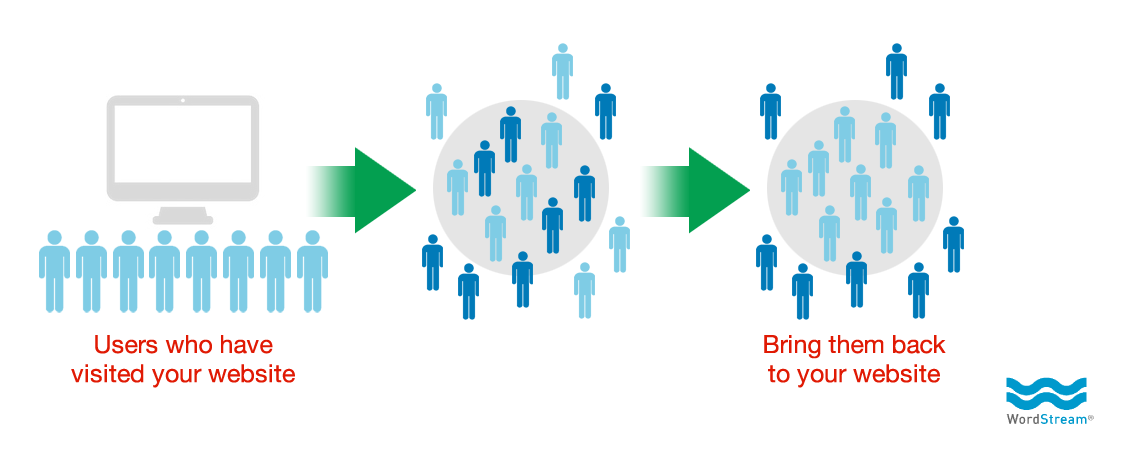
Remarketing enables you to tag site visitors and get back in front of them as they go about their business around the web, checking their email, watching YouTube, searching Google, and even hanging out on Facebook.
It helps turn abandoners into leads, which is huge considering that 97% of people will leave your landing page without converting. Remarketing amplifies the effect of all of your other business marketing activities – content marketing, social media marketing, etc. – by positioning you in front of your audience again.
Remarketing using the Google Display Network gives you 92% reach in the U.S., across millions of websites, videos, and devices. We’ve found that remarketing ads fatigue is about half the rate of regular ads, so be aggressive! Use our Remarketing Cheat Sheet to get started.
Gmail Ads are powerful tools for getting right in front of your target audience.
For a Business startup, no audience is more valuable than your competitors’ customers. With Gmail Ads, you can target your AdWords campaign to only ever reach people who receive emails from your competitors, giving you direct access to people that already use similar products.
There are several ways to do this. One is to target keywords that your competitors are likely to use. Sign up for your competitor’s email lists and take note of any words and phrases that they use frequently, then add them as target keywords.
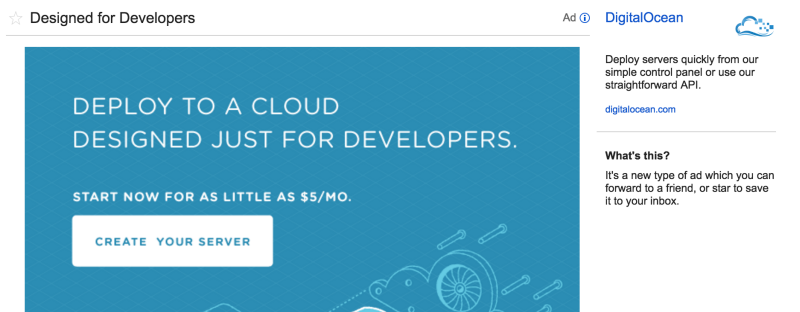
A more accurate solution is to target your competitors’ domains. Below is an example of a Gmail Ad from DigitalOcean, a cloud infrastructure provider. I receive emails from other cloud storage companies, which Digital Ocean is clearly targeting using domain placements.
Expanded, the ad looks like this:
Using Gmail Ads like this lets you reach the same audience that you’d reach through a search engine marketing campaign, all at a fraction of the cost.
Rapid growth needs serious lead generation strategies
We have seen great success in our respective companies and at a far faster clip than average. If you want to grow and grow fast, you need to prioritize your lead generation strategies and use tactics like the ones we’ve recommended above to get as many qualified prospects as possible into your funnel.
Internal and external links play an important role in SEO. Find out why they matter and how you can use them to enrich the customer experience.
Internal and external links have a significant role to play in guiding website visitors to the answers they seek about your products and services.
Each link should lead your audience to the next relevant piece of content they need to continue their information gathering and/or customer journey.
Links are the lifeblood of the web, connecting each piece of content to the next. Search engines use both internal and external links to determine, in part, which pages are most authoritative on any given subject.
As such, both internal and external links play an important role in SEO.
Why Are Internal Links Important?
Internal links are used by Google and other search engines to better understand the structure of a website.
They enable site owners to let their visitors and the search engines know which pages are most important.
For example, the top-level sections in a website’s navigation (e.g., Products, Services, About Us, Resources) tell the search engines what the site owner believes to be the most important content.
Search engine spiders crawl the various links within a site to determine its structure, and those pages closer to the top of the hierarchy are naturally considered more important.
After all, you wouldn’t want to bury your most important content several layers deep within your website where it would be difficult to find.
Always keep in mind that you are ultimately creating your website and all of the content within it to provide readily accessible answers to your target audience’s questions.
Why Do External Links Matter?
Google and other search engines value links. If you link to an external website, search engines perceive this as an endorsement of the content being linked to.
External links can be used to cite a source, provide verification for information, and offer further context for the reader.
Again, Google’s modus operandi is delivering the right content to the right people at the right time. It doesn’t really care where the answers live, so sometimes it makes sense to link to the right piece of external content. You can’t be expected to have all of the answers.
For example, there may be an excellent article published on a highly relevant and well-respected industry website that directly or indirectly relates to a product or service offered by your organization.
If the information in this article will benefit your audience by answering additional questions they may have or shedding more light on a topic, it certainly behooves you to link to such an article.
Where, When, And How Should Links Be Added?
When you’re looking at adding links to new or existing website content, put yourself in the shoes of a member of your audience. Think about how they will want to engage with it and where a link might help.
If you have not already, take a step back to map out your typical customer journey. This will help guide which pieces and/or types of content you control should link through to other pieces, from awareness to consideration to intent, and on to conversion.
Do not be afraid to incorporate clear calls to action (CTAs). These are helpful for those customers who are ready to click through to the next logical step in their journey and/or those who are not ready and may require additional information.
Today, most customer journeys are not linear. It’s important to provide options depending on where your customers find themselves in their search for answers, products, or services, and you do that with links.
Are there topical keywords and/or concepts within your new or existing piece of content that require elaboration or raise questions?
Do you have additional content to answer those questions (in blog posts or FAQs, for example) or do you know where the answer lies? Can you conduct some research to find it?
By linking to content that provides relevant answers to these questions via the actual keywords (a.k.a., anchor text), you provide the search engines with an important signal to help tie the questions and answers together.
Your most prominent links and calls to action can naturally be tied to a button or image, such as a banner, and placed strategically to better catch the attention of your website visitors. Visual UX analytics tools like click heatmaps can and should be used to monitor how visitors are engaging with your content and which links they are (or are not) clicking on.
Open In A New Window/Tab
When linking externally, you may want to have the link to the external web page/content open in a new window or tab.
This way, when the reader is done looking at the “related” content, they can easily close this second window, navigate back to your original article, and continue on with their journey.
Internal links generally do not need to open in a new window as you are not directing your reader away from your property.
However, there may be instances where this makes sense; for example, when linking to an associated Help documentation on a software website.
Far too often, I click on a link and am taken to an external website within the same browser/window, then click on another link that takes me to a second external site.
Suddenly, I’ve lost track of where I started.
Yes, I could hit my browser Back button or review my browsing history. But I am not making an extra effort to find the original article if the author didn’t think it was important enough for me to stick around in the first place.
Follow Or Nofollow
As a website owner, you have the option of designating your links as Follow or Nofollow by tagging the link with a <rel=”no follow”> attribute.
All other links are Follow by default.
Using Nofollow tells search engines that support it not to assign any value to the link in relation to the page it has been included on. It literally means that you do not want Google to follow that link and crawl the corresponding page.
It’s worth noting that Google has clearly indicated they take this attribute as advice and not as a directive.
Virtually all of your internal links will be Follow links, but there may be circumstances where you choose to have Nofollow external links on your site.
There are also attributes for links to paid, sponsored, or user-generated content where you cannot confidently vouch for it or have control over it.
While using internal and external links adds value for your audience and the search engines, as with all things SEO, it is also important not to overdo it.
In fact, Google recently indicated that having too many links on any given page can actually have an adverse effect, as it will dilute the value of those links.
Google uses links to understand the structure of a website and if there are too many, it can become a jumbled mess.
However, if you’ve done a proper job of reviewing your content and incorporating links to other relevant complementary content, a logical structure should reveal itself.
If you review your content and it feels like there are too many links or links that do not really add value for your audience, reevaluate and edit with that in mind.
To Recap Strategically adding and managing internal and external links remains an important SEO activity.
Links help guide Google, other search engines, and ultimately all website visitors through the logical structure of a website, highlighting those pieces of content deemed most important as they go.
A good linking strategy will roughly follow a customer journey, answering searchers’ questions or elaborating on topics with awareness content through to conversion via links and clear calls to action.
Always keep your user’s experience top of mind with linking, and you’ll naturally optimize for search, as well.
And how to avoid these persuasive marketing mistakes by embracing consumers’ intuitive ways of thinking.
About five years ago, I had a minor epiphany, in two parts. First, I realized that marketing and advertising were starting to bug me. They were becoming more disruptive and intrusive every day, and marketers seemed to be locked in an “arms race” to outshout each other, pull my attention away from whatever else I was doing, and persuade me to buy their stuff. And second, I knew if I wanted to question the belief that the purpose of marketing was persuasion, I would need a boatload of evidence. Because as British marketing professor Tim Ambler so memorably put it in 2000:
“The assumption that advertising equals persuasion is so ingrained in the USA that a challenge elicits much the same reaction as questioning your partner’s parentage.”
In pursuit of that boatload of evidence, I turned to three branches of brain science: neuroscience, social psychology, and behavioral economics. What I found was a trail of findings and insights that seemed to support my vague sense of unease with the role marketers wanted to assign me in their marketing and advertising plans: persuasion target.
In this article, I won’t try to summarize any positive argument for intuitive marketing, but I will try to describe some of the major “collisions” I found between how marketers traditionally think about persuasion and how consumers respond to it.
So, in no particular order, here are
10 Mistakes Persuasuve Marketing Makes
Mistake #1 — Assume That Grabbing Attention Is What Every Marketing Message Must Do
Most marketers assume that grabbing attention — aka “rising above the clutter” or having “stopping power” — is always good for marketing and advertising. But is it? The surprising answer is unambiguous ‘no’ for at least three reasons. First, brain science tells us that when people pay attention to marketing, they may start consciously thinking aboutwhat they’re paying attention to. And when they start thinking about it, they may start questioning it. And that can lead them to at least three responses marketers never want to see:
Persuasion resistance: When people become aware that they’re the target of an unwanted persuasion attempt, their most common reaction is to resist it. Common strategies include discounting the credibility of the persuading agent, objecting to the appropriateness of the persuasion effort, identifying ulterior motives for the persuasion agent, or counter-arguing the content of the persuasion attempt. Marketers too often act like persuasion resistance isn’t a thing. It is.
Habit disruption: One of the defining characteristics of a habit is its thoughtlessness. You don’t need to think about it; when you find yourself in the right situation, the habitual behavior is automatically triggered. But if you stop to pay attention to what you’re doing, you can easily disrupt the habit. For any product or brand that is lucky enough to be a recipient of habitual buying, the last thing it wants is to disrupt that habit and replace it with conscious deliberation, which may lead to …
Variety-seeking: Once a habitual behavior is disrupted, people may begin asking dangerous questions like, “Why am I buying the same old toothpaste every time?” This can trigger the bane of leading brands: variety-seeking. Ironically (for the marketer), getting consumers to pay attention to your product or brand can have the perverse effect of causing them to try a different brand.
Second, marketers need to consider that consumers don’t experience marketing messages in isolation, one at a time. They usually come in clumps, whether as incessant ad breaks on TV, annoying peripheral ads and pop-ups online, disruptive “notifications” on your phone, or signage overload in retail stores.
Marketers need to consider the collective effect of multitudes of marketing messages all clamoring for attention on the consumer’s limited attentional capacity.
Marketing designed first and foremost to attract attention can — when surrounded by competing marketing messages with the same aim — contribute to a situation that not only thwarts its own objectives but also trains consumers to become experts at suppressing marketing messages and devaluing the products and brands being offered. There is a kind of tragedy of the effect of the common here. By overgrazing the “attentional commons,” marketers collectively run the risk of making the marketing environment as a whole inhospitable to the very audience they are trying to reach.
Third, as Robert Heath has documented, some of the most successful ads and marketing campaigns appear to work best in low-attention conditions. Brain science explains why this is. The learning that occurs in the absence of attention is implicit and automatic, not explicit and effortful (see Mistake #9 below). What consumers learn is not the informational content of the message, but what brain scientists colorfully call its affective residue — the overall emotional valence (positivity or negativity) of the experience.
Once marketers understand what aspects of cognition are impacted when marketing is experienced with low attention, they can see how it can be at least as influential, if not more influential, than marketing experienced with high attention.
Marketers must learn how to activate attention strategically, not universally.
Mistake #2 — Fail to Follow Consumer Responses Through the Full Consumer Cycle
It’s useful to think of consumers as interacting with products and brands through a consumer cycle — that is, a continual updating of associations and expectations as consumers repeatedly pass through the three stages of the cycle: awareness through marketing, acquisition through shopping, and adoption through consuming.
The consumer cycle model emphasizes that no stage in the cycle can be evaluated and optimized in isolation from the others. Measuring immediate responses to ads or marketing messages tell marketers nothing about the expectations brought to the experience, how those expectations were formed, or how associations are updated as a result of the experience. It is essentially a snapshot of a dynamic process that continues and evolves — often subtly but sometimes dramatically — outside the frame of the snapshot.
To fully understand how marketing influences consumers, marketers must trace associations and expectations as they evolve over time — often long periods of time — in response to multiple
journeys through the full consumer cycle of marketing, shopping, and consuming.
Mistake #3 — Focus on Novelty at the Expense of Familiarity
Marketers like creating surprises. They have active imaginations. They love novelty. But brain science tells us consumers are not like marketers. They tend to be suspicious of novelty. They are attracted to it, not because they prefer it, but because novelty creates an opportunity for learning. And the purpose of learning is to transform something novel into something familiar. Consumers prefer familiarity to novelty for many reasons: It can be experienced without much attention, it has a calming rather than stimulating emotional effect, it’s processed more automatically than a novelty, it triggers less conscious vigilance, and it’s associated with approach rather than withdrawal motivation.
Traditional persuasive marketing regularly uses novel situations and incidents to attract attention, trigger conscious information processing, change preferences, and get consumers to take action.
But it’s a familiarity that consumers crave in the marketplace.
Familiarity depends on consistency, consistency signals reliability, and reliability forms the basis for trust. Intuitive consumers don’t like to think about the products they buy unless they have to. Trusting a familiar product to perform consistently and reliably means you don’t have to think deeply about your choice. It’s much easier, and much less risky, to go with the brand you trust, not the one that’s new and different.
One important implication follows: Marketers need to be very cautious about making any changes in product, packaging, price, or promotion that might disrupt familiarity and trust.
Mistake #4 — Expect Too Much from Mere Exposure and Processing Fluency
Mere exposure and processing fluency at first glance appear to be silver bullets for marketers. Mere exposure seems to say: “You don’t need to convince people of anything. Just expose them to your product repeatedly and they will automatically come to like it.” And processing fluency seems to say: “If you just make your messages fluent — by using simple techniques like short sentences, rhyming, and readable fonts — people will make all kinds of positive inferences; they will see your message as more likely to be true and your product as more familiar, effective, likable, and risk-free.”
Unfortunately, just as there’s no crying in baseball, there are no silver bullets in marketing.
It’s true that both mere exposure and processing fluency increase liking when properly deployed. But just as these effects are easy to create, they’re also easy to displace. This is because the kind of liking produced by mere exposure and processing fluency is ephemeral, easily manipulated, and easily replicated.
Marketers need to recognize that mere exposure and processing fluency are not ended in themselves, but only intermediate steps along a much longer road leading to lasting and mutually beneficial customer relationships. What marketers need to strive for is not “mere liking” based on shortcuts to immediate preference, but more enduring trust and, through trust, long-term customer loyalty and repeat buying.
Mistake #5 — Rely on Expressed Preferences to Predict Consumer Choices
This is an area in which traditional persuasive marketing has been led astray by the classic economic model of rational choice, which predicts behavior based on assumptions that preferences are stable, consistent, known before choices are made, and known with adequate precision to make the process of choosing among alternatives unambiguous.
Sadly, the economic model of rational choice has been demolished by behavioral economics. And expressed preferences have been found to be poor predictors of future behavior.
Brain science reveals a number of reasons why this is so. Rather than preceding and guiding choices, preferences are often constructed in real-time out of the choice experience itself. They can change radically over time as contexts and goals change. They can be misattributions based on unconscious processes like priming, mere exposure, or processing fluency. They can be implicit and inaccessible to conscious awareness. Brain scientists have even found that people can simultaneously hold implicit and explicit preferences that contradict each other.
Marketing by itself can only build weak and temporary preferences. Lasting preferences come from multiple journeys through the consumer cycle in which marketing, shopping, and consuming experiences all mutually reinforce each other and strengthen a trustworthy product/brand image in the minds of consumers.
Mistake #6 — Put Too Much Emphasis on In-the-Moment Emotions
Traditional marketers have rebranded emotion as an alternative to information in the persuasive marketing model. While not abandoning the idea that marketing is about persuasion, they have identified emotional displays, rather than arguments, demonstrations, comparisons, or endorsements, as the potential mechanism for delivering persuasion in a marketing message.
Brain science has identified a flaw in this strategy.
When people focus on highly emotional events, they tend to remember the emotional incident itself but not the details surrounding it.
They mentally simulate and internalize the emotional display, but the intensity of the display narrows what they commit to memory. They strongly and vividly encode what triggered their emotion, but not when or why, or in what context, or with what consequences.
This discovery that emotion-related experiences “narrow” memory encoding implies some dangers for marketers who want to wrap their products and brands in emotionally saturated narratives. When emotional content is deployed in advertising or marketing to capture an audience’s attention and direct that attention to an emotional-persuasive message, emotional memory researchers warn that while the emotional event may be successfully transcribed into memory, the associated details may not. If the product or brand is not deeply embedded in the emotional moment, it’s likely to be seen as peripheral to the central emotion, and therefore unlikely to survive the transition from sensory impression to lasting memory.
This highlights another important brain science finding. Memories, not immediate feelings, are the primary mechanisms by which marketing and advertising influence consumer choice and behavior.
Mistake #7 — Emphasize “Liking” Over “Wanting” and “Needing”
Brain science tells us that “liking” is overrated in the marketing world. It’s overrated because it’s unreliable and untrustworthy; it can be induced in too many ways that are independent of any properties of the “liked” object itself.
The comfort and sense of safety produced by familiarity can be interpreted as liking.
The mere exposure effect can induce a feeling of liking based on repetition alone.
Processing fluency can induce a feeling of liking based on ease of mental processing alone.
According to Antonio Damasio’s somatic marker hypothesis, unconscious or barely conscious affective residue can be interpreted as liking in a choice or decision-making task.
Like preferences, “likes” are fragile, contextually dependent, constructed in the moment, and tend to follow behavior rather than precede it.
Persuasive marketing assumes that emotions like “liking” directly influence consumers and impact their subsequent behavior. Emotions do impact behavior, but not directly. Before an emotion can trigger an act, it must be translated into a want, need, or goal.
It is motivation, not emotion, that drives consumer behavior.
Mistake #8 — Ignore Consumer Aspirations and Identity Needs
Persuasive marketing assumes that marketing must change attitudes because it’s only by changing attitudes that you can change behavior. This makes a kind of sense, because an act of persuasion is, by definition, an effort to convince someone to think or act in ways they don’t currently want to. Persuasion assumes, often implicitly, that human motivation can only be activated by external sources, such as a reward, threat, or punishment.
Brain science — specifically, the branch of psychology called self-determination theory — says this is not the case. Humans aren’t passive vessels waiting to be filled up by marketing messages aimed at imposing marketers’ preferred shopping and consumption goals on them. Instead, we’re all naturally motivated actors who are constantly pursuing our own intrinsic goals — from immediate to lifelong — driven by three universal psychological needs identified by self-determination theorists: autonomy, competence, and belonging.
Pursuing and achieving our intrinsic goals is far more central to our identities and aspirations than embracing the extrinsic goals imposed by persuasive marketing. When a persuasive message tries to grab our attention and change our attitudes and behavior, it’s not just providing a motivation where none existed before — it’s asking us to interrupt whatever goals we were previously pursuing to begin pursuing new goals provided by the persuasive messenger. Marketing doesn’t need to work this way.
What if, rather than trying to disrupt and divert consumers’ internally driven motivations and intrinsic goal pursuits, marketers positioned their products and brands as facilitators of those motivations and goals, as allies in people’s pursuit of better, more enriching lives?
Connecting to aspirations and identity doesn’t impose motivations on consumers — it focuses on the motivations and goals they already have. It provides a narrative as to how products and brands can help consumers achieve those goals. Brands that signify the aspirations and identities of their consumers can be positive influences in people’s lives. Such brands seldom resort to the tactics and pressures of persuasive marketing. Instead, they present themselves as partners in consumers’ aspirational and identity-affirming goals — goals to improve one’s life, to be a better person, to be welcomed and accepted by others, or to do something good in the world.
Mistake #9 — Misunderstand How (and What) Consumers Learn From Marketing
Traditional persuasive marketing is built on a partial and outdated view of human memory and learning. It’s partial in the sense that it assumes marketing messages get committed to memory primarily through conscious processes of intentional learning. It’s outdated in the sense that, while it does acknowledge that learning can sometimes occur through implicit memory processes like conditioning, it assumes that what gets encoded through these processes is essentially the same information — semantic and episodic memories of a single object or event — that gets encoded through conscious learning. Neither assumption stands up in light of the latest findings from brain science.
Persuasive marketing assumes learning is conscious and deliberate because persuasion can only be experienced consciously. This is self-evidently true. You can’t persuade someone if they’re unaware you’re trying to persuade them. And they can’t be persuaded if they have not attended, understood, and agreed to the terms of your case, whether logical or emotional. Remembering your persuasive message at a later point in time requires an act of “declarative” memory retrieval — a person must deploy explicit memory recall to access and “playback” a semantic memory of your case for behavior change.
Most marketing, however, does not enter and exit memory in this way. If we begin with the assumption that marketing is most often experienced with low or no attention, it follows that most learning from such exposures can’t be a function of explicit memorization. Unlike “declarative” (consciously accessible) memories, implicit memories aren’t “brought to mind” as recollections of facts or episodes.
Implicit memories can only be experienced indirectly and observed retrospectively as invisible influences on preferences, attitudes, habits, moods, choices, and actions. They’re not just hidden from conscious access; they’re also different in kind from explicit memories.
What consumers take away from most marketing and advertising aren’t memories of individual facts or events; they’re memories of patterns of association between multiple facts and events. Implicit learning helps us classify a product or brand, determine its probability or frequency of occurrence, establish its emotional valence oraffective residue, estimate its motivational relevance, and calculate its potential reward value (given our immediate and long-term goals and purposes).
All these learnings develop unconsciously and incrementally over repeated — not single — exposures. They update the associations we attach to a product or brand, and they alter the expectations we bring to bear the next time we encounter that product or brand in our ongoing journeys through the consumer cycle.
Mistake #10 — Misuse Covert Persuasion in Behavioral Designs
Behavioral designs, also called choice architectures or behavioral interventions, are powerful tools for shaping consumers’ choices so they align with marketers’ desired outcomes. But marketers have a choice of their own. They can use these powerful tools to help consumers pursue intrinsic aspirations to be “happier, healthier, and wealthier,” or they can use them as “weapons of influence” to get people to do things that are good for the marketer, but not good for the consumer.
Each of these paths is governed by a different mindset on the part of the marketer. The mindset underlying behavioral design for consumer well-being assumes it’s OK to “nudge” people toward one choice rather than another, as long as that nudge will help them make better, welfare-enhancing decisions.
The mindset underlying the other path, which might be called behavioral design for covert persuasion, is different. Practitioners of covert persuasion see the purpose of behavioral designs to be the control of consumer buying behavior, not the enhancement of consumer well-being. As a marketing strategy, covert persuasion exploits the heuristics and biases discovered by behavioral economists to help marketers achieve the overriding goal of persuasive marketing — to get consumers to do what marketers want them to do.
The problem with this mindset is that it tends to be accompanied by a dehumanizing attitude toward the targets of the proposed persuasion techniques — a tendency to view people as easily manipulated and controllable. Searching for a “persuasion methods” book on Amazon, for example, brings up over 300 titles. All of these books offer surefire ways to lure others into doing your bidding, whether for the purpose of making a sale, winning a negotiation, or just maintaining an advantage in any interpersonal exchange. As one successful persuasion methods author declares, “This book will teach you how to successfully (and ethically) become a puppeteer in a world full of human marionettes.”
Viewing humans as simple “puppets” waiting to have their strings pulled is about as far as one can get from viewing them as self-motivated agents pursuing their own goals and interests in a complex world.
Covert persuasion designed to manipulate, and control others are unethical. Specifically, it’s unethical to the extent it disrupts, disregards, or attempts to displace a consumer’s existing goals with new goals that benefit the seller but do so by damaging the health, wealth, or happiness of the buyer.
If consumers were as easily manipulated as the persuasion methods literature implies, marketing would be the world’s easiest profession. But it’s not. Consumers are not push-overs, easy marks, or puppets. Marketers who fail to see consumers as autonomous agents who want and need to be treated with respect and dignity will be unable to build the long-term relationships of trust and repeat business they crave. Marketing that maneuvers people into doing things they don’t want to do — or buying things they don’t want to buy — seldom leads to a second transaction.
As these 10 mistakes illustrate, persuasive marketing can rely too much on disruptive attention-grabbing, it can be overly transactional, and it can expect more from persuasive arguments and emotional displays than our cognitive miser brains are ready to provide. But the biggest mistake persuasive marketing makes is its tendency to treat consumers as passive recipients of marketing messages, ignoring their deeper motivations and goals, and expecting them to be ready and willing to do whatever marketers want them to do.
Generational marketing targets audiences based on attributes associated with their generation. Product development, marketing efforts, and sales strategies all center around generational paradigms,
such as the values, attitudes, habits, technology usage, and product and media consumption trends of those age groups.
There’s a bit more to generational marketing, such as when it should be used in a marketing strategy, which demographics and age brackets are worth targeting, and how to employ it in practice.
Here’s how to avoid clichés and stereotypes
Creating generalizations about any group of people is dangerous, and more often than not, it backfires. It’s dangerous to assume that people of the same age are alike or even similar. Just consider the size of some of the largest generations in the U.S.:
More than 60 million members of Generation Z (1997-present).
That’s a lot of people per age group. Painting with too broad a brush or benchmarking the identity of an entire demographic with portrayals in pop culture will get you into hot water time and time again.
Use data, and know what matters to your audience
So where is the line between stereotyping and practicing generational marketing effectively?
Think of it this way: Each generation is likely to be more receptive to certain:
Formats of content.
Distribution channels for that content.
Attributes used to sell products (cost, value, personalization, sustainability – and so on).
For example, surveys and social media usage trends suggest that Gen Z prefers Snap Chat and Instagram to Facebook, with only 9% of that age group citing the world’s largest social network as their preferred channel.
Meanwhile, a Nielsen poll of more than 30,000 millennials found that 73% of consumers in that age group are willing to spend more money on sustainable products.
If I’m a manufacturer with a largely millennial and Gen Z customer base, I know that I need to be present on Instagram and that I need to play up the sustainable aspects of my products.
But beyond that, targeted marketing is about knowing your audience, not attributing generational stereotypes to it, and then building campaigns around those misguided assumptions.
In 2017, Pepsi had to apologize to its customers, to the media, and to Kendall Jenner after horribly misrepresenting millennial values and co-opting an important cause. The lesson? Instead of taking persona-development shortcuts by making age-based assumptions about your prospects, take the time to understand them.
Collect quantitative information pertaining to their buying and shopping preferences. Who influences them? What channels do they prefer? What brand values are the most successful brands in your industry espousing? Construct marketing campaigns based on that data.
Simply put, generational targeting is rarely the entire basis of your marketing tactics. It’s just one aspect of your target audience that may or may not influence how you engage with them. You may discover that age has nothing to do with shopper preferences within your industry. If that’s the case, focus on the persona attributes that do matter, whatever those may be.
What does the data tell us about marketing to different generations?
Again, combine this information with your experience and your understanding of your industry or vertical’s nuances.
With that in mind, let’s look at what the research says about generational commerce habits:
Baby Boomers: 23.5% of the U.S. population
Although Baby Boomers have been dethroned in the U.S. as the largest generation, they still have a substantial amount of spending power. In fact, Deloitte estimates that Baby Boomers will remain the wealthiest generation until 2030.
Example of marketing that targets Baby Boomers from T-Mobile.
Some high-level attributes of this generation include:
Most prefer to shop in-store, but they like having online options, and most use the internet daily.
Generally, prioritize discounts and pricing above all else.
More likely to watch traditional TV than other generations as opposed to using streaming services.
Facebook is their social media platform of choice, and is primarily used for maintaining relationships and reconnecting.
Gen X: 20.3% of the U.S. population
Generation X – while often ignored – is the closest rival to Baby Boomers in terms of spending power. Some studies even argue that they have more spending power, and because of their age and the fact that many are raising children, are more likely to invest in a wider array of products than any other generation on this list.
Perhaps more than most generations, Gen X cares about being rewarded for its loyalty.
They’re also loyal. Despite all the talk about millennials and Gen Z, this is quite possibly the treasure trove of generations.
85% own smartphones.
Most prefer to shop online, but like to have in-store options as well.
More likely to watch traditional TV than millennials.
Facebook is their social media platform of choice.
Gen Y (millennials): 24.7% of the U.S. population
37% of millennials will pay extra money for products that support a cause they believe in.
Millennials were coming of age during 9/11, they’re digital natives, witnessed the shift to Y2K, entered the job force during the economic collapse, and are saddled with more student loan debt than any other generation ($1 trillion of $1.5 trillion in total student debt in the U.S.). Perhaps more than any other generation, they’ve had countless stereotypes hurled at them (lazy, entitled, uncommitted, shallow, limited attention span). I can promise you that buying into those tropes will not help you sell to them.
Millennials are catching up fast in terms of spending power, and have already surpassed Baby Boomers as the largest living generation.
Less loyal to brands than Gen X, and generally value a strong customer experience.
Consume more digital video and streaming services than either of the preceding generations.
Facebook is their social media platform of choice; are generally more receptive to social media influencers than other generations – they also tend to care more about what their peers say (on social media and through online reviews).
Are generally less receptive to interruptive advertising – with the glaring exception of radio (millennials listen to more of it than any other generation because of podcasts).
Gen Z: 21.5% of the U.S. population
As the youngest generation on this list, Gen Z lags in spending power but possesses the significant potential to lead the way within the next decade or so. For now, they are generally considered influencers more than decision-makers (or buyers).
This generation was raised with smartphones and is by far the most tech-savvy. More so than any other generation, they see technology as an expectation and even associate it with brand credibility (a Gen Z-er will know a subpar website when they see one, even if they have zero web-design experience). They also are more accustomed to personalization.
Are twice as likely to use an online-only store as any other generation; but they also value in-store experiences that use technology effectively.
87% want omnichannel loyalty programs.
Consume digital video and streaming services on-par with millennials.
Snapchat and Instagram are their social media platform of choice, and they use social media more for content consumption and entertainment than communication.
Like millennials, they generally dislike disruptive advertising and are tech-savvy enough to work around it in many cases.
Generational trends
A few trends are fairly apparent here.
First, all of these generations are tech-savvy. Most baby boomers are on social media, use email, and own smartphones. However, digital technology plays a much more central role among millennials and Gen Z, because these generations learned to be reliant on tech at earlier ages than Gen X and Baby Boomers.
Equally important, the need for personalized experiences tends to be more prominent in younger generations, mainly because that’s the expectation that has been set in their lifetime thanks to brands like Netflix and Amazon.
On the whole, brand loyalty is exceptionally important across the board, arguably – and ironically – with the exception of Baby Boomers, who are more likely to chase discounts than wind up being “set in their ways.”
So what does this tell us?
If we read between the lines, mostly we see that the need for personalized, data-driven, and technology-oriented marketing is becoming more of a priority. It already is the priority for millennials and will be the expectation for Gen Z. We could argue Gen X has been principally overlooked. We should focus on Gen X.
We can also deduce that millennials and Gen Z are least likely to encounter interruptive advertising based on their TV and streaming habits, and most likely to ignore it (e.g., in the form of banner ads) when they do see it.
If you’re not taking a data-driven, personalized approach to non-interruptive marketing (content marketing), you’re already behind the curve.
Generational marketing in practice
Let’s start with email. The beauty of email is that it spans generations. Even Baby Boomers are more receptive to email marketing than direct mail. Of all digital marketing channels, email marketing has the highest return on investment, partly because everyone uses it. Email addresses are still the anchor for most online accounts and services.
Marketing automation has also made it easier than ever to segment audiences based on a wide variety of factors, including location, job title, industry, and age.
In other words, email grants access to key generations and let you target each of those generations individually. Generational marketing doesn’t get much more precise than that.
Content consumption habits
Again, it’s worth taking some of this with a grain of salt, as different people have different preferences. But here are a few things to keep in mind:
Baby Boomers: Will spend more than 20 hours every week binging content, which they often find through search of via Facebook.
Gen X: They’re busy raising kids and helping take care of older loved ones, so they crave content that is useful and to the point.
Millennials: Are particularly hungry for video content (37% binge YouTube videos on a daily basis).
Gen Z: Their favorite brand is YouTube, so that should clue you into their appreciation for video content.
In Summary:
Generational preferences exist in terms of what brand values matter, content consumption, social media usage, technology, etc. In B2B marketing, age groups can also help differentiate influencers from decision-makers. Gen X and Baby Boomers generally account for the latter, while millennials and Gen Z still largely account for the former (although that’s changing fast).
At the end of the day, the best marketing informs, entertains, and/or inspires, and this is true for all generations.
While generational segmentation can help us figure out the best way to engage with certain age groups – and even clue you into what products and services might appeal to them – it’s only one dimension of your target-audience personas.
Really, age is one of the least meaningful indicators of who a person is – people prefer to be identified by what they do and what they care about.
Use generational cues as a form of high-level guidance, and nothing more.
For more valuable information about Generational Marketing and to help create a Generational Marketing Strategy,
It’s what customers look for the most. I stopped reading on news sites because I can’t stand to click through another ad.
I’m not alone in this feeling. Most millennials don’t like advertising. 84% of the generation that’s the largest adopter of mobile technology and social media say they don’t like ads. This is troubling if you’re a business that relies on digital advertising to get the majority of your customers.
In a world that is increasingly globalized and digitized, it’s quite a conundrum to advertise and market effectively. Because there’s more mobile adoption than ever before, it’s easier to literally have your brand in a potential customer’s pocket.
But the aspect of community — or places where people come together and can talk about your brand — is missing.
A 2019 study from Oxford University found that while UK families spend more time together overall, they spend more “alone-together time”. Alone-together time “jumped by 43%” in the study, between 2000 and 2015.
“But the biggest change was the rise in “alone-together” time — that is, in the same house but not in the presence of one another. So-called alone-together time jumped by 43% over the period of study, to 136 minutes per day in 2015.” — Quartz, March 2019
In addition to spending less “together-time” in households, people are socializing less in general.
Word of mouth, something that can only happen when people are together, is one of the most effective formats of influencing a consumer’s purchasing decision. 66% of buyers “trust consumer opinions posted online”, whereas 83% of them “completely or somewhat trust the recommendations of friends and family.”
How can we create conversations about our brand and product if the people who’d buy them aren’t together? What’s the solution to this? Creating communities.
Niche vs. Community
Whereas a niche is the composition of a group of people who share a similar interest and engage with that interest, a community is where people within the niches engage with each other.
The difference between niche marketing and community marketing is that the former serves customers as individuals, the latter brings them together.
How can the customer engage with other customers? How can you create a conversation about your brand that brings them together? What benefits does bringing your customers together have for both you and them?
Salesforce’s values aren’t only ingrained in its work culture.
Equally important it has created a community of people who adhere to the Salesforce mantra. In a January 2020 article on Harvard Business Review, the authors found that although there’s a “precipitous decline” in membership of civic organizations, firms like Salesforce have managed to be the exception of this rule. Take their word, not mine.
“Take Salesforce for example. While you might think it’s $140 billion valuations is due purely to its innovation of software delivered on-demand through the cloud, it has also created a community of nearly two million members who support each other, organize events, produce content, and are a critical part of its global operations. This community is an international network of minds, talent, and time, all supporting the success of Salesforce. The company’s annual ‘Dreamforce’ conference, which attracts nearly 200,000 acolytes to San Francisco each year, represents a mecca for its ecosystem to convene, build relationships, and advance its corporate agenda.” — HBR, January 2020
Marc Benioff, the founder, and CEO of the company has even managed to transcend the community in his books. Trailblazer — his most recent penned work — helps readers understand how they, too can take the lessons of community building from Salesforce and apply them to their businesses.
It’s not surprising to see that the company even let its 48,000 employees expense the book.
The enormity of Salesforce’s community is impressive considering the space that the firm is in.
Despite high margins, B2B is a more difficult space to create a community in. It’s difficult to arrange a large amount of C-suite executives and VPs in events that aren’t expensive conferences or dinners.
Yet Salesforce has managed to figure out a formula for creating community among its enterprise customers.
Because the community is already assembled and in constant contact, members can interact with your product more easily. You’re not viewed by them as another business. You’re viewed as part of their lives.
Salesforce built a brand so powerful that customers even engage with the firm after working hours. The Salesforce Philadelphia Meetup, for example, regularly gets 50+ people participating in after-work events.
The brand is so important to them that they meet out of work to talk about Salesforce. Who does that? For any company?
It’s much easier to have traction when you create communities and conversations via your brand. Word of mouth can’t happen if there isn’t a place to talk.
You might ponder that Salesforce’s success is due to a superior product. I am not saying that it is not.
But how many companies are capable of bringing together hundreds of thousands of customers solely due to their products? How many companies are able to get people to meet after work just to talk about a brand?
There are plenty of spectacular products on the market, but great products alone don’t bring customers together. That’s what community is for.
Customers don’t just talk about Salesforce by themselves. Nor do they need ads to engage in conversation about it. They do so via the community Salesforce created.