The short answer is “it’s different for everyone”.
Search Engine Optimization is the tortoise, not the hare. Overnight results are non-existent but with diligent work on your website through best practices put forth by Google, you’ll see your website improve over the course of months and years and you’ll be the one smiling in the end.
Why is it SEO so different for everyone?
You may have already wondered, “why does SEO take so long?” There is a multitude of factors that influences how quickly you go from the dark ages to the first page of Google.
These factors vary and are often a factor in more than one issue of the list below:
Content (quantity and quality)
No. of errors on your site
How long your site has been around
Proper page titles + descriptions
Number of backlinks
Quality of backlinks
Poor strategy
This isn’t an exhaustive list and each one of these items could take hours of work to fix.
So how long does SEO take to work?
Before you even decide to look at buying SEO services or evaluating your website, you should identify a goal. Look at the Google Analytics on your website and compare traffic as far back as you can.
Once you know where the traffic is coming from (paid, organic, direct, social) you can set goals for where you want your website to be 6 months from now, a year from now, and three years from now in terms of traffic, time on site and bounce rate.
It’s highly likely your goals may change once you’ve had a professional audit completed of your website. They might also change as you get more information from professionals or research that provides further education for you.
With goals in hand, it’s now time to audit your website and see where you stand. The remainder of this article will be a step-by-step guide giving you the basics of how to start improving your website today.
Step 1: Get a website audit
How can you improve your website to rank in Google, Yahoo, and Bing if you don’t know how it’s currently doing? A website audit gives you a baseline on where the current version of the website is and what you need to fix to start seeing results.
Any digital marketing company worth its salt should offer a paid or free website audit for your company.
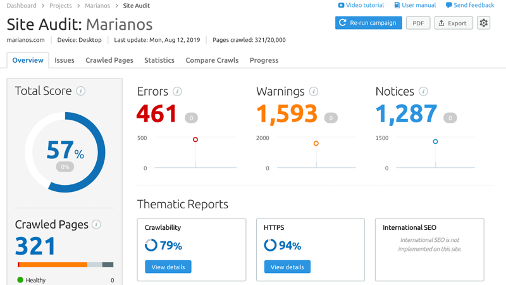
Within a few minutes, you’ll see where your website stands. SEMrush gives you an audit score and identifies the errors on your site that you’ll need to fix to start speaking to the search engine algorithms correctly.
Step 2: Fix the errors
Once you’ve completed the site audit in SEMrush, you can go into the audit itself and see how many errors your website has.
Clicking into these errors and warnings will show you which website pages have broken links, which pages have duplicate content issues, how many pages couldn’t be crawled, and more.
To the layperson, this information can get overwhelming quite quickly and you may not know where to begin.
If the majority of the information you see here can’t be fixed by you, it’s time to talk to a professional about what it means and how to fix it.
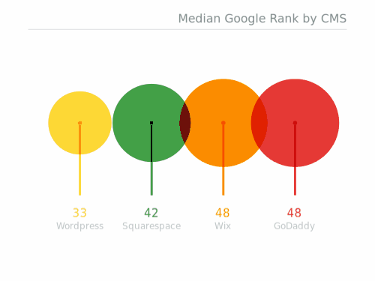
You may have heard of website builders like WordPress, Squarespace, or Wix. These are CMS and some are better than others when it comes to ranking in Google.
Wix currently holds the highest percentage of market share among individual website builders.
However, the website builder that gets the best results on average is WordPress. *Lower numbers are better here as they indicate Google Rank.
When it comes to high-quality search engine optimization work, you’re trying to impress Google. But you don’t have to start from scratch to see how to do that.
Using SEMrush, you can look in on your competition and see what keywords they are ranking for and how their traffic is being dispersed.
By simply inputting your competitors’ websites into the search bar, you’ll find some fantastic information.
In the report above, SEMrush shows how a Minneapolis law firm gets 95 out of 1900 total searches each month for the keyword “qrc”. This is 12% of their traffic each month to their website. You can also see where they are currently ranked in Google (6 means the sixth result on page one of Google).
Not only can you do this for your competitors’ websites, but you can also input your own as well and see how far behind or ahead you are for the keywords you want to be found for online.
Step 5: Choose a focused list of keyword phrases
Now your goals start to blend with your plan. If you set a target to double the traffic to the website, what keywords will help you get there?
With all, you learned from SEMrush’s reports on your competition, identify 10-20 keywords you really want to rank for online.
BONUS: Once you have your list, set each keyword into Google and see who is ranking on the first page for that phrase. Click on the first few results
and start seeing what type of content is featured on these pages. Is it long-form? Is it a video? Are there a lot of calls to action?
Step 6: Create a content strategy
Now that you have the list of keywords you want to rank for, you need to incorporate those keywords into your site.
This means inserting these keywords into page titles, descriptions, headers, and body content on the pages of your site. CAUTION: Do not just insert these phrases on your site willy-nilly. Each phrase should make sense to the page it is placed on.
It’s also vital to not over-insert these phrases on your website. Doing so will cost you dearly as you run the risk of getting penalized by Google for blackhat tactics.
A properly formed content strategy will see you identify the assets your website currently possesses and dictate which pages and blog posts you may need to create from scratch. If you have to create new pages or blogs from scratch, use your competition and industry resources as inspiration as content for your own site. Just make sure it’s unique to you.
When building content that includes phrases you want to be found for you want to make sure there is enough meat on the bone for the algorithm to truly identify what the focus of each page on your site is. It also needs to be 100% unique to your website. Plagiarizing your competition or other sites online is also considered a blackhat tactic and can be disastrous for your website’s long-term potential.
Step 7: Linking
You’ve audited your site and fixed its errors and you’ve evaluated your competition, figured out what keywords you want to rank for, and have written some high-quality content on your site focused around these keywords. All that’s left to do is watch the web traffic roll in, right? Wrong.
Think of your fantastic website as a New Year’s Eve party. It could be the biggest party on the block with the best music, food + drink and atmosphere. But if you don’t send out invitations to the party, nobody is going to show up.
Website’s don’t just rank in Google because they have good content. You need to tell Google about this content off of the website and link back to it.
Whether it’s guest posting on blogs, using social media, commenting on industry forums, or other ways to link to your site, the more highly authoritative websites that link back to your company site, the more the search engines will start paying attention to it.
Websites with high domain and page authority are prime targets to build your online credibility.
You can check a website’s domain authority (including your own) by going to this link.
Here’s an example of two Chicago shoe stores compared side-by-side in the Moz Link Explorer tool.
Although they are only a mile apart from each other in Chicago, Fluevog is galaxies ahead of Born With Soul online. The biggest difference? The number of high-quality websites linking to fluevog.com.
Fluevog has worked hard to build their online presence and as a result, are ranking for over 2000 keywords in Google nationally, while Born With Soul can be considered irrelevant online.
The takeaway? If you’re a reseller of both of these company’s shoes, which one will be more beneficial to write a guest blog on? The answer is clear.
How to set realistic SEO goals
And so, “how long does it take for SEO to update?” If you’ve completed the step-by-step guide above then it’s time to reset your goals. When it comes to answering the question “How long does SEO take to work?” it completely depends on how authoritative your website is now, how authoritative your competitors are and how much time you’re willing to invest to improve.
Most often, the time investment is too much for companies and they hire digital marketing agencies to handle their SEO.
If you put your search engine optimization in the hands of an SEO company, how do you know if they are doing a good job for you?
Talk through your goals with them. And know the following going into that conversation:
SEO is a never-ending process
Ranking in Google organic results doesn’t happen overnight or even weeks most often
Companies can’t guarantee results (If they guarantee you page one results, STEER CLEAR)
They should offer a website audit and content strategy
These are baseline items. If a company balks when bringing up any of these, it’s best to look for another company.
So how long does it really take for SEO to work?
How long does it take for google to update SEO? Just like it was said at the beginning of this post, it’s a difficult answer.
There are so many different factors to consider like what industry you’re in, how competitive it is, the health of your website today and so much more.
What’s important is to have realistic goals. Many people want to double their traffic and rank on page one for every keyword they choose. It’s simply not the reality, especially if you’ve never put work into SEO before.
What’s most important is steady growth. If your keywords continue to rise and your traffic continues to rise it’s a clear indicator that the search engines like the work you’re doing. And over time you’ll see more inquiries to your business and a better bottom line.
Here’s an example of a trajectory to expect in the first year of search engine optimization.
So does it happen overnight? No.
Will you see results in weeks? Possibly.
Will you see drastic increases in your traffic in months? Potentially.
Will it take a focused strategy month over month? Certainly
Since most content starts with written words, it doesn’t matter what type of content you produce, you can benefit from knowing the secrets of professional writers.
One of the biggest struggles content marketers have is producing enough content and simultaneously keeping the quality high. That’s something professional writers must work through on a daily basis.
So in this chapter, you’ll learn 12 secrets of professional writers: the tips and tricks that help them consistently produce a steady stream of high-quality content.
Stay in research mode at all times.
In order to keep your queue filled with great content ideas, you need to stay in research mode at all times.
Research shouldn’t be reserved for planning or writing sessions only. The quality of your content will increase substantially if you do it on an ongoing basis, as ideas pop into your head.
As soon as you get an idea, begin jotting down ways you could develop it.
You can wait until it’s time to produce your content to think about what you want to say. But it’s often easier to begin developing your ideas before it’s time to write. To do that, as soon as you get the idea, begin looking for:
Major points you’d like to make about the topic
URLs for sites that provide additional information
URLs for Web pages that illustrate your points
By stepping into research mode every time you browse the Web, you can often have your entire outline finished before it’s time to sit down and write.
Example #1
Example #2
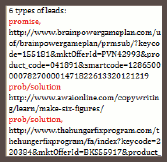
The idea for this post began with a simple idea, “6 types of leads.”
To create a rough outline, the writer entered the types of leads she was considering (in red). Then as she browsed the Web, if she found a good example of one of them, she entered the URL under the subhead.
That way, when it was time to write the post, she could easily find the Web pages again — and most of the research was already done.
As you read/browse the Web, gather resources to use as reference material.
Don’t just browse the Web. Research the Web. Whenever you’re online, be on the lookout for material that could help you tell your stories.
If you see a social media post or article that relates to a topic, grab the URL and paste it into the cell where you’ve listed your idea. Add notes so you know why you wanted to use the material, and when you finally sit down to write, you have much of your research already done.
Use Google+ and Evernote to file your research
Sometimes you don’t have an idea yet. But you see a Web page or report that has valuable information you know you can use.
When you see posts that have great research or fresh ideas, or if you simply want to keep it as a sample of what works, be sure to save those Web pages.
There are three ways to do that, and we’ve listed them in order, from simplest to most advanced.
Use Google’s +1 feature
When you +1 a Web page, Google keeps a record of it.
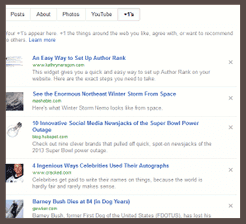
To see the pages you’ve +1’d, go to your Google+ profile, and click on the tab below your cover banner called “+1’s.”
You’ll see a list of the Web pages you’ve +1’d, with the most recent ones on top.
This creates a simple log of the pages you want to be able to find again later. But it doesn’t give you a way to add notes or categorize your pages.
If you’d like to save notes with your ideas, you’ll need to use the technique we talk about next.
Create a Google+ circle with no one in it.
Here’s how it works:
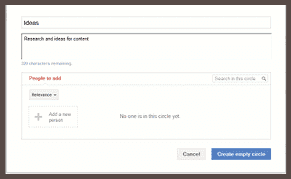
Create a new Google+ circle called “Ideas,” but don’t put any people in it.
Then, when you find a Web page you want to remember, you can “share” it with your Ideas circle. Since no one is in that circle, you’ll be the only one who can see it.
It’s a simple way to keep track of Web pages you want to be able to find later. Here’s how to set it up:
First, create your “Ideas” circle:
Go to your Google+ profile and click on the “Find People” link in the left sidebar.
Across the top of the page are three tabs. Click on “Your circles.”
3. At the bottom of the screen will be a row of blue circles.
Click on the first one, which says “Drop here to create a circle.” A pop-up will appear.
Enter the name of the circle: “Ideas”
Write in a description of the circle: “Research and ideas for content”
Click “Create empty circle.
Now, whenever you come across a piece of content that you want to save for future reference, here’s what you do:
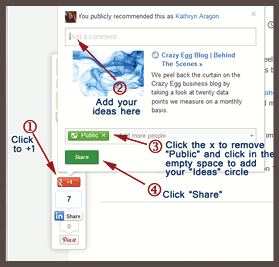
Hit the +1 button on that Web page (or copy the URL and manually paste it into your Google+ stream)
Write your ideas into the post.
Remove the circles you have showing, then click in the empty space to see a list of your circles. Scroll down to “Ideas” and click on it.
Click “Share.”
When you need to find a Web page that you saved, simply review the posts in your Ideas circle. Here’s how:
When you are on your Home page, select “More” at the top of the page.
The circles you have created will appear in a drop-down box. Select the “Ideas” circle to populate your stream. You will see all your Ideas in your
stream.
When you’re done reviewing them and you want to return to your normal stream, select “All” from the options at the top of your Home page. You will see posts from the people you follow, including any recent Ideas you have created.
One caveat: Your posts to the Ideas circle won’t populate anyone’s Google+ stream, but they could show up in a Google search if they contain the keyword being searched for.
Here’s a post we made for the sole purpose of capturing screenshots. It ranked on page 1 of Google!
Use Evernote.
Evernote allows you to save Web pages to a cloud-based file system. You create the folders and tags, and you include notes that help you find that information when you need it later.
This is the most advanced technique for saving Web pages for future reference. And the nice thing is, you can customize the experience to your own needs.
Create a folder for each writing project.
Create a folder for each category you create content for.
Create a folder for each client or department you create content for.
ORGANIZE YOUR SAVED WEB PAGES IN WHATEVER WAY THAT WORKS FOR YOU. HERE’S HOW TO SET IT UP:
In the upper left corner, beside “Notebooks,” click the small caret. A link to “New Notebook” will appear. Click it.
In the “Create a New Notebook” pop-up, write your project name or the category of the information you want to save.
For instance, if you write blog posts for several categories on your website, create a folder for each. When you find research that applies to one of those categories, save it in the appropriate folder. (We’ll talk more about that in a minute.)
Or if you create content for several departments in your organization, create a folder for each. Then when you find research that applies to one of those departments, save it in the folder labeled with that department’s name.
After you’ve created folders to store your research, set up the Evernote Web Clipper on your desktop.
From Google, search for “Evernote Web Clipper” and select the appropriate search result depending on your Web browser.
For instance, if you have Firefox, select the first option. If you have Chrome, select the second.
Evernote will add an icon to your search bar at the top of your browser.
Now you’re ready to use Evernote to file your research:
When you are searching the Web and find a page you want to save, click the Clipper icon at the top of your browser.
The Web page darkens and Evernote highlights the part of the page being saved. A pop-up also appears asking you to fill in the notebook you want this
page saved in, the tags you want to assign it, and any comments you may have.
Enter the appropriate information and click “Clip Article.”
That’s it. Your article is saved in Evernote in the file folder you specified
Then when you’re writing and need to find a statistic, here’s how you find it in Evernote:
When you are writing a blog post or writing a video script and you need a statistic or other fact, go to Evernote.com and log in to your account.
In the search bar at the top of the page, type in your keyword and click “Search.”
All the Web pages that you tagged with that keyword will populate the Notes panel below the Search bar. Each page is labeled with the page title and the date you saved it to Evernote.
Click on any of the search results, and it will appear in the reading panel on the right.
Of the three options for saving your research, Evernote takes the most up-front time. That’s because, in order to be able to find information later, you must add tags to the pages you save.
But Evernote is your most efficient way to find your information later.
Write in your own unique voice.
Don’t try to copy someone else. Your content should have an individual style that is unique to your personality or brand.
Once you develop your own voice, you aren’t done. (Writers never stop working on their writing skills. As a content writer, you need to continually hone your skills too.)
Style is your most prized possession as a writer, and it should continue to evolve over the lifetime of your career.
We are all apprentices in a craft where no one ever becomes a master.
Ernest Hemingway
If you haven’t found your voice yet, try this exercise:
How to find your voice
No matter what content you produce, it needs to be in your own voice or style. It should never seem like a copycat of someone else. That said, it’s only by copying skilled writers that you’ll find your own unique voice.
Typically, creative professionals go through three stages of development: imitation, mastery, and, finally, innovation.
You start out reading and studying the styles of writers you admire. Then you use what you learn to develop your own style.
Here’s an exercise that can walk you through the process:
Find 5 content writers whose style you enjoy reading
Select one piece from each that is representative of their work, or that you enjoy reading.
Select your favorite of the five writing samples, and read it slowly, word-for-word, out loud if necessary.
Study how that writers do it:
What the first sentence looks like.
Format of introduction.
How the article is structured.
How the topic is developed and ideas presented.
How the article is drawn to a close.
What the call to action was.
Now you try.
Write an article or blog post for your own brand that’s similar to the one you just studied. Try to format your article the same, and imitate the style of your chosen writer.
Do this for each writer.
Repeat this exercise for the remaining four articles. When you’re done, you’ll have five articles of your own, each written in a style similar to one of your favorite writers.
Review these articles.
Select the one that was easiest to write and sounds most “like you.” It should sound or feel a bit like your own (or your brand’s) personality and style.
Write the sixth article in this same style, making one small change to make it sound more like your own natural voice
Let your personality come through, your own way of talking, your individual way of seeing the world. You may keep the structure of your chosen writer. Or you may continue to use some of the writer’s style. But begin to make it your own.
With each article, you write, tweak this adopted style a little more until it begins to sound unique to you.
Your goal is for someone to say, “When I read your posts, I can hear you talking.” That’s voice. And it should be as unique as you are.
Talk about one thing only.
Each piece of content should have one point. Only one.
The first thing you should do when you sit down to write is to figure out what your bottom-line point is.
After you write, the first round of edits is to make sure your writing stays on point.
You need to be ruthless. As William Faulkner said, “kill your darlings.” Any word, sentence, or paragraph that breaks this one rule must be deleted — no matter how much you like it.
Depth and length should match.
There are two things that make writing difficult to read. One is not giving enough detail and giving only spotty coverage of an idea. The other is to try to give too much detail for the space allowed.
Whether you want your content to be long or short, make sure you only go as deep as your length allows.
Short articles should only provide a high-level discussion of your topic or in-depth coverage of one aspect of it.
Longer content has the space to provide more details.
Any length is acceptable. Seth Godin and ZAGG write as few as 100 words per post, while KISSmetrics and Crazy Egg blog posts range from 800 to 1,500+ words.
The idea is to know what your readers want and provide the depth and length that gets them engaged.
Find a unique angle to cover your topic
Every piece of content has a TOPIC, a POINT, and a SLANT.
Topic
a subject of discussion or conversation
Point
a major idea
Slant
a specific point of view
You may cover a trending topic that other content marketers are also writing about — but only if you add to the conversation, not repeat it. Try to make a new
point or find a unique angle for talking about the topic. Otherwise, find something else to talk about.
Spend as much time on your title as you do writing
Even the most valuable, interesting content will be ignored if the title doesn’t connect with readers. Your title should create interest and forecast the information people will find when they click through.
10 types of titles that tend to perform well are:
# of [Something Useful or Interesting]
Top # [List]
How to [Do Something Useful or Interesting]
How [Brand Name or Celebrity] [Does Something the Reader Wants to Do]
Best of [Category or Type]
Why [Something] Is [the Way It Is]
Interview with [Celebrity]: [Interesting Topic or Title]
Newsjacking
Breaking News
Secrets of [Something We’re Dying to Know]
Make the first sentence your best
You have about three seconds to hook your readers and get them reading. After your headline, it’s up to your first sentence to do the job.
Never mislead. Your headline and first sentence should take the reader smoothly to your main point. But do say something that makes people pay attention.
In business, it’s important to learn from your mistakes.
Babar Suleman
As a reader, I think, “Mistakes? What mistakes? Maybe I’m making one…” That little bit of doubt creates curiosity.
So you noticed, eh?
Russ Henneberry
The tone is casual and fun. I think, “Noticed what?” And I’m into the article.
Want better results on your landing pages?
Kathryn Aragon
You’ll hear that you should never ask a yes/no question. Readers might say no and move on. But in this case, everyone wants better sales results, so it’s a safe question.
Craft an irresistible lead (introduction)
The lead (or as journalists call it, the “lede”) is what writers call the introduction to your content.
For very short articles, it could be the first paragraph or two. For books, it could be the first chapter. But for most content, it’s the first 100-600 words: the intro and your point.
Your lead must be compelling without being overly long. It must be a tease about what’s to come without giving away the gold.
Types of leads that perform well in content:
Fascinating story
Little-known fact
Contrarian viewpoint
Promise of information available nowhere else
Breaking news
Kill the hype. Keep it believable
Your readers don’t want to waste time on content that isn’t accurate and trustworthy. So the rules are no hype and no stretching the truth.
No hype.
Hype tends to make people feel like they’re being manipulated — and no one likes that.
So tone it down. Write content to help people and add value to their lives. Use content to inform and entertain. Use sales copy to sell.
No stretching the truth.
People will only see you as a resource if they can trust you. That’s why it’s so important to research your topics.
If you present a surprising fact or figure, you need to back it up. Provide your source. If you quote someone or reference a book or report, link to it.
Make it easy for people to believe you — or they’ll stop reading and move on.
The Close is as important as the lead
Good content tells who, what, where, when, and why. Great content also tells “so what.”
Don’t let your content lose steam just because you ran out of ideas.
At the close of every piece of content, summarize your main point, then tell your readers how they’ll benefit from the information you provided.
If at all possible, go full circle by tying it back to the main point you made in the lead.
Plain writing is best
Short paragraphs, short sentences, and easy words are the most readable. So don’t try to win any writing awards.
Digital content is not what you learned to write in English class.
Shorter and simpler is your mantra for better readability.
Paragraph
6 lines max
Sentences
25-word max
Syllables
1-2 syllable
Edit. Edit. Edit.
Great writing never happens in the first draft.
The first draft is usually a good effort at figuring out how to put your ideas into words. As a result, they’re almost always badly written. For all writers.
Great writing happens in the editing stage. So when you write:
Just get your ideas down.
Write fast so you can keep up with your ideas.
Then put your best effort into your editing.
And don’t just settle for one round of edits. For high-quality writing, you’ll need to go through several rounds of review.
Translating “written” content into “new media”
We live in an exciting age. There was once a day when nearly all content was written: physical books, magazine articles, glossy brochures, and the like. Some marketers included recordings or videos in their arsenal of content, but for the most part, “content” implied “written.”
We realize the last few chapters seem to follow that same assumption. But nothing could be further from the truth.
In reality, all media starts with an idea that is expressed in words. So even if the narrative is delivered in a podcast or video, the material must be well organized and logical. They still must rely on the basic architectural structures used by writers.
So how do you transform your words into new media instead of a written piece of content? Here’s the process:
Define your topic and big idea.
Select the structure you’ll use to present your ideas.
(You’ll learn 12 structures in Chapter 6.)
Research, outline, and flesh out your presentation.
Decide on the best media for delivering your information.
Set up the technology for creating your content
Create your content
Edit, refine, improve
See how similar it is to the Creative Process for writing?
The point is not to worry about whether you should write or make a video. The point is to start creating content — in whatever format works for you.
So get creative. Tell your stories. Talk about your products and services. Engage your readers.
The best content marketing strategy will balance what your audience wants to know with what you want them to know (your marketing message).
1. Establish your goals.
While just about every brand can benefit from content marketing, your reason for putting time and effort into content can’t be, “Just because.”
“I think there’s a lot of brands out there today and even small businesses that are thinking, I need to get into content because that’s what everyone else is doing. But really you need to figure out why content is important to you and to the success of your brand.”
— Alex Kubo, VP of Ecommerce and Digital Marketing, Burrow
You should establish content marketing goals, align them to broader marketing and business goals, and determine the metrics you’ll use to measure success. If you do this at the very beginning, you can map all your subsequent efforts to those goals and make the best use of your time.
2. Know your audience.
You won’t effectively be able to generate content that resonates unless you have a clear understanding of who you’re trying to reach. Creating buyer personasis a popular method of distilling information about your target audience, like:
Hobbies they participate in or communities they are a member of
Where (or from who) they get their information about products and services
What goals they are trying to achieve when they purchase your product
How they make decisions about what products they will purchase
It’s okay to not have all of this information right away; just flesh out an image of your ideal buyer as much as you can, and make sure you’re creating the content they need. To learn more about your audience, you can conduct surveys or “listen” to conversations on the social media channels they frequent.
It’s also a great idea to have one-on-one conversations with customers and prospects — this will give you unrivaled insight into their motivations, and probably result in more than a few new content ideas.
3. Map the buyer’s journey.
Because serving the right content at the right time is so important, you also need to know how your customers move through the path to purchase. This will differ between B2B and B2C, and also by vertical.
Large, pricey purchases will likely have a longer buyer’s journey and include more research and product comparisons. These buyers will need more extensive information from you and have more questions that you need to answer. Small, inexpensive items may be purchased (or forgotten) in the blink of an eye, so bite-sized content may be more effective.
Once you have a clear understanding of how your customer makes purchasing decisions, you can map your content to their pain points and answer their questions before they have to ask.
4. Identify what differentiates you from your competitors.
One of the most important foundations for your content strategy is a clear understanding of what makes you different from your competitors. Competitive analysis can help you clarify what your competitors are doing and saying. Compare your messages and proof points to theirs. Find the areas that make you unique and give you an advantage and make content focused on that message.
5. Build your brand narrative.
Consumers identify with stories. One of the keys to a lasting brand and loyal fan base is a story that customers can connect with. Storytelling works because it connects facts with emotion, and it’s that emotion that will lead to loyalty down the line.
“Big brands are now under attack from smaller brands/start-ups who have a story…it’s a way of making your brand feel real and approachable, and so large brands need to connect with consumers too in order to make themselves approachable too. Therefore by going direct to consumers, brands are able to create and nurture relationships with customers rather than be this untouchable and unemotional behemoth.”
Line Skis knows the power of a brand narrative in connecting with its audience. The example below is from their About page, and in just two paragraphs and one image, they speak volumes about who they are and what they’re about. The line doesn’t need to sell to everyone — they have a target market, and they’re not afraid to speak directly to them.
5. Inventory and audit existing content.
If you’re working on a content marketing plan but already have a good deal of content, before you go any further, do a content audit to make sure you know what you already have. Then, review it for quality and relevance. (This should be done regularly, whether you’re developing a new strategy or not.) You can use Google Analytics or other analytics platforms to identify your most successful content.
6. Define your content mix.
My favorite marketing maxim is, “Just because you can — doesn’t mean you should.” But the reverse is also true: Just because you should, doesn’t mean you can. Identify the content types that resonate best with your audience and the ones you and your team can do well. Where there is overlap, those are the content types you should invest in.
“My recommendation would be to invest more time and effort into the main set of categories, build-out buyers guides, and other content that supports those key categories, and you are likely to see better traffic increases than if you were to build thin content across a wider range of categories and pages.”
You may have heard of the concept of “Big Rocks” in the productivity world. You can use that concept as you start to plan your content calendar. By starting with the “Big Rocks,” or the most substantive content you have planned, you can build in everything else around it.
Your Big Rocks should be clearly aligned to your audience and goals, meeting their highest needs. You can then turn those substantive pieces of content into derivative pieces. For example — if you have a buying guide, maybe there’s a piece of information in it you can turn into an infographic or engaging social post. Maybe it can spin off into a couple of blog posts.
This not only contributes to a cohesive content marketing message — but it also maximizes the value of your team’s time and energy.
Make sure you don’t forget about timely events, holidays, and specials that are important to your brand.
8. Maintain your content.
Before getting too far along with your content plan, make sure you have processes and workflows in place to help you maintain it. You’ll want to schedule regular content inventories and audits, make sure you have a plan in place to update and repurpose content where possible, and measure performance.
“Once you create a piece of content, it’s not just a forever asset, it’s something that you need to continue and iterate on, just like any other part of your marketing strategy.”
— Alex Kubo, VP of Ecommerce and Digital Marketing, Burrow
Many entrepreneurs make the mistake of looking at the wrong things in the wrong sequence while attempting to figure out how to build their business. Making mistakes is painful, expensive, and completely unnecessary. Since the stages of establishing a successful business are straightforward, too many people complicate things and end up nowhere.
For instance, exhaustive business strategies, 3-5 year revenue estimates, and so on are neither required nor guaranteed for each company’s success. In most circumstances, it is totally impractical to expect what you write on paper to manifest in the real world exactly as you say it will. The market is moving far too quickly. It’s difficult to anticipate exactly what your business will look like in a year, let alone 3-5 years, let alone ten years.
Business success is not something that just happens, it’s part of a plan. It’s also not just about the numbers either; we’re aiming for success in terms of time management, client relationships, work-life balance, and much more. With these things in mind, these are the five little steps to help you see what you can do to make your business a success.
The 5 Steps To Succeed in Your Business
Tip#1: Message to Market
Your marketing message is what captures your prospect’s attention, tells them how you can solve their problem, why they should trust you, and why they should choose to do business with you over all other options. Your marketing message should “talk” to your potential customer.
When you first start, your only priority should be to get your product to market. Building systems, hiring, Facebook ads, and so on are all priorities. All you should be doing is developing your minimal viable product (MVP) and attempting to sell it to someone. Consider your MVP to be the most basic version of your product that someone would be willing to pay for. It solves the problem, but perhaps not as well as you would like or with all of the bells and whistles.
How do you know whether you have finished this stage?
Someone has paid you.
Many entrepreneurs fall into the trap of becoming trapped in this phase and striving to make the product better and better before moving on to step 2. So don’t do it and instead go on to the next level. There will be plenty of time in the future for continued product improvement.
Tip #2: Marketing and Sales Engine
Marketing is the activity, collection of institutions, and processes for producing, conveying, delivering, and exchanging products of value to consumers, clients, partners, and society as a whole, whereas a sales engine is a cohesive sales and marketing strategy that provides consistent sales outcomes.
Now that you’ve received payment for your product, it’s time to create a marketing and sales engine. You are also changing your identity from creator to marketer during this time. To begin, ensure that you are measuring the most essential metrics of your marketing funnel because if you can’t measure it, you can’t manage it. Here are the three most important KPIs to monitor for your funnel:
Clicks/Calls
This is the “head of your funnel,” where people will click on your ads/posts, visit your business, or contact your phone number.
Leads
A lead is someone who expresses interest in your product or service by providing you with their contact information (name, phone, and email).
Customers
This is the result of converting a lead into a sale. A customer is a person or business who buys goods or services from another company. Customers are crucial because they provide revenue; businesses cannot function without them.
You can observe what percentage of people pass through each stage by tracking the figures for each stage above. This will help you to quickly forecast how many sales you may expect from your marketing efforts. For instance, your funnel could look like this:
100 clicks/calls
10 leads (10% conversion rate)
2 customers (20% conversion rate)
Assuming conversion rates remain constant, if you want four clients this month, you’ll need to generate twice as many clicks/calls.
Other metrics to keep an eye on at this point are:
Cost to Acquire a Customer (CAC)
This measures how much it costs to attract a single client through marketing efforts.
Profit Margin
This is the amount of profit you make on each sale. Take the revenue (what they paid you) and subtract the expenses (what you paid to supply the product/service) to get your profit. To calculate your genuine profit, include the CPA in your expenses.
Lifetime Customer Value (LCV)
This is the total amount of money that your business can expect to gain from working with a customer.
How do you know if you’ve completed this phase?
You’re overwhelmed.
The most common error here is that people skip the next phase and instead hire. When you do this, every problem in your company is magnified and compounded by the number of individuals you hire. Instead, concentrate on the next phase.
Tip #3: Create Systems
Systems are step-by-step instructions for completing processes in your firm. These are also known as Standard Operating Procedures (SOPs). Many business owners despise this aspect, but it is vital to the success of the company. You’ll want to write these SOPs in a clear and precise manner such that anyone with the bare minimum of technical understanding can complete them.
After you’ve completed all of your SOPs, you can create a job description for the person you want to recruit to perform each SOP. These are the positions you will need to fill.
How do you know if you’ve finished this stage?
You have finished your SOPs and job descriptions.
You’re probably feeling overwhelmed and lonely at this time. Fortunately, it is now time for you to move on to the following stage.
Tip #4: Build a Team
With your job descriptions in hand, you can start looking for the best candidates to fill them. This is the point when your identification transforms to management. People should be hired based on their ability to match your job description as well as their fit with company culture and values. Invest the time required to fully teach them on their role and your SOPs. It will pay off handsomely, especially when you suddenly find yourself with less to do.
How do you know if you’ve finished this stage?
You still have time.
All of the jobs you’ve been doing for so long are suddenly removed from your plate by your new hires. Because your team members are concentrated, the work often gets done faster and better.
Tip #5: Scale
Many businesses are uneasy about having additional time, and many feel bad about it. However, time is a gift. Don’t give in to your temptation to return to dull tasks. That is the purpose of your team. You now have the chance to do what you do best: think.
You should have a terrific product, a profitable marketing and sales engine, detailed systems, and an exceptional team by this point. Use this extra time to start strategizing how to take your company to the next level and actually scale.
Here are examples of some questions you may ask:
What are the most profitable marketing channels for you?
Can I put more money into this to obtain a better return?
Are there any more channels that I haven’t tried yet?
Are there any additional revenue streams I could add to my business?
Where can I improve my business?
Could my standard operating procedures be streamlined?
Is there anyone on the team who isn’t needed?
Is it possible to outsource work at a cheaper cost and still obtain the same result?
Is it possible for me to save money on certain products or services?
It’s critical at this point of your business to guard your time and give yourself time to ponder. This will be an ongoing battle, but one that you will undoubtedly win. Always test your concepts and customer segmentation using the business model camass.
Need Help?
If you would like help growing or scaling your business, please contact Mach 1 Design. We are a small, local firm with a global reach, and we have helped businesses of all sizes grow and scale. We can help you take your business to the next level. If you’d like to work with a firm that knows how to do just that, please contact us – we’d love to hear from you. Email us at [email protected] or call us at (469) 536-8478.
In 1885, Mark Twain published The Adventures of Huckleberry Finn. Grover Cleveland was inaugurated as president of the United States. The Statue of Liberty arrived in New York City…
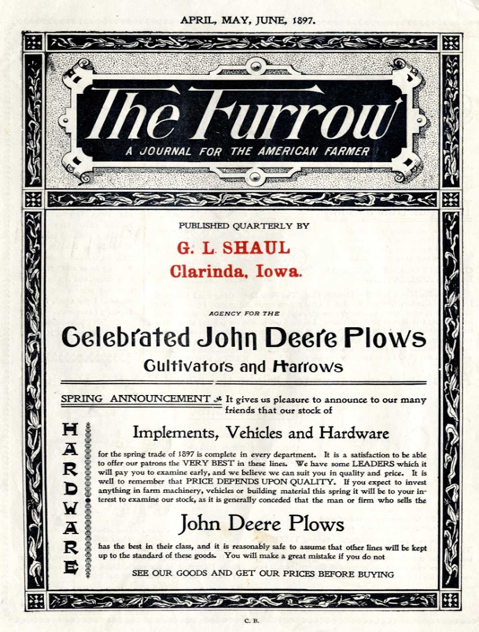
John Deere released the first issue of its magazine, “The Furrow,” to position themselves as an authority in the agricultural space by providing information and advice to farmers. (A furrow, as I found out after looking it up, is a trench made by a plow for irrigation and planting seeds.)
Source: Contently, where you can read more about the history of The Furrow, and in which the magazine is referred to as “the agrarian version of Rolling Stone.”
Despite the changes in technology, advances in understanding human psychology, and growing consumer expectations, the cornerstone of content marketing remains the same: to provide valuable content without — or with only a touch of — a sales pitch in order to build authority, community, and trust.
Content marketing caught on fast and has stuck with us over the last 135 years because it works.
In fact, even The Furrow is still around! What has changed is that marketers have refined their processes, learned to become more strategic and focused, and improved ways to measure the value of their efforts.
Content marketing isn’t easy. But with stalwart commitment and a lot of elbow grease, it is more than possible. So let’s fast-forward 135 years to look at the state of content marketing in 2020 and how you can build a strategy engine that works for your business.
What is Content Marketing?
Content marketing focuses on the creation and distribution of content to attract and retain customers. It’s one form of inbound marketing, which Hubspot defines as a strategy to “attract prospects and customers to your website.”
In other words, it brings users to you, instead of you going to them through direct marketing, social advertising, search engine marketing, and display advertising.
70% of your audience prefers to learn about products through content they seek out — not ads that are served to them.
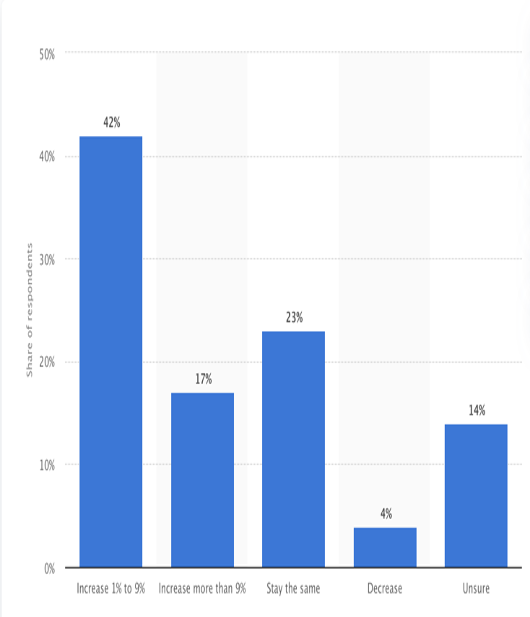
Brands today are investing in content marketing more than ever before. 59% of respondents to a mid-2018 survey reported that they expected to increase their content marketing budgets between 2019-2020.
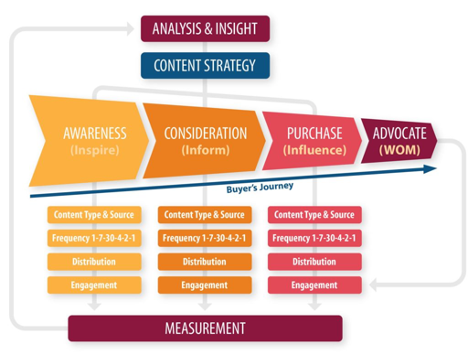
The goal of any content marketing effort should be to answer your audience’s questions where they’re looking for them — via a search engine, social medianetwork, or other — in a way that’s tailored for each stage of the buyer’s journey.
Do that well, and it will build your brand, drive customers to your website, and generate more leads. It can also build customer trust in and affinity for your brand — which improves customer retention rates — and brings long-term benefits for search engine optimization (SEO).
“In today’s industry, meaningful content is a must. Your potential consumer wants and needs to feel in control of their shopping experience. Be genuine, because consumers know when you’re too commercial and pushing to sell. So it is very important to create a bond with customers, educate and share your beautiful story through landing pages, videos, tutorials, infographics and blogs. If you explain to your consumer you have what they need and they believe in it, you will have a lifelong loyal customer.”
Common Content Types in Content Marketingstartegies
There’s more to content marketing than just blog articles and social media posts — much more. Here are 9 types of content you can consider if you’re doing content marketing in e-commerce. You don’t have to do it all; choose a few types that are right for your business, that align with your marketing goals, and that your marketing team can do well.
Blog posts.
Blogs can be used to answer popular consumer questions, tell stories about your brand and customers, and provide updates on product features and launches. They are also one of the best ways to build SEO value, so at least part of the strategy is often built around keyword research.
“Your blog opens up your website to be found for thousands of keywords with considerably more search volume than your product pages alone — this is where you get people aware of your brand, collect backlinks (for SEO), capture email address (for email coupons and retargeting on ads), and so much more. It hurts my heart to see how many brands miss this critical piece to building their eCommerce empire.”
Organic social media marketing content is a great way to engage with customers, build brand awareness, and secure and nurture leads. You can also use social networks as a method of distribution for other types of content, like blog posts, videos, andinfographics. Useful, high-quality content is likely to be shared among networks, expanding your reach even further.
“Trust in advertising and brands has declined so consumers are increasingly relying on recommendations from their friends and family to determine where to shop. Combined with ever-increasing CPCs on social platforms, and organic social sharing strategy is critical to cutting through the noise with trusted messaging from real, happy customers.”
One of the challenges of e-commerce versus an in-store experience is that customers aren’t able to ask real-time questions. Use buying guides to educate consumers on your product categories and help visitors make informed decisions without being too salesy.
Infographics.
Infographics communicate information in a visual way, either as a standalone piece of content or to promote blog articles, buying guides, and more. The advantage of infographics is that they are easily consumable and shareable.
Videos.
Videos are one of the most popular forms of consumable content today and can be used at several stages of the funnel. At the top and middle of the funnel, aim to inform and entertain. At the middle of the funnel, give consumers a better view of your product in action.
“Video is a medium that enables you to tell that story on a completely different level than a blog or photography.”
— Alex Kubo, VP of Ecommerce and Digital Marketing, Burrow
Videos are also great for your SEO strategy. YouTube is the second-most popular search engine in the world, just behind Google.
Podcasts.
Podcasts are relatively inexpensive to produce and can be a great addition to your marketing mix if your target audience aligns and if you have something of unique value to offer. They can help you establish brand authority and expand your reach.
Quizzes and tools.
Quizzes and tools can be used across B2B and B2C to help buyers make informed decisions (“Which riflescope is right for me?”) or even just to entertain.
BigCommerce merchant Bushnell wants to make sure visitors to their site have the resources to find what they need. Buyer’s guides and quizzes can help buyers new to the category learn what they’re looking for and help more experienced buyers more quickly zero in on exactly what they want.
Category descriptions.
Category descriptions refer to the content included on your product category pages. These pages are a great place to build SEO value, particularly for long-tail keywords. These long-tail keywords may have less search volume but they tend to have a higher purchase intent.
“Use semantic, human-readable language that isn’t overly specific to your brand. If you sell apparel, call your categories by what people would look for in a store — ‘T-Shirts, Jackets, and Pants’ work so much better than ‘Stylish Tops, Winter Warmer Uppers, and Leg Accessories.’”
— Brandon Jones, Business Unit Director, Salted Stone
Think of category pages as middle-of-the-funnel content — your user wants to buy a product like yours, they just need to get to know your brand story and view your available offerings.
Product descriptions.
Product descriptions are the copy on product-specific pages that convince your visitors to purchase. These descriptions need to provide all the information a user would get from shopping in-store — benefits and features, product specifications like size and weight, and descriptions of possible use cases.
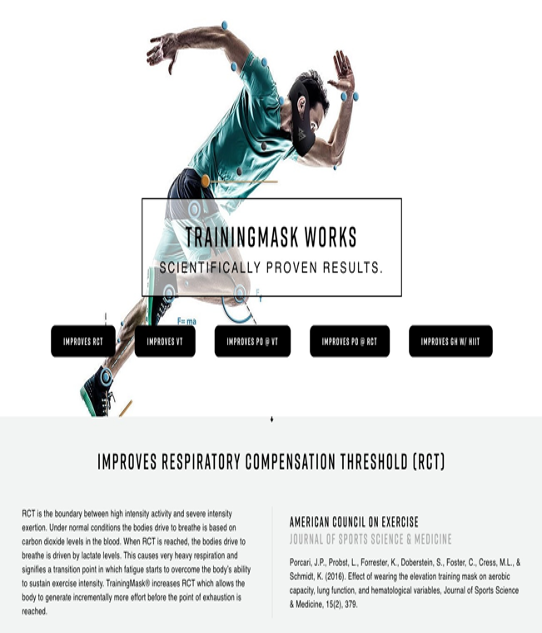
BigCommerce merchant TrainingMask knows their customers want scientific proof that the product does what it says it does — so they provide it on their product pages. They have information about not just benefits, but the features that get you there.
What Are the Benefits of Content Marketing?
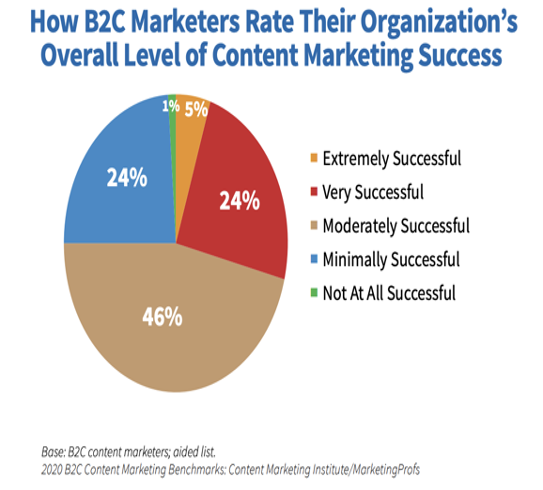
As competition for consumer attention increases, it’s getting more difficult to acquire and retain through traditional marketing methods like direct marketing and advertising. Content marketing provides consumers with extra value by educating or entertaining them. By providing information that is genuinely interesting to them, you’re more likely to draw them in and bring them back time and time again. Content marketing is widely used and highly successful across B2C businesses. According to a 2020 report from Content Marketing Institute, three out of four marketers report their organization’s content marketing is at least moderately successful.
“Videos, blogs, and social postings that show your products in action create opportunities for your customers to relate and identify a need in their own lives. It shows the type of person who uses your products and the context in which those products are valuable. Plus, it adds a certain amount of legitimacy to your brand, especially when your content has engagement from customers through blog comments, social media followers, and the like.”
— Ryan Garrow, Director of Partnerships & Client Solutions, Logical Position
Building SEO value.
Consistently publishing high quality content is one of the best ways to build brand and domain authority — with both your customers and with search engines. Just remember that this doesn’t happen overnight. It takes consistency, quality, and volume.
More posts mean more pages for Google to index, leading to more potentially ranking keywords. If you rank for more keywords, you’ll attract more inbound traffic.
“Invest in SEO as quickly as possible. With a new domain you may not see that organic traffic build for quite some time, but the faster you start the faster you can bring down that PPC budget.”
— Joe Chilson, Head Writer and Project Manager, 1Digital
Engaging prospects and customers without selling.
One of the keys to providing a smooth buyer’s journey is to begin by providing value and sparking engagement without a hard sell. Think of it as a service you’re providing that has the added benefit of keeping your brand top-of-mind.
“So many people are engaging with online influencers who are acting like brands. Brands need to begin acting like online influencers and building communities. The best way to do this is through content.”
If you’re providing content that is valuable to consumers, they’ll keep returning to your site even if they don’t plan to make a purchase — and that is the foundation of a long-term relationship.
“Your potential customers have already given you some indication that they want what you have, so by offering videos of your product in use, sizing charts, or an infographic on features, you are putting yourself ahead of your competition and giving your potential customer that much more of a reason to convert and make a purchase.”
To build trust among your prospects and customers, you want to establish your brand as an authority in your vertical. If you’re selling outdoor products, for instance, your target audience will trust you more if they know you can answer their questions about those products or related activities.
“There are a lot of things that content marketing can accomplish, but at its core content marketing enables you to build trust with your consumers/customers. You’re the expert. Convey that to your customers and the ROI will come back in droves.”
What is a Content Marketing Strategy (And Why Do You Need One)?
A content marketing strategy should be a high-level roadmap detailing your target audience, goals, and key performance indicators (KPIs) for your content, and how those goals align to the needs of the broader business. It should also provide a broad outline of the content creation process — how your organization plans to ideate, produce, manage, and measure your content analytics.
“Tons of e-commerce brands are making a killing with Facebook ads and Influencer marketing. The problem is once you stop the ads, the sales will stop too. This is why a long-term content strategy is so important. Not only can you get long-term traffic, but you can tell a better story through branded content. Powerful content can amplify your advertising effectiveness and also position you for long-term organic traffic.”
— Darren DeMatas, Founder, Ecommerce CEO
It’s important to take the time to document your content strategy. Having a documented strategy can make your organization’s efforts more successful, and it’s also a sign of a more sophisticated content organization. In the Content Marketing Institute’s B2C survey, only 33% of all respondents reported having a documented content strategy. But, of the respondents belonging to a mature content organization (you can read the full report for more information on how the institute defines “mature”), more than half had documented their strategy.
B2B marketers have tried everything under the sun to improve on-page SEO. Using all the keywords. Writing 5,000-word posts. And then going off-page to promote the post to everyone. But you’re still missing one key ingredient in your on-page SEO optimization: mini-infographics.
With them, your content engages. Without them… not so much.
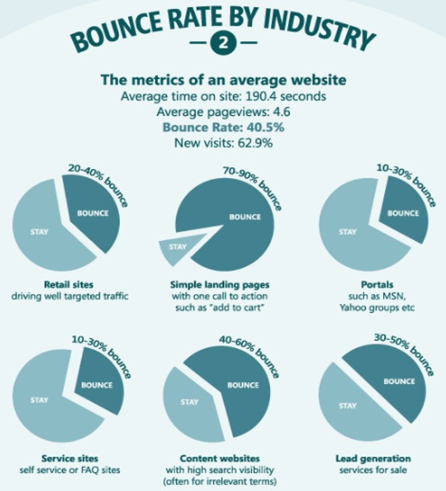
What does the engagement for all those long posts of yours, as measured by bounce rates, look like? Here they are by industry:
If your bounce rates are shockingly high, you’re not alone.
There is so much content available online. Why should people in the busy B2B sector read your post and not someone else’s?
Marketers need to get creative. Don’t rely on just text to do your work for you. Start creating visuals—specifically, mini-infographics.
How Do Mini-Infographics Improve On-Page SEO?
There is one reason why B2B marketers are struggling to retain audiences with their content. Online users don’t want to read that much text. They don’t have the time.
Users want only two things from your content: (1) to skim through it and (2) to find the answer they were looking for.
That’s what we learned by conducting a focus group among our B2B customers a few years ago. We showed them two articles that we scrolled through very quickly.
The feedback we received included two major points:
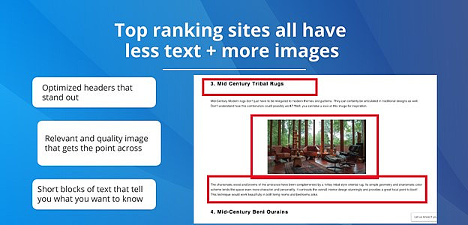
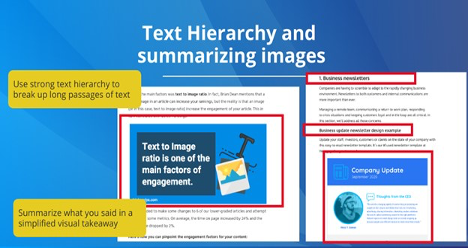
Text that is divided into headers makes it easier to skim.
The readers were drawn to articles that included visuals every 100 words or so.
In other words, to reduce bounce rates, you need to change your text-to-visual ratio.
That’s because attention spans have been decreasing over the years. If content doesn’t grab a user’s interest within seconds, that person will leave your page.
What’s one of the on-page SEO factors that helps you rank—and reduces bounce rates? Relevant visual content.
You need to shorten the text you write. And to get your message across to your audience, instead of the text you would have used, use more mini-infographics.
How to Design Graphics That Help Your Page Rank on Google
Don’t have a graphic designer on staff? That’s fine, you can always use an online infographic maker. Online platforms offer templates for you to customize.
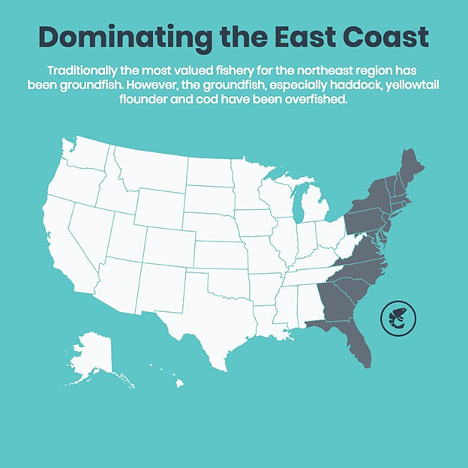
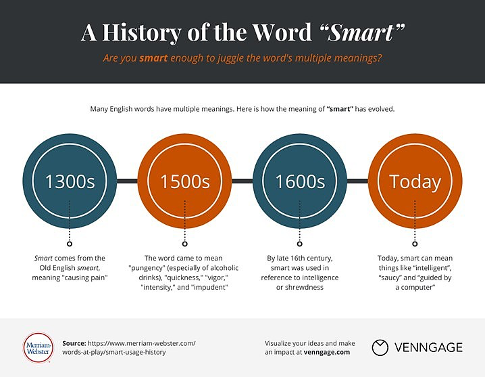
But don’t let more options confuse your goal. This on-page optimization exercise is about creating mini-infographics, like this map:
You want to summarize your information and give visitors a reason to move on to the next section of your text. And then the next, and the next, and so on—till they reach the end of the page.
The intent is to encourage more micro-conversions—small steps that lead users to major conversions, such as signing up for a newsletter and completing a sale.
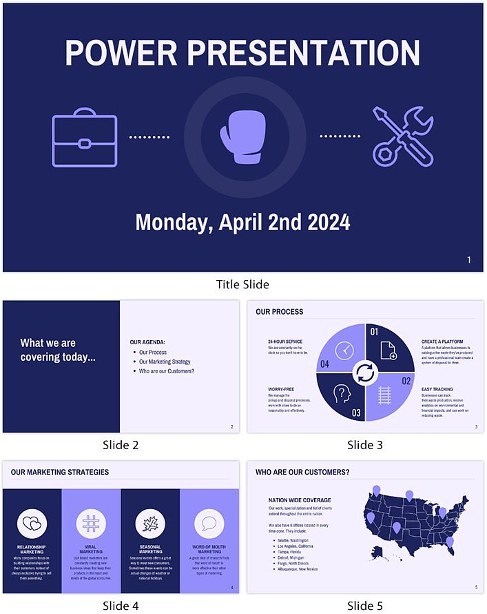
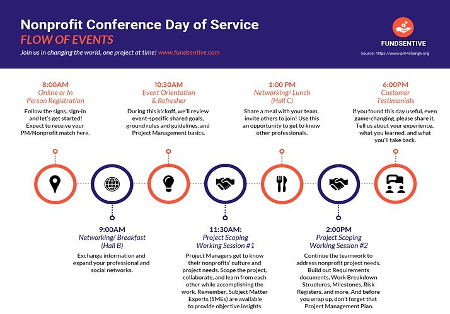
Even if you have a longer visual, break it up into smaller graphics. For example, a longer presentation can easily be divided into smaller sections, like this:
Source: Venngage
Insert those mini-infographics every 100-200 words to break the monotony of text and move readers down the page.
To create mini-infographics, follow a few design tips when using templates:
Keep plenty of white space between elements.
Don’t go overboard with color use; 2-3 colors are enough.
Use color contrasts and relationships to build out a color scheme, explained in this video:
Use a maximum of 2-3 fonts—and use readable fonts for the body.
Keep elements aligned so the visual looks professional.
Group elements according to hierarchy or similarities.
Icons are your friends; they tell a story in an instant.
Use branding elements, such as your logo, colors, and fonts.
Use those tips to design mini-infographics that make your pages more attractive to audiences. That’s how you can lower bounce rates and get your website to rank on Google.
What Kinds of Mini-Infographics Influence On-Page SEO Factors?
If you’ve seen infographics, they tend to be longer and larger visuals because they attempt to be comprehensive. But to improve on-page SEO optimization, you need shorter and smaller graphics.
Mini-infographics summarize key points. They work alongside text hierarchy—titles, headers, and subheadings—as follows:
What does a content summary look like in action? Here’s an example of a mini-infographic that’s packed with information:
Note how the graphic is still short enough to give users a reason to stay on your page. Plus, it encourages them to click on your call-to-action button.
That graphic could easily have been a long page that users would have to scroll forever to get through. Instead, the mini-infographic gives them the information they need at a glance.
Charts, like the following example, tend to draw the eye of the user. The chart uses bold colors and fonts to get to the point. It’s easy to skim, and it gives the reader a break from just text.
One more important point when you’re adding visuals like mini-infographics to your posts: Don’t forget about optimizing the images—particularly by adding alt-text, which can also help your website rank on a keyword.
Conduct On-Page SEO Analysis to Incorporate Mini-Infographics
I’ve shared why you should create mini-infographics for your new posts. But what about the existing content on your site? It’s time to do some on-page SEO analysis.
Use Google Analytics to study your bounce rates. What are the keywords for those pages? What’s the bounce rate and rank for pages with those keywords?
Not all pages will need a revamp. But if your bounce rates are higher than other pages on the same topic, those pages will need mini-infographics.
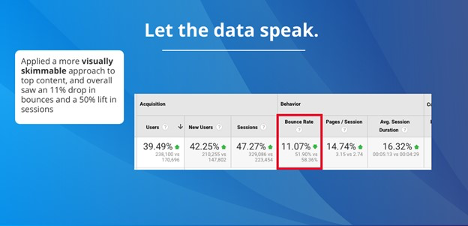
After updating a page with a high bounce rate, we found a huge drop in bounces:
Now it’s your turn to experiment on your site. Update your text to be more skimmable. Use shorter sentences and more headings. Write a line summing up your points.
Then add visuals like mini-infographics and charts every few hundred words.
What I’ve suggested in this article may be a new method for you. But if you practice creating more graphics, you will get better at it.
And the result will be higher-ranking pages with lower bounce rates. That’s a win-win in any book.
If you would like to add Micro-Infographics to your thought leader content, let us know at [email protected] or call us at (469) 536-8478.
We are going to go over all 48 digital marketing definitions so you can get familiar with the right terms!
The Marketing Definition Are:
1. CTR – Click-Through Rate
Click-through Rate identifies the percentage of people who click on link. Usually placed in an email, an ad, website page… etc. The higher the CTR percentage, the more people went through. CTR is extremely important for many parts of the Digital world.
2. CPA – Cost per Acquisition
Cost per Acquisition is a pricing model where companies are charged by advertising platforms only when leads, sales or conversions are generated. It’s been around for awhile but has been generating much more traffic as a common pricing model in late 2013 and early 2013. Best part about CPA is you are only charged for the results that you want.
3. CPC – Cost per Click
Cost per Click is a pricing model where companies are charged by publishers for every click people make on a displayed/test ad which leads people to your company’s website (hopefully to a landing page!).
4. CPM – Cost per Thousand
Cost per Thousand is a pricing model where advertising impressions are purchased, and companies are charged according to the number of times their ad appears per 1,000 impressions. It’s definitely a favorite form of selling ads by publishers because they get paid regardless by just displaying ads. CPM model really only makes sense if you are trying to increase brand awareness.
5. Conversion
When a visitor takes the desired action while visiting your site, it is called conversion. This can be a purchase, membership signup, download or registration for newsletter.
6. Impressions
This term is used to define the number of times a company’s ad will appear to its target audience. Impression could also be related to a website and the number of times the web page appear in total.
Example of how impressions work: 1 visitor could view 5 pages which would create 5 impressions. 2 visitors could view 5 pages which would generate 10 impressions.
7. Keyword
A keyword is word or phrase that your audience uses to search for relevant topics on search engines. If you are a flower shop, a relevant keyword could be “Buy Red Roses” [short keyword] or “Looking to purchase roses from a flower shop” [long tail keyword]
8. Organic Traffic
This is traffic that is generated to your website which is generated by a Search Engine. This could be traffic from Google, Yahoo or Bing. It’s also known as “Free” traffic. Organic traffic is the best type of traffic!
9. Paid Traffic
Paid search is when a company bids on keywords and makes advertisements around those keywords to be displayed on search engines. These results appear separately, either on the top, bottom or right side of a search results page. Paid traffic also encompasses any form of paid advertisement that directly points to your website.
10. SEO – Search Engine Optimization
Search Engine Optimization is a way a company optimizes its webpage allowing the website to rank higher on a search engine’s results page (SERP). The higher your ranking, typically more traffic is generated (if the keyword has traffic) and more targeted traffic.
Search Engine Results Page is the list of results provided by a search engine after a search query is made. Essentially, if you are looking for where your website ranks for “Best Digital Marketing Agency” a SERP report will let you know that your website is ranked #4. Meaning that your website is in the Fourth position (1st page).
13. Domain Authority
This is a scale from 1-100 that search engines use to determine how authoritative a company’s website is, 1 being the lowest rank and 100 being the highest. The higher your domain authority the more Search Engines trust you.
14. Keyword Stuffing
This is the practice of using too many keywords in content in hopes of making it more visible on search engines. You will be penalized by search engines if you resort to it. Never keyword stuff, just provide great and valuable content.
15. META Description
The META description is the few lines of text that appear on the search engine results page.
16. RSS – Really Simple Syndication
Really Simple Syndication is a technology that allows users to become subscribers of content and ultimately get automatic alerts if updates are made. They would need an RSS Reader which is where they receive all the updates. Here are a few popular RSS Readers:
This is a way of marketing where the audience is encouraged by companies to pass on their content to others for more exposure. Usually, a successful viral marketing campaign has an easy share functionality. If you had to pay a lot to generate awareness, it wouldn’t be considered “Viral Marketing” (it would be considered paid traffic).
18. Subscriber
A subscriber is a person who allows a company to send him/her messages through email or other personal communication means. These subscribers are high value to publishers and businesses alike. Subscribers keep coming back!
19. Social Networking
Social networking is the practice of using web-based platforms (or mobile) to build online communities where people share common interests or activities. The most common social networks are: Facebook, Linkedin, Twitter, Pinterest… just to name a few.
20. Landing Page
This is the page on a company’s website that is optimized to act as the entry page to a site. When redirected from external links, this is where the visitors will be led back.
21. KPI – Key Performance Indicator
KPI’s appear in all types of marketing and businesses use them to measure the success of their campaigns. Your KPI can be any type of analytic like a click through rate, engagement rate, bounce rate and so on. We will talk about several marketing terms that be can key performance indicators in your campaigns.
22. CPA – Cost Per Acquisition
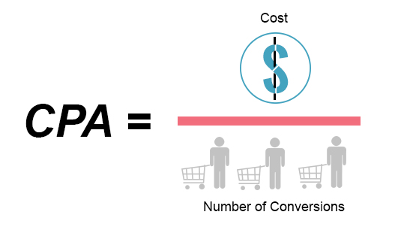
This is a metric used to determine how much it costs to acquire one customer. You can calculate this by dividing the total cost of your campaign by the number of conversions. This metric is important because it actually shows you how much you are spending per conversion. If this cost is too high, you should consider reworking your marketing campaign.
23. Lookalike Audiences
Lookalike audiences are built using email lists. This is a way to target users that are similar to the ones you already have. You can upload your email list to your Facebook ad campaign and it will take these emails and find similar users to target. You can even exclude the emails that you upload if you do not wish to advertise to current customers. With lookalike audiences, you’ll be able to easily reach new customers that are similar to your existing customers. If you do not have an email list, work on acquiring quality subscribers with these seven tips!
24. A/B Split Testing
When running any type of advertisement, it’s best to split test. This means you will have 2-3 similar ads that are all running at the same time to see which performs best. You can run the same image and switch up the copy or vice versa. A/B split testing will help you better target your audience by showing you which advertisement people liked more. When you are finished with your split test you will be left with an ad that performs great and helps you capture those potential buyers!
*This can be applied to email marketing as well.
25. CPI – Cost Per Impression
CPI measures how many times your ad appears on a site whether or not the users actually sees or interacts with it. This is similar to the marketing term “reach” but reach measures how many people see your content and impressions measure how many times your ad or content was displayed. Impressions build brand recognition while reach will help you build your brand. You can learn more about the differences between reach and impressions here.
26. Lead Generation/Lead Magnet/Lead Nurturing
These three marketing terms go hand in hand. Lead generation is exactly what it sounds like – how your business generates leads or how you grab the attention of your customers. A lead magnet is a small giveaway, free ebook, guide, etc. that your business offers to customers in exchange for their email. A lead magnet is a tool that is going to help your business capture those potential customers. Once a potential lead becomes a lead, you will need to nurture them until they become a customer. Typically business nurtures their leads through their sales funnel. Lead nurturing can be in the form of sending emails, retargeting them on social media, or actually calling your potential customers to follow up with them.
27. CTR – Click Through Rate
When running a social media advertising campaign, the click-through rate shows how many times an ad was clicked on by users. In order to calculate your CTR, you will need to take the total number of clicks your ad received and divide it by the number of times it was shown (impressions). Then convert that number to a percentage.
*You will see this term again in our email marketing section*
28. Engagement Rate
Blog, Facebook posts, tweets and photos on Instagram all have engagement rates. This is how much users are interacting with your brand. How many comments did you get on that post? How many shares did that blog receive? Usually the higher your engagement rate is, the better your content is – which is great for SEO. If search engines see that users are interacting with your website and social media channels you will be viewed as a notable source in your industry.
29. Remarketing
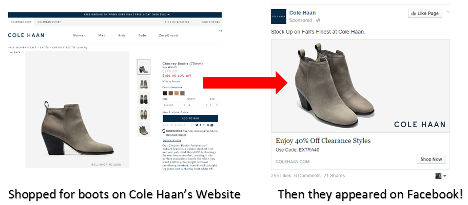
Chances are you have seen remarketing almost every day. If you are shopping online and are viewing a pair of shoes, this pair of shoes will most likely show up again on another website you visit. Remarketing is a tactic used to get customers who did not make a purchase back to your site.
If your business sells more than one product you can set up carousel ads to appear on other sites as well as social media channels. These ads are composed of several products that your customers have already viewed. Since they have already looked at these products, they are probably interested in them and are more likely to buy if they see the product again.
30. Relevancy Score & Quality Score
When running campaigns on Facebook, you will receive a relevancy score for your creative and copy in your advertisements. This score is given to each of your ads by Facebook. It is a way for them to decide how relevant your advertisement is and how it compares to other similar ads.
Google essentially does the same thing for your paid search ads by giving you a quality score. Many factors go into your quality score, and it can be improved over time.
Why should you care about your relevancy score or your quality score? Well, the higher your score, the more your ads will be shown over your competitors and the less money it will cost to do so. A better score lowers your cost per click. Not every click is going to be a conversion so getting your CPC as low as possible is key.
31. B2B and B2C
Business to business (B2B) and business to consumer (B2C) are two marketing terms that describe who businesses interact with. Do you market to other business or directly to consumers – our social media experts can help you decide which platforms your business should be on. You strategy is going to look a lot different if you are targeting customers instead of businesses or decision makers. There are some social media channels that B2B companies should be on that B2C companies should not be on. Your ad strategy if you are targeting other businesses is probably going to be different that an ad strategy that is targeting consumers. Make sure you know who your audience is!
32. CTA – Call To Action
A call to action is usually a button used to get your customers attention and make them click, purchase, give their email or any other action you want them to take. A call to action can be used in social media advertisements, email campaigns or on your website. Your CTA should be big, bold and be able to grab your customers attention. An effective CTA is also short, sweet and to the point. When someone lands on your website they should immediately know what action you want them to take whether it is to shop a sale, enter their email or browse your newest products.
33. Buyer Persona
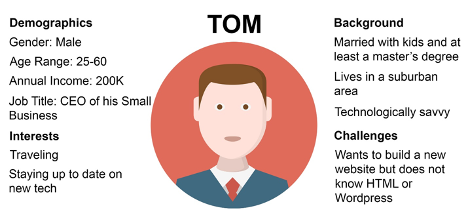
A buyer persona is something that you or your marketing team create that will give you a better idea of what your potential customers look like. This will include demographics like gender, age and interests. This is not just some made up persona. It is based on research of your target market so that your customers’ buying motivations, behaviors and goals are considered. Zeroing in on the demographics of your potential customers is an important step in your marketing strategy so don’t skip it!
34. Pixel
This is a snippet of code that is inserted onto your website for tracking purposes. It can gather analytics and data on your customers and their movement across your website. You can also use pixels to retarget customers with Facebook. Since the pixel on your site is tracking every customer that visits, you can use this data to target them in future Facebook ads.
Your pixel will look like a bunch of words and symbols if you are unfamiliar with HTML but all you really need to worry about is copying and pasting it in the correct place on your website. Facebook provides great tutorials on how to do this for almost all major website platforms.
35. Thank You Page
A thank you page is imperative if you are an ecommerce business. Why do you need a thank you page pixel? Something we see often is customers going through the checkout process and the site not tracking their conversions. A simple thank you page is all you need to track your ROI. This page can be added after people make a purchase on your site but if you are not an ecommerce business you can add a thank you page to your contact form. This will show you where your customers are coming from and make tracking your conversions really easy!
Search Engine Marketing Terms
36. SEO
Search engine optimization or SEO is the organic way to move your site up in search engine rankings. There are many moving parts to SEO such as selecting target keywords that you want your business to rank for, optimizing your pages with those keywords, writing blogs, and acquiring backlinks. Our digital marketing specialists are experts in on-page optimization, blogging, and acquiring backlinks and can help you quickly optimize your site! This method of search engine marketing takes time as the search engines will need to crawl your site to pick up on any changes you make. If you want to rank now, there is a quicker way, but it will cost you.
37. Business Blogging
This is quite the same as “regular” blogging but is optimized for businesses. The articles that are usually found in a business blog are keyword optimized and are created to provide educational, helpful and professional insights. They are also typically bundled with a downloadable offer such as eBook, case studies, checklists, etc. To sum it up, this type of blogging is usually meant to grow your email list.
38. PPC
Pay Per Click has similarities with SEO but these are paid ads that run on Google. PPC is instant. As soon as you set up your ad campaign, you can begin ranking immediately. If you have the budget and you are willing to spend it, you will be at the top of Google search results in no time at all. PPC also involves keyword research but instead of on-page optimization, you will need to create ads. Ads include two short headlines, a description, and a link to your website or landing page. You can also include extensions like your business’s phone number or links to additional pages on your site.
SEO and PPC work great individually, but together they can skyrocket your business! Learn more about the differences between these two digital marketing terms and how to use each of them with our beginner’s guide to SEO vs PPC.
39. DA – Domain Authority
This is a number 1-100 that is assigned to websites by Moz, a marketing analytics company. The higher your Domain Authority, the more powerful your website and higher your chances of ranking. When doing keyword research, domain authority is a metric that will help you determine whether or not you will be able to compete with the companies that are already ranking.
For example, if your DA is 20 and you do a google search for your keyword and the websites that appear all have DA’s of 50-70, you are probably not going to be able to rank for that word.
40. PA – Page Authority
Each page on your website has a rank as well as your site as a whole. It’s important to make sure you are distributing page authority evenly across your site. If you have one page (let’s say your homepage) on your site that is ranking number 1 in search and has a PA of 100 that’s great but what about your other pages? The more pages that have high PA’s, the more likely they will be able to rank which means your business has a better chance of showing up in search results.
41. Bounce Rate
A bounce rate in terms of search engine marketing is when a user lands on your site and only views one page. Google Analytics will show you the bounce rate for your website. If this number is high, you will need to make some adjustments. The more pages a user views and the more time they spend on your site, the higher the chances for you to move up in search rankings.
*You will see this term again in the next section as it is a little different when it comes to emails.
42. Above the fold
Content that is “above the fold” is any content that appears before the user has to scroll. So what should go above the fold on your site? Your most important content as well as your H1 tag (for SEO purposes) and a call to action! If a customer lands on your site and they do not immediately know what is going on, there is a chance they will press that back button. The call to action on our homepage is to talk to an expert and “accelerate your marketing.” It is clear that we are a social media marketing and management agency and that we want you to contact us to talk to an expert about your social media marketing campaign.
43. List Segmentation
Segmenting your email lists can work wonders for automation. There are so many ways to break up your lists – by industry, age, location, new and returning customers and the list goes on. These lists can be used to create automation or to funnel into automatons. If you need help creating some killer automations to move your leads through your sales funnel, let our email marketing experts build your campaign! You can have a new customers automation, a returning customers automation or an automation for customers who have not made a purchase in a certain amount of days. However you want to segment your lists, there should always be a strategy in place.
44. Bounce Rate
A bounce rate in the email marketing world is the percentage of emails that were not delivered in your campaign. If your bounce rate is high, there might be as issue with your email or the domain that you are sending from so make sure you are always checking your bounce rate whenever you send out an email.
There are two types of bounces, a hard bounce and a soft bounce – two very important marketing terms that you need to know in order to run successful email campaigns.
25. Hard Bounce
In your email campaigns you will undoubtedly see bounces. Hard bounces are emails that were not delivered. There are essentially two reasons for this. The email could be wrong so if you do have a small subscriber list, check to make sure your email address are correct or you have been blocked. This is why it is so important to build your email list organically. This means that you have gathered emails from people and have their explicit permission to send them emails. Do not buy email lists. This can really hurt you in the long run – if enough people block or report you as spam your deliverability will plummet.
46. Soft Bounce
A soft bounce means that your email was delivered but bounced back because the user’s inbox was full, their email server was down at the time of delivery or maybe the email was too large. Some email APIs will continue to attempt to deliver to these emails several more times before they give up. If the soft bounces continue, eventually the API will remove the email address from your subscriber list.
47. Open Rate vs Total Opens
Some email platforms will show you an open rate as well as the number of total opens. It is important to know the difference between these two email marketing terms. Your email open rate tells you how many users opened your email. Sometimes people will go back and open the same email two or three times, especially if there is a coupon or special offer associated with it. Total opens accounts for every time your email has been opened.
48. CTR – Click Through Rate
While open rates look great on paper the click through rate is the metric you should be most concerned with. The goal of most email campaigns is to keep email subscribers engaged and keep them coming back to your site. Engagement can be measured by the open rate and click through rate measures how often they go to your site, or how often they click through. These metrics work together because without people opening your email there’s no way they can click through to your site.
43. List Segmentation
Segmenting your email lists can work wonders for automations. There are so many ways to break up your lists – by industry, age, location, new and returning customers and the list goes on. These lists can be used to create automations or to funnel into automations. If you need help creating some killer automations to move your leads through your sales funnel, let our email marketing experts build your campaign! You can have a new customers automation, a returning customers automation or an automation for customers who have not made a purchase in a certain amount of days. However you want to segment your lists, there should always be a strategy in place.
44. Bounce Rate
A bounce rate in the email marketing world is the percentage of emails that were not delivered in your campaign. If your bounce rate is high, there might be as issue with your email or the domain that you are sending from so make sure you are always checking your bounce rate whenever you send out an email.
There are two types of bounces, a hard bounce and a soft bounce – two very important marketing terms that you need to know in order to run successful email campaigns.
25. Hard Bounce
In your email campaigns you will undoubtedly see bounces. Hard bounces are emails that were not delivered. There are essentially two reasons for this. The email could be wrong so if you do have a small subscriber list, check to make sure your email address are correct or you have been blocked. This is why it is so important to build your email list organically. This means that you have gathered emails from people and have their explicit permission to send them emails. Do not buy email lists. This can really hurt you in the long run – if enough people block or report you as spam your deliverability will plummet.
46. Soft Bounce
A soft bounce means that your email was delivered but bounced back because the users inbox was full, their email server was down at the time of delivery or maybe the email was too large. Some email APIs will continue to attempt to deliver to these emails several more times before they give up. If the soft bounces continue, eventually the API will remove the email address from your subscriber list.
47. Open Rate vs Total Opens
Some email platforms will show you an open rate as well as the number of total opens. It is important to know the difference between these two email marketing terms. Your email open rate tells you how many users opened your email. Sometimes people will go back and open the same email two or three times, especially if there is a coupon or special offer associated with it. Total opens accounts for every time your email has been opened.
48. CTR – Click Through Rate
While open rates look great on paper the click through rate is the metric you should be most concerned with. The goal of most email campaigns is to keep email subscribers engaged and keep them coming back to your site. Engagement can be measured by the open rate and click through rate measures how often they go to your site, or how often they click through. These metrics work together because without people opening your email there’s no way they can click through to your site.
Is Social media too time-consuming and results too dismal?
Everyone is on social media. That’s why you are also juggling Instagram, Facebook, Twitter, Yelp, Pinterest, Snapchat (just to name a few) accounts. Are you getting the results that you were expecting?
Juggling multiple social media accounts is not easy. Firstly, they are relatively different and the people who use them are different, as well. They also use each and every one of them for different reasons. That requires lots of your time and consideration — because you want your efforts to bring the results.
Even with a social media dashboard consolidation tool, it is difficult. Social media is important. But instead of relying heavily on it, we suggest you adopt at least a couple of strategies listed below. This article will solely give ideas for retail businesses of any type — coffee shops, restaurants, hotels, car wash, hairdressers, etc. You name it. Ecommerce requires a different kind of approach; thus, we will leave it aside for now.
Here are the 5 Digital Marketing Alternatives
Strengthen Your Website
Website Organic SEO is as important or more so than your active Facebook or Instagram accounts. In fact, it may be even more important. The reason is, Google is used for search and if your website is well optimized for it, you’ll be discovered. That’s why you need to take the time to analyze your website. List the main keywords you want to rank for on Google search and make sure that your website is well optimized for these key phrases.
Here are the steps to follow
Identify and come up with a general Organic SEO strategy by researching and identifying the main keywords and overall website structure.
Make your website easy to navigate and make the navigation natural and page load speed is quick.
Have well-optimized content on your web pages. This means the text you produce should include the keywords you want to rank for.
Use original photos that are relevant to your business. Ensure they are well optimized for search. (Hint: The picture name should always be the main keyword of the page.)
Make sure all your titles and subtitles are optimized for search.
Make sure all pages are optimized for mobile users.
Connect your website to your social media accounts. Once you have people coming to your website, make sure you entice them to come and visit your shop. A strong website with relevant ranking organic SEO is a foundation for your success in search results and organic traffic. Remember that organic traffic is cost-free and can be very beneficial to your business with very high return-on-investment (ROI)
Use All That Google Has to Offer
Google is a tremendous tool for digital marketing. Not only should you rank high in Google search results, but you should also ensure that you advertise on it. Google Ads is one of the most popular digital advertising tools because it brings traffic that intends to find out more about your business.
For example, if your ad ranks for “hairdresser in downtown Miami”, it will be shown to people who are in fact looking for a hairdresser in downtown Miami — these people are your potential customers. By bringing them to your website, you’re one step closer to converting them into paying customers. Google search (organic or paid) has an advantage over social media posts. Its users intend to find particular information or a service.
If I am shown a hairdresser’s ad in downtown Miami on my Facebook feed, it may be redundant to me, because I may not be looking for such a service. Another important tool that Google has is Google for Business. It’s free and gives you an option to list your business on Google. People would be able to see the address, contact information, opening hours, etc. It makes the search much simpler for your potential customers and will also increase your traffic to the website.
Get Your Customers’ Email Addresses
Nowadays, having a loyalty program costs barely anything. If you come up with a simple registration form for your customers to become members of your brand’s loyalty program, it will give you the most valuable information — your customer’s email address.
By having their email address you’ll be able to send regular newsletters with various promotions and brand information. It is essential to have an audience and email marketing gives you that. This is a huge advantage compared to social media followers because your email content will definitely reach the people on your mailing list. This cannot be guaranteed on social media, as social media platforms control the algorithms and how the content is distributed.
When I talk about loyalty, I don’t mean having a membership card — everyone is bored of these and has definitely too many. Simply tie your customers to yourself with their email.
Re-engage With Your Past Customers
Customer relationship management (CRM) is a crucial component of your business’s success. If people visited your shop, they are likely to come again. Entice them! That’s where your email marketing strength should come in.
Don’t neglect your past customers. They are frequently busy and if you subtly remind them of yourself, they will be happy to return. For example, we are a member of a nice private club. It’s not convenient for us to visit the place every weekend as I seldom come to the area. However, I keep being reminded of my outstanding cash-back balance (loyalty program that they offer) from time to time and it keeps me enticed to visit the place again and again. Especially if there is some special occasion.
That’s why you must not neglect your past customer base. The conversion rates from the past consumers are much higher, and it takes much less effort and money to drive them back to your shop. Just have the right strategy. Don’t sound too desperate.
Get As Many Reviews As Possible
Consumers today are spoilt with choices. If I Google “hairdresser in downtown Miami”, I will be exposed to tens or even hundreds of options. How would I choose one? Based on consumer reviews. Google reviews are crucial, as Google is the first stop where people will hear about you. If they are happy with your Google reviews, they might check up on Yelp or Facebook and browse further to find out more about your brand.
Therefore, encourage your customers to leave positive reviews on Google. It costs nothing to them, but it can be a game-changer to your business. I noticed that some businesses ask people to write a review in exchange for a discount. I believe this is one of the ways to get the ball rolling, however, what is important is genuine and honest reviews. If someone leaves “great service” it actually is meaningless to a prospective consumer, because he/she won’t be able to get a better understanding of what they would be getting by choosing your business.
I wouldn’t trade discounts for reviews. I would strive to wow my customers so that they would love to share their experiences with the world.
Bottom line
I know We have been writing a lot about alternatives to social media and how businesses should start paying more attention elsewhere. I believe that social media is important, but it’s becoming very crowded and the results are hard to achieve and sustain. I suggest paying attention to alternative digital marketing strategies, but at the same time have a decent presence on social media.
We recommend about 10% of your digital marketing budget. I wouldn’t recommend relying solely on social media to drive traffic and customers. I notice this a lot. Many retail businesses, where I am, do not have a proper digital presence. They rely on Facebook and strive to get more followers. In the end, the consumer chooses their competitor, because the competitor looked more professional and better positioned himself/herself on digital space, such as website, organic SEO, and thought leader publishing, newsletter, or reviews on Google.
Don’t be one of those losing businesses. Win your customers! Wow, them with your organic SEO thought leader publishing and website customer experience. If you would like help with your digital marketing strategy contact Mach 1 Design at [email protected] or call us at (469) 536-8478
Content marketing focuses on increasing sales by providing what customers or clients are looking for when they are actively searching for it. The advantages of content marketing are numerous and the goal of this post is to help you realize how beneficial a content marketing strategy can be to your business:
What are the Benefits of Content Marketing?
Google Values Content
Generate More Sales
Aids in Sale Process Automation
Controls Conversation
Content Marketing Over Traditional Marketing
Enhances Brand Awareness
Builds Credibility
Yields Social Media Following
Drives Visibility
Ease Customer Service Team
Enables Sales Team
Scales Audience
Google Values Content
Google prioritizes high-quality content. Do you not believe me? Simply go to YouTube and search for interviews with Matt Cutts (the former head of webspam at Google). When asked how to rank higher in Google, he consistently says, “create fantastic content.”
Google is preoccupied with providing its consumers with search experiences that deliver the results they seek. High-quality content is frequently the most effective approach to give that experience. So, Google enjoys content. What does it matter? Everyone, in a nutshell.
SparkToro’s 2018 study was used to create this image. According to a SparkToro analysis from 2018, Google sends 10x more traffic to the average website than Facebook (and more than 10x for any other website). Content marketing significantly increases website traffic from your most effective traffic source or organic search.
Generate More Sales
Improving website traffic is pointless unless it leads to increased sales. Effective content marketing increases sales and frequently shortens sales cycles. The majority of your customers or clients will not be ready to buy from you or use your services the first time they hear about your company.
Before making a purchase, people go through a buying process. This buying process is known as “the customer journey,” and it is faster for smaller things than for larger products, which is typically labeled a “major purchase.” The current U.S. The average sales process requires 8-20 touchpoints to guide the consumer or client through their specific customer journey in order to obtain enough knowledge and trust to make a buy decision. To illustrate, below is an inbound marketing process.
People understand they have an issue that needs to be solved before making a purchase (awareness). They spend time researching and better understanding their challenge (consideration). Then they decide which solution is best for them (decision). A well-planned content marketing strategy assists your potential customers or clients at all three stages by educating them on what they’re looking for. Content marketing, therefore, helps by:
Getting your prospective customers one step closer to making a buying decision.
Developing a relationship with your target audience to increase their likelihood of working with your company rather than your competitors.
If that isn’t enough, inbound leads, those generated through web marketing have a 14.6% conversion rate, while outbound leads (those generated through cold phoning, direct mail, and so on) have a 1.7 percent closing rate.
Aids in Sale Process Automation
Cold sales call outreach is extremely challenging and delivers low benefits in comparison to the amount of work expended. People are busy, and none of them are looking for marketing services. Many of our clients have completely ceased doing cold outreach. Instead, they decide to concentrate on digital marketing, with content marketing receiving the majority of their attention.
When potential partners are ready to work with our clients, they reach out to us. They discuss their goals, determine the best method to help them improve, and determine if they are a good fit to collaborate with. In many circumstances, they are the right partner; in others, they are not. In any case, we assist each of those potential partners (customers/clients) in locating the best solution to help them expand.
Content marketing assists in the transformation of sales from forcing a customer to buy your product or service to being a valued resource that is ready, confident, and waiting when your customers or clients are ready to buy from you or choose your service.
Controls Conversation
It’s no secret that selling a product becomes a lot easier when your buyer is actively looking for what you have to offer. As an example, suppose you sell high-end sofas. Someone looking for a $200 bed isn’t going to be simple to sell to. They’ve already decided on the type of sofa they want by the time they step into your store. But what if you could talk to that person as they were looking for beds? What if you could convince them of the value of paying a premium for quality before they decided how much they were willing to spend?
It’s priceless to be able to steer the conversation when your most likely clients are educating themselves. Everything from car insurance to company software is the same. So why not write about these issues of discussion? Why not take command of the conversation while your consumers are deciding what they require? Your competitors are most likely beating you to the punch and stealing your finest potential clients.
Content Marketing Over Traditional Marketing
Nobody enjoys being disturbed in the middle of their day by individuals on the phone attempting to sell them something. Ad blockers are now used by 40% of internet users, and this number is growing over time. Banner advertisements can be an effective approach to promote your brand. However, spending money on TV advertisements and other forms of promotion that disturb your clients does not appear to be the most effective approach to win them over in today’s new environment.
Content marketing, conversely, enables you to build customer relationships by putting your brand in front of your customers in a way that helps them. So, pay hundreds of dollars for a 30-second television commercial or thousands of dollars for a static billboard? Content marketing is far less expensive and is way more effective.
Enhances Brand Awareness
Assume you manage an investment firm and intend to publish an instructive post that ranks first on Google for “how to invest in stocks.” Every month, 40,000+ people search for that precise term. Every year, you now put your brand in front of 480,000 potential clients. And that’s just for the precise phrase “how to invest in stocks.” Every month, another 40,000 individuals search for the exact phrase “how to buy stocks,” not to mention the various near versions. Every year, at least one million people look for this topic.
Builds Credibility
Every year, your investing piece is now seen by over a million potential clients. 25% of those people will click on your article. Assuming you devote time and effort into making the article useful to your audience, 250,000 people will now regard your brand as a thought leader and reputable information source each year. Many of those visitors will eventually become customers for you, or they will tell a friend about your website and turn their buddy into a customer.
Yields Social Media Following
Each potential consumer who discovers useful material on your website becomes a potential brand champion. Many of these readers will follow you on Facebook or Twitter to keep up with future items you create. Many of these readers will also share your content on social media with their friends and family, which helps to geometrically build your following over time.
Drives Visibility
Content marketing draws much more traffic to your product pages, both directly and indirectly.
Directly:
Assuming you create articles on your products or services, many of your visitors will visit your product or service pages after reading your articles especially if your articles link out to those product pages.
Indirectly:
When you create high-quality blog content, other websites will link to it. Each new backlink is viewed by search engines as proof that your post is a valuable resource. And each page to which your content connects is regarded as a more useful resource as well. So every time someone connects to that blog item that links to your product page, it gives a little love to your product page.
Ease Customer Service Team
Is your customer service or intake team answering the same questions on a daily basis? Take the time to provide an insightful answer to those questions, whether it’s how to reset your password or how to use your product. Compile them into a blog article or series of blog entries that your customer care team can distribute when they receive those common inquiries. Many clients will even get these answers through an online search rather than contacting your customer service team in the first place.
Enables Sales Team
Inquire with your sales or intake staff about the types of queries they receive on a daily basis. Create relevant material in response to these common sales questions/concerns raised by prospects. Give those items to your sales team now. Request that they improve these articles based on what they see as producing the best results for your team. Congratulations. With quality content and answers to frequently asked questions from prospective consumers or clients, your website has just become your new best salesperson (and it works for you 24 hours a day, seven days a week).
Scales Audience
Setting up display adverts of their items to customers who visit their product pages but leave the site without purchasing a thing is one of the most efficient marketing methods for e-commerce enterprises. Content marketers can use the same strategy.
How To Get Started with Content Marketing?
Consider the following: do I have the time to study content marketing and do it myself, or does it make more sense to collaborate with a professional team that does it every day? Download the Mach 1 Design content marketing guide if you like the first strategy. This will provide you with the step-by-step structure that we utilize every day to scale businesses through content marketing.
Mach 1 Design may be the appropriate content marketing firm for you if you’re looking for a partner to help you with content marketing.
Simply said, there is no better long-term marketing investment for your company than content marketing. It’s the marketing service that increases your ROI without confusing your customers. Now that we have a better understanding of why a content marketing strategy is useful, we should look at how to create one.Here’s what a content strategy at its most basic, and how to build your own in basic steps:
Brand and Value Proposition
Audience and Needs
Goals and Audience Connection
Measurable
Establish Message
Choose Right Channels
Collect Feedback
Storytelling and Strategy Improvement
Brand and Value Proposition
Determine your identity and what you have to offer. What exactly is your mission? What is your (personal or brand) global vision? What is it that you or your organization knows more about than others, is better at than others, and/or that people would like to learn from you about? Make a note of these. For the time being, choose one to three topics to write about.
Audience and Needs
Determine what people you could assist genuinely require by conducting study and speaking with them. It’s definitely a good idea to do some keyword research here as well. Determine who your target audience is – this will help you design a better strategy and content.
Goals and Audience Connection
Determine how you can assist the people in your audience, as well as what a fair goal you could reach for yourself with the help of content marketing. Could you, for example, give individuals advice? Would that be in the form of free stories or an e-book? If you’re already at this point, it might be useful to write (or amend) a simple value proposition. What product or service could you provide that genuinely meets the needs of your target audience?
Measurable
Link a few KPIs (Key Performance Indicators) to your objectives. It is recommended that you maintain track of no more than three major KPIs at a time. How many people will you be able to reach? How many people are going to read your stories? How many consumers will you serve in a certain amount of time if you’re selling something? Make sure the numbers are as specific as feasible, not too high but still posing a decent difficulty. Also, keep track of your results so you may adjust your strategy as needed.
Establish Message
With the trinity of Needs, Solution, and Result, create messaging that reflects your understanding of what your audience needs, how you can help them, and how it will benefit them. The Need, Solution, Result structure can be developed into a single piece, but it can also serve as the foundation for a three-part plot, leading your reader from a problem to your answer, proof of your solution, and a Call-to-Action. Perhaps the simplest content flow is three sections connected together in this manner, building up to a (paid) offer.
Choose Right Channels
Share where your audience listens and reads for the topic matter and type of narrative you’re sharing on a regular basis. What platforms are your target audience or potential consumers using? Conduct research, speak with individuals and test the response you receive through various channels.
Collect Feedback
Measure and track comments from your audience and customers on your messaging on a regular basis. Examine data that relates to the KPIs you listed in step four. Will you be keeping track of views? Shares? Clicks on links? Will you be tracking website page views, contact form submissions, or both? Why? Don’t forget to get qualitative feedback as well: talk to people. Inquire about their reactions to your content. Is it useful? Is it significant? What could you do to make it better?
Storytelling and Strategy Improvement
Improve your story on a continuous basis depending on feedback and data from step 5: return to step 1 and repeat. That’s the sum of it.
It is not necessary for your content strategy to be flawless. It simply has to make sense. And, ideally, you’ve talked to people in your target audience to ensure that you’re not just making assumptions, but that you’re also taking into account what people truly need.
Finally, you don’t have to plan out a content strategy for the entire year. It’s frequently advisable to plan for three or six months ahead of time. That way, you’ll be ready to assess what works and what doesn’t after the first few months of sticking to the plan. This will make your content strategy a lot more responsive to what the world around you is telling you, and thus far more successful.
Content Marketing Success
A basic content strategy is what distinguishes the advanced content developer or marketer from the total novice. And it’s what makes you feel like you know what you’re doing, and it’s what keeps you focused on what you should be focusing on next. Furthermore, it assists you in determining which piece of content you should focus on next, which is critical if you want to maintain the habit of creating and distributing content online.
Finally, a content strategy that incorporates data monitoring and feedback gathering are what distinguishes the expert from the advanced content creator. Because doing so allows you to consistently improve your material, the method you provide it to your audience, and, ultimately, your odds of meeting your content goals. A well-documented content plan is essential for content marketing. Despite this, according to HubSpot, only 37% of B2B organizations that utilize content marketing have a documented content strategy.
A content marketing plan is essential because it enables everyone in your organization to grasp the what, how, and why of your communications. Are you able to recognize your company’s most important marketing and sales opportunities? Do you know where you’re squandering money – either draining your budget or missing out on potential revenue? Your top answers to those queries are likely to entail software investments that aren’t paying off or marketing outlets that you’ve overlooked. Those and other obvious replies aren’t incorrect, but they overlook an opportunity that almost every organization possesses but few realize.
We’re talking about how to improve your written communication skills. According to one researcher, poor writing costs American firms about $400 billion each year. That figure is based on the fact that workers spend 22 percent of their time reading, a figure that rises for higher-paid individuals. The more time employees spend attempting to grasp bad communication, the more paid hours they lose. Though the number is imprecise, even half of the lost revenue cited in this study would be a significant sum.
This study only considers the costs of poor communication from the standpoint of productivity. What about marketing costs squandered due to unread copy? Sales offers squandered because the value of a service isn’t effectively communicated? A large part of this is due to a lack of a robust content strategy.
Mach 1 Design focuses on providing businesses with the tools they need to boost their content marketing and digital communications. We know that readers’ online behavior has changed in the last five years. Mobile devices account for more than half of all web traffic. The average human attention span is now shorter than that of a goldfish. All of these variables, as well as others, are altering the landscape of content marketing and communications in general. We created this website as a recap of our content marketing experiences, as well as the lessons we’ve learned about digital communications in general from working with our fantastic customers.
Poor Writing Costs American Firms over $400 Billion Yearly
We’ll go far deeper than just making outlines for a piece of writing here. A strong content marketing or communications strategy has a lot of moving parts. Fortunately, there are numerous tools available to assist with these duties. On this page, we’ll show you a variety of tools and templates, both third-party and our own creations.
Anyone whose job requires writing and communication will profit from the information presented here. Content and social media marketers, internal communications experts, salesmen, and others will find resources to help them succeed at work. We’ve made every effort to make these teachings as applicable as possible. Our goal is for you to be able to utilize everything we’ve shared here right away.
Mach 1 Design Complete Guide in Content Marketing Strategy
Creating Personas
Identifying your audience is the first and most important step in cleaning up your messages. Our content strategy at Mach 1 Design is what we call “writing on purpose,” and we don’t believe in producing material for the sake of posting content. Every piece of writing should be directed at a specific audience and inspire them to do a specific action. Unfortunately, proper targeting is challenging, and many organizations struggle to find the correct tone of voice for their audience. Persona creation is an excellent tool for assisting your efforts. A persona is a made-up character established to represent your ideal customer.
These personas should be central to any content strategy and, along with concepts such as the buyer’s journey (which we’ll cover later), are the starting point for anything you write. So, how do you go about assembling personas? It’s a process of deep introspection, and it requires you to consider your current audience, desired audience, and the value you provide as a company. We’ll explore all of that in-depth, but first, a word on why this all matters:
Pitfalls of Poor Targeting
Assume you work for a company that makes project management software. This may theoretically be marketed to everyone, but there is something about your product that makes it appropriate for corporate legal firms. Many businesses nowadays, particularly those in the SaaS industry, place a premium on making their content engaging and conversational. This technique may be ideal for attacking a large number of groups, but it is less likely to work in the conservative legal world.
Starting From UVP
Consider your Unique Value Proposition, or UVP, as a good beginning point for developing your personas. Your UVP is a statement that defines the value of your product and the benefits you deliver to customers in the simplest and clearest terms possible. Many organizations are truly struggling to decipher this. They discover that a clean and unambiguous answer is out of reach after years of investigating and explaining all the amazing aspects about themselves.
However, it is critical to translate the benefits of your business into simple words. This enables you to think logically about your consumers and why they choose you. Examine a list of clientele and a list of professions with whom your salesmen frequently converse. Compare it to your assumptions about who your UVP’s target audience is. You’ll have a clear picture of one or more audiences who demand your attention as a writer when those groups intersect. These are folks that are interested in your message and would like to hear from you.
Examining your UVP is crucial, but it just gives you a hazy picture. The next stage is to take your insights and shape them into a living, breathing thing.
Craft of Character
Consider yourself to be drafting a letter. Which sounds easier: addressing a group of people with a few broad similarities or approaching an old friend? Making your audience real, personal, and specific aids in the creation of effective content and, as a result, the development of rapport with potential buyers. To create a persona, you don’t have to genuinely pretend you’re writing to an old buddy (though if that works for you, go for it). What you must do is create fictional characters, individual people who personify your target audience.
Try to give these characters as much depth as possible. Don’t presume you know them intimately right away. Rather, go through all of the character creation stages we’ve covered above. There’s a chance you’ll be startled by what you find.
Word on Style
These are the target personas for your organization. They serve as the framework for the remainder of your marketing and communication efforts. After you’ve finished outlining your personas, you should start researching style. Later on, we’ll go over the basics of developing a style guide and even provide our own.
What you can do right away after finalizing your personalities is look online for some of what’s already being written by or for like folks. You may locate genuine people online who are connected with your personas by studying their work titles and industries. If you’re lucky, you’ll come across some of these real people who have published their own writing, such as blog articles on LinkedIn.
Even if they haven’t, others are almost probably writing with these folks in mind. Whether it’s industry blogs, marketing materials, or something else, that writing will provide you with a glimpse into the style connected with your new personalities. Take note of the style they employ. Is it conservative, entertaining, technical, or solution-oriented? Is it written in extended, in-depth paragraphs or in short, journalistic ones? All of this will assist you in developing a writing style suitable for your new personality. The next step is to decide what to write.
Topics and Formats
Choosing the right themes and forms for your material is as crucial a part of your strategy as anything else covered here. The most important thing to remember is that you’re attempting to convince your target audience to visit your website and eventually convert to paying clients. What problems do they face on a daily basis? What marketing materials will assist them in overcoming these challenges?
Examine each persona’s hopes, dreams, concerns, sufferings, barriers, and hesitations. Cross-reference those with your UVP, and you’ll have no trouble coming up with a list of topics. The issue of usefulness applies to both topic and format choices. Topics and formats may already be widespread in your target sector. However, it is critical to put yourself in the shoes of your character and consider whether there is a content gap in the sector that needs to be addressed.
Audience
You may be wondering how to reach the personalities you’ve identified for your work once you’ve decided who they are. Marketers typically have a set of distribution tactics at their disposal, such as social media and email outreach. While they are excellent practices, they cast a wide net. Why not make the most of your identities if you went to the work of creating them?
Determining where your personas are most likely to be reading content is a difficult process that requires some trial and error. However, the more skilled you become at this, the more your efforts will be rewarded. You’ll have more control over where your efforts are directed, and you’ll know which channels require more attention to increase conversions. Some of the effort involved in channel discovery is intuitive, while others are learned abilities. Today, we’ll look at a couple from opposite sides of the spectrum to get you started. Take our recommendations as a starting point, as always. There are an infinite number of new skills to learn.
Internal vs External Communications
Let’s start with one of the simpler questions. Do you intend to write for internal or external stakeholders? While the majority of this website is aimed at marketers whose primary purpose is to acquire new consumers, some of you reading this may also be internal communications professionals. The other tips above may be less relevant for individuals on the internal side, but there are still many avenues for you to examine. Internal newsletters, distributed via email or your workplace intranet, have a lot of potential. Some Mach 1 Design users are already doing so.
Furthermore, although it may seem paradoxical, you may want to consider using external marketing to assist you meet internal goals. Seeing their firm in the press or going viral on social media will thrill employees in ways that traditional internal communications cannot.
Diving in head first to Google Analytics
Moving on to external audiences, there is no better tool for discovering new ways to reach your target audience than Google Analytics. The Segments function, in particular, allows for significantly more in-depth studies than you may have known were feasible. To create a new segment, open any report and look towards the top of the page for a box labeled All Users, followed by another box labeled Add Segment. Select Add Segment, and then click the red New + button in the upper lefthand corner of the newly created window. Then you may experiment with the unlimited possibilities, or you can utilize the Import from Gallery option to check out some custom configurations produced and made public by other power users.
Segments allow you to view statistics for a specific group of users based on demographics, traffic type, and other factors. Google Analytics collects massive quantities of data with each visit to your site, and Segments are your secret weapon for organizing it all. How can this assist you in locating your target audience? Assume you want to improve your social media approach. You have a good notion of who your ideal consumer is, and you’ve created some amazing content for them.
This is simply scraping the surface of what Segments can do. The alternatives are nearly limitless, and they can help inform your strategy significantly. Segments can also tell you a lot about the devices your visitors are using to access your content. However, before you get into Google Analytics on that front, there is one piece of advice that applies to practically every business today.
Don’t Neglect Mobile
There are few trends that are broad enough to encourage all organizations to pay attention to them. One of these is the increase in mobile traffic. On average, mobile accounts for approximately 55% of all internet traffic – more than half. As a result, while contemplating the methods through which you’ll reach your target audience, you must assume that many of them will be watching your material on a mobile device.
The shift to mobile has an impact on your email marketing as well. Mobile devices only allow around half the characters that a desktop computer does. You can either develop shorter subject lines or subject lines where the first half entices viewers to read the complete thing. Both strategies will work, but you should use one of them.
These are just a few examples of how you can think of your marketing channels. We haven’t covered important topics like paid advertising, earned media, how to find relevant conversations on social media, and more. This should, however, be enough to get you started.
Mapping Buyer’s Journey
Content marketing can be intimidating. It’s possible that you’re working with a variety of content kinds, such as blog posts, newsletters, case studies, eBooks, white papers, and webinars, and you’re confused about what fits where. What material is appropriate for your company? What will pique the interest of your target audience and entice them to become customers?
When you learn how to include the concept of a buyer’s journey into your content strategy, your success as a digital marketer will skyrocket. The buyer’s journey is a framework that describes the processes a person takes in recognizing a problem, researching that problem, and ultimately acquiring a solution to solve that problem.
Awareness
In the awareness stage, the potential buyer is confronted by some problems. They’re aThe potential buyer is confronted with a dilemma at the awareness stage. They are conscious of their dissatisfaction, but they don’t know what’s generating it or whether it is unique to them. This is usually when someone searches for the symptoms of their problem online, looking for any information they can discover. People in the awareness stage are not ready to be sold to, but they will be open to any source that may help them name and frame their problem. They are still developing the terminology around the problem that will aid them in their search for a solution.
This is an excellent moment to raise awareness of your brand. You will rank higher if you can provide information that helps people comprehend a problem they are having, and if you can optimize that material around the search keywords they are using. Blog entries that articulate and describe a problem, assist readers in contextualizing that situation, and offer a variety of solutions are more likely to resonate with people in the awareness stage.
The goal of content aimed at the awareness stage should be to educate, define, contextualize, clarify, and inform. The greatest strategy to attract people into your funnel is to provide material that assists them in understanding their problem and prepares them for the next step: searching for a solution.
Consideration
Potential buyers in the consideration stage have a better understanding of the root cause of their problem and are now studying several types of remedies. The knowledge they got and the vocabulary they developed in the awareness stage determine how and where they search, which is why that stage is so important. Content aimed at the contemplation stage should strive to explain and even demonstrate how your product or service can efficiently answer the specific problem highlighted by the consumer in the awareness stage — and preferably entice them to test it out for themselves.
Decision
During the decision stage, the potential buyer is researching a few products or services in depth. They have a good idea of what they want in a solution and are seeking the one that best meets their requirements. The buyer will most likely make a purchase at the end of this stage. In this stage, your goal is to persuade prospects to buy your solution rather than a competitor’s. The content for the decision stage should highlight the benefits of your solution and provide convincing evidence of how it assisted others who encountered similar problems in succeeding.
Identifying Gaps with Content Audit
Make a spreadsheet that lists all of the content your organization has created and is planning to create in the future. The spreadsheet should have columns for its state (published or planned), type, title, buyer’s journey stage targeted, persona targeted, and URL. Simply filling out this sheet will give you a good indication of where you could be short in the material. You may see, for example, that the majority of your information is targeted toward the decision stage and that very little is geared toward awareness. Perhaps your awareness stage is well-covered, but your consideration stage content is lacking.
Identifying gaps aid in future planning. Concentrate your content production efforts on addressing these gaps and ensuring that every buyer’s stage/persona combination is well covered by quality material.
Establishing Goals
The goal of mapping content to your buyer’s journey is to be more effective at attracting visitors through your funnel by supplying them with the content they need to take the next step toward a purchase. So, after identifying where each piece of content fits in the buyer’s journey, you must determine whether those assets are actually doing their job. The goals you set for each piece of content are dependent on both the buyer’s stage they belong to and the sort of content. Only when you’ve established a goal for each asset can you evaluate its effectiveness and begin optimizing it.
Mach 1 Design Content Goals
Here are 6 content goals we use at Mach 1 Design:
Acquisition: To attract new visitors
Activation: To turn visitors into subscribers (micro-conversion)
Education: To engage subscribers and keep them coming back
Revenue: To persuade visitors to make a purchase (macro-conversion)
Expansion: To encourage customers to upgrade
Referral: To delight customers and turn them into evangelists
The goals do not necessarily correspond to the stages of the journey. While acquisition and activation are most commonly connected with the awareness stage, depending on the circumstances, activation could also fall neatly into the deliberation stage. What’s essential here is that giving goals to content allows you to measure and optimize its efficacy. Only when you’ve established a goal for each asset can you evaluate its effectiveness and begin optimizing it.
Building Content Calendar
A strong content strategy must be well-organized. To be successful, you must be able to understand the big picture in terms of what content assets you’ve previously developed, what’s coming up, and what you have planned for the future. As previously said, part of this entails determining which content assets correspond to the stages of the buyer’s journey.
A thorough timeline is also an important organizational tool. Creating a content calendar provides you with supervision that allows you to manage your time and expectations, as well as the flexibility to add or remove content assets in any way that best supports your overall business goals.
Spreadsheet Set-Up
Mach 1 Design’s calendar has several columns indicating the following:
Is the content currently in progress?
What is the estimated deadline?
What is the status of the project?
Who is the project owner?
What is the type of content?
Is the content part of a campaign?
What is the title?
What is the business goal for your content?
Which stage of the buyer’s journey are you targeting?
Which persona are you targeting?
Since content marketing is a continuous endeavor rather than a one-time activity, you’ll want to ensure that you set acceptable expectations for concurrent projects. Working on too many major things at once ensures that you will miss your deadlines. This is common sense, but without the organization given by your content calendar, it’s difficult to put into practice. When filling out your calendar, make sure that larger projects are spread out and that only smaller projects are running concurrently. Fortunately, it’s quite easy to predict which projects will take the most time and effort. This is frequently related to the number of words and the amount of research required.
Where to go from here
The bulk of your style guide should be based on the work that you put into the values, mission statement, and product description. Suggested sections that your style guide can include are how to write:
For social media
For marketing and sales emails
For landing pages
About people within the organization
Technical and legal content
As well as:
Spelling conventions for numbers and more
Preferred grammar, punctuation, and much more
Those sections will vary depending on what writing your organization does. Different industries all require different written materials. However, the purpose is always to make sure everyone can write with a consistent style and usage across the company, whatever the purpose. Everything in those other sections should evolve from the work we explained previously. Take your values, mission statement, and product description, and examine the vocabulary and syntax you use. Which verbs and nouns are the correct ones to use for your business? Do you use longer or shorter sentences? Does the vocabulary choice make you sound technical or friendly?
Beyond the vocabulary and syntax, you’ve already picked out, come up with some other acceptable choices. These choices will also likely vary depending on where that writing will live. Try to cover as many scenarios as possible, but make sure they all align with your original efforts. After that, you’ll have all the components of a great style guide. If you follow all our instructions here, you’ll have all the most important components finished.
Write Style Guide
Creating and sustaining a distinct voice is critical for any brand. It allows them to stand out and establish rapport with their audience. Having a consistent voice throughout all of a company’s communications makes them more distinctive, recognizable, and trustworthy. A company’s style guide is often where the guidelines for brand voice and textual assets are compiled. Not all organizations use a style guide, but it’s a tool that all should consider adopting. A good style guide can be accessed, understood, and utilized by anyone in any department.
Distributing your style guide
Finally, a word on making sure your style guide is used. There isn’t an easy answer for how to make sure your colleagues conform to your style guide. However, there are a few steps you can take. The most important thing is making sure people are aware that the style guide exists and making it easy to access. A company-wide email should take care of the awareness portion. Hosting the guide in a central place like a company intranet, or even just a Google Drive that everyone can access will accomplish the rest.
Once people know how to find your style guide, getting them to use it is a bottom-up task. Luckily, once you get a reputation as a good writer at a company, it’s common for your coworkers to ask for help on everything from emails to presentations to social media. As you guide them, make sure they learn to see the style guide as a resource to make their efforts easier. If you’re successful, you’ll see a big transformation across your company. Effective, consistent writing makes any organization feel like a trustworthy, well-oiled machine.
6. Tips to keep your writing fresh and sharp
Throughout this page, we’ve discussed how to write on purpose. We covered topics such as targeting your writing to specific groups of people and organizing your content writing efforts. Implementing all the tips found on this page will make you feel like you have a lot more control over your writing.
Good writing is sometimes underappreciated, but it’s the cornerstone of any successful business. Without good, consistent writing, a brand can’t take shape. Customers and prospects churn due to inconsistent messaging. Even employees in the organization will be unable to produce consistent results. One assumption this page has made thus far is that you, the reader, are comfortable with your basic writing skills. We’ve spoken as though you only want advice on applying your mighty pen to your company’s marketing efforts.
But what if you need more confidence as a writer in the first place? We haven’t forgotten those of you who find yourselves with content marketing responsibilities but scant training in the written arts. The good news is there are a few simple steps you can take to vastly improve your writing. Stick with us through this section and we’ll introduce some essential tips and resources.
Got a question? Choose your guru wisely.
Grammar and style questions can certainly be Googled, and you can also ask teammates for their opinions. However, you may get different answers from different people or websites. This leads to inconsistent writing, which itself leads back to the problems we mentioned earlier. For this reason, you as a writer should choose a central authority to answer all your questions. This happens to be a problem many have previously tackled.
Central authorities for grammar and style questions are style guides. You’ll recall that we explored how to create a style guide for your business. This doesn’t prevent you from working with another style guide as they sometimes address different concerns. You can even pull parts of your company’s style guide from a previously extant one.
Some well-known systems writers use are MLA, APA, Chicago, and Turabian. You may recall these from writing essays in high school or college. Though they’re sometimes written by or for specific industries (APA, for example, is the American Psychological Association), they all establish fundamental standards for grammar and style. They should all address any questions you might have. Just make sure to use the same one every time. Special mention goes to The Elements of Style by Strunk and White, first published in 1959. This has been a go-to in English classrooms since it first arrived on the scene.
Sometimes less is more
A basic style guideline that should inform a lot of your writing choices is the economy of words. This means using as few words as possible to make your point. The economy of words is meant to make your prose straightforward, elegant, and easy to understand. Written communication in the English language always holds the economy of words as a golden rule. Other common style rules, like avoiding the passive voice, often have a secondary effect of enforcing the economy of words. “The report was printed by the man” has more words than “The man printed the report,” but they communicate the same idea. Therefore, if you look for ways to maximize your economy of words, you’ll use the active voice by default.
The economy of words enforces other common-style rules as well. Because of this, if you’re going to memorize one rule of style, make it economy of words. If you’re going to memorize one rule of style, make it economy of words.
Don’t change things up
Consistency is a topic we’ve touched on a lot, but it deserves an additional mention here. Whatever rules you choose to follow, stick to them. Certain style and grammar questions have multiple answers, depending on which style guide you follow. Not choosing the same rule every time leads to sloppy writing. This is why we talked about creating your style guide. Referencing those guides mentioned above is a great starting point, but it’s not enough. You need to make choices about which rules you follow in relevant situations. Consciously defining those and sticking to them is the trick to becoming a good writer.
As you continue your content writing journey, we hope you’ll continue to reference the tips and resources on this page. Mach 1 Design is committed to helping content creators across locations and industries maximize their output. We believe that good content is a necessity for all modern businesses. If you have any other questions about producing awesome content, please reach out to one of our experts! We’d be happy to hear from you.
7. Bonus section: future trends in content marketing
Thanks for coming on this journey with us. Throughout this page, we’ve taken a deep dive into the details of what makes a good content marketing strategy. Hopefully, at this point, you’ve seen that content marketing, indeed any business communications activity, is more involved than posting the occasional blog entry. Of course, your strategy will also be affected by current trends in the field. Because of the nature of digital advertising, content marketing is here to stay. However, there will always be a need for new techniques that help content marketers set themselves apart.
We at Mach 1 Design are avid followers of current and potentially upcoming content marketing trends. Staying a step ahead of the pack helps you get noticed, which is the ultimate goal of most marketing efforts. With that in mind, we thought we’d share some of the trends we think will be important in the coming months and years. Let the principles we’ve already discussed guide you as you experiment with these trends, and remember to always be on the lookout for how the industry is evolving.
The death of PDFs
PDFs were introduced in 1993 as a way to correctly render documents on any operating system. For a long time, they were the standard format for all kinds of content. With the changes the internet and smartphones have brought to marketing in general, we’re seeing PDFs fall out of favor after nearly three decades. Unfortunately, the format that once enabled advances in communication is now inhabiting it.
Because they aren’t responsive and don’t allow page-by-page analytics, PDFs are less than ideal for the connected and mobile world of which we’re all now a part. Both a better reading experience and more in-depth insights can be attained with web-based formats. Content marketers have taken longer than some other professions to catch on to this trend, but the benefits of moving away from PDFs are already accessible. It’s only a matter of time before this antiquated file format has disappeared completely from the content marketing arsenal.
Responsiveness
It’s no longer acceptable to publish content that forces your audience to pinch and zoom in just to be able to read it. This will turn away readers quicker than you can say “Please buy from my competitors.” With over half of your audience likely now reading on a mobile device, you need to ensure everything you create is built with them in mind. It’s not surprising that responsiveness is important. The challenge will come with the new content types that marketers are exploring. Aside from the trends, we mention here, the proliferation of content marketing means that companies are likely to start experimenting with new and unique content types. Those will have various combinations of written content and design, and they’ll have different levels of interaction. That means companies will have to do extra work to ensure that they are all responsive on all devices.
Interaction and personalization
The holy grail for marketers is the ability to reach all of their potential customers and speak to each of them as individuals. Big data lets us do that more easily on social media, and there’s a high degree of personalization that’s possible on companies’ websites. However, content marketing has lagged until now. As web-based content replaces traditional eBooks and white papers, there’s an opportunity to bring in some of that sought-after personalization. Not only can you address readers by name, but you can also now make sure they see content that’s related to their industry, hide case studies from their competitors, and more.
In a similar vein, interactive content is quickly becoming an important way to give conversations between you and your audience a more authentic feel. From clickable infographics to quizzes and more, interactive content holds your audience’s attention and stands out from static written documents of the past. For that reason, it’s earned its seat at the table
In-depth analytics
As we mentioned earlier, page-by-page analytics were not possible for content distributed as PDFs. However, it’s very much in the grasp of content marketers today. You’re probably already making use of such analytics for your website. Monitoring bounce rates, exit rates, scroll depth, time on page, and more gives you a good idea of how visitors react to your copy and design. That’s what gives you the ability to A/B test and improve over time. thanks to the changes happening in content marketing, you now have that ability with each page of your eBooks and white papers. Just imagine what you can do with that knowledge. Aside from the basic knowledge of what content draws more visitors and conversions, you’ll be able to test and optimize your content page by page. This means you can truly provide your audiences with the content they want to read.
Why Mach 1 Design?
By this point, you should be well on your way to becoming a content marketing expert. You certainly have enough knowledge to take your company’s marketing program to a higher level of productivity and effectiveness. Of course, as this final section highlights, there will always be new developments in the field. As you move further in your journey toward content marketing nirvana, you’ll learn to recognize and predict those trends.
We’re glad you chose to read and consider everything we’ve discussed here. To take the next step, we’d encourage you to reach out and speak with one of Mach 1 Design’s Digital Strategy Advisors. They’re our foremost experts on content marketing technology and best practices. You can book a meeting here.